(Take $\pi^2 = 9.8$, and $g = 9.8 \text{ m/s}^2$)
Calculating Simple Pendulum Length
To determine the effective length of the simple pendulum, follow these steps:
- Calculate the Time Period (T): The time period is the time taken for one complete oscillation. Given the time for 30 oscillations is 60 s, calculate T.
$ T = \frac{\text{Total time}}{\text{Number of oscillations}} = \frac{60 \text{ s}}{30} = 2 \text{ s} $
- Use the Simple Pendulum Formula: The formula for the time period of a simple pendulum is:
$ T = 2\pi\sqrt{\frac{L}{g}} $
Where \( L \) is the length of the pendulum and \( g \) is the acceleration due to gravity. - Rearrange Formula for Length (L): To find the length \( L \), rearrange the formula:
Square both sides: \( T^2 = 4\pi^2 \frac{L}{g} \)
Isolate \( L \): \( L = \frac{gT^2}{4\pi^2} \)
- Substitute Values and Compute Length: Use the given values: \( g = 9.8 \text{ m/s}^2 \), \( T = 2 \text{ s} \), and \( \pi^2 = 9.8 \).
$ L = \frac{(9.8 \text{ m/s}^2) \times (2 \text{ s})^2}{4 \times 9.8} $
$ L = \frac{9.8 \times 4 \text{ m}}{4 \times 9.8} $
$ L = 1 \text{ m} $
Therefore, the calculated length of the simple pendulum is 1 m.
Similar Questions
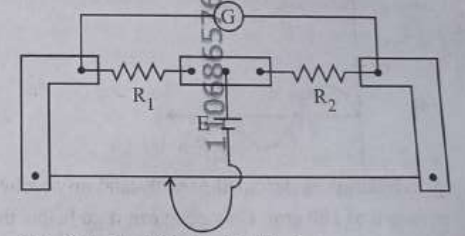
In a metre bridge experiment, the positions of the cell, E, and galvanometer, G, are interchanged. We shall observe in the galvanometer :
- In a vernier callipers, 20 VSD coincide with 16 MSD (each division of length $1 \text{ mm}$). The least count of the vernier callipers is :
- One main scale division of a Vernier calliper is equal to $1\text{ mm}$ and the number of divisions on the Vernier scale is $10$. When both the jaws touch each other, the Vernier scale shifts to the left of zero of the main scale in such a way that $4^{\text{th}}$ Vernier division coincides with a division of the main scale. If this Vernier calliper measures the length of a wire to be $1\text{ cm}$, the actual length of the wire is :
- Which of the following measurements require "index correction" ?
Important Questions from Practical Physics
- For the determination of refractive index of glass slab, a travelling microscope is used whose main scale contains 300 equal divisions equals to 15 cm. The vernier scale attached to the microscope has 25 divisions equals to 24 divisions of main scale. The least count (LC) of the travelling microscope is (in cm) :
In a metre bridge experiment, the positions of the cell, E, and galvanometer, G, are interchanged. We shall observe in the galvanometer :
- In a vernier callipers, 20 VSD coincide with 16 MSD (each division of length $1 \text{ mm}$). The least count of the vernier callipers is :
- One main scale division of a Vernier calliper is equal to $1\text{ mm}$ and the number of divisions on the Vernier scale is $10$. When both the jaws touch each other, the Vernier scale shifts to the left of zero of the main scale in such a way that $4^{\text{th}}$ Vernier division coincides with a division of the main scale. If this Vernier calliper measures the length of a wire to be $1\text{ cm}$, the actual length of the wire is :
- Which of the following measurements require "index correction" ?