Main Scale Division Calculation
The main scale has 300 divisions covering a total length of 15 cm.
The value of one main scale division (MSD) is calculated as:
\(\text{MSD} = \frac{\text{Total Length}}{\text{Number of Divisions}} = \frac{15 \text{ cm}}{300}\)
\(\text{MSD} = 0.05 \text{ cm}\)
Vernier Scale Least Count Calculation
The vernier scale has 25 divisions that are equal to 24 main scale divisions.
This means:
\(25 \text{ VSD} = 24 \text{ MSD}\)
\(1 \text{ VSD} = \frac{24}{25} \text{ MSD}\)
\(1 \text{ VSD} = \frac{24}{25} \times 0.05 \text{ cm} = 0.96 \times 0.05 \text{ cm} = 0.048 \text{ cm}\)
The least count (LC) of the travelling microscope is the difference between one main scale division and one vernier scale division:
\(\text{LC} = \text{MSD} - \text{VSD}\)
\(\text{LC} = 0.05 \text{ cm} - 0.048 \text{ cm}\)
\(\text{LC} = 0.002 \text{ cm}\)
Alternative Least Count Calculation
Alternatively, the least count can be calculated directly using the formula:
\(\text{LC} = \frac{\text{Value of smallest main scale division}}{\text{Number of divisions on the vernier scale}}\)
\(\text{LC} = \frac{0.05 \text{ cm}}{25}\)
\(\text{LC} = 0.002 \text{ cm}\)
Therefore, the least count of the travelling microscope is 0.002 cm.
Important Questions from Practical Physics
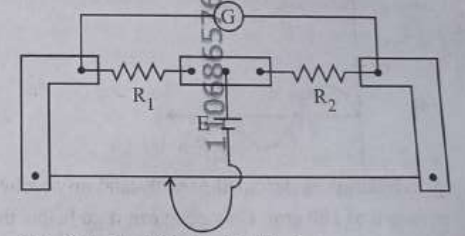
In a metre bridge experiment, the positions of the cell, E, and galvanometer, G, are interchanged. We shall observe in the galvanometer :
- In a vernier callipers, 20 VSD coincide with 16 MSD (each division of length $1 \text{ mm}$). The least count of the vernier callipers is :
- Savitha, a XI standard student, while conducting an experiment to determine the effective length of a simple pendulum L, notes down the data of time taken to complete 30 oscillations as $60 \text{ s}$ and hence calculates the length of the simple pendulum as :
(Take $\pi^2 = 9.8$, and $g = 9.8 \text{ m/s}^2$) - One main scale division of a Vernier calliper is equal to $1\text{ mm}$ and the number of divisions on the Vernier scale is $10$. When both the jaws touch each other, the Vernier scale shifts to the left of zero of the main scale in such a way that $4^{\text{th}}$ Vernier division coincides with a division of the main scale. If this Vernier calliper measures the length of a wire to be $1\text{ cm}$, the actual length of the wire is :
- Which of the following measurements require "index correction" ?