Index Correction in Physics Measurements
Certain physics measurements require "index correction" to account for systematic errors. This often relates to how readings are taken from scales or the influence of the medium on the measurement. Analyzing the options helps identify where such corrections are essential.
Analyzing Measurement Techniques Requiring Correction
- Measurement of gravitational acceleration using simple pendulum: This experiment measures '$g$'. While corrections for factors like air buoyancy might be applied, a standard "index correction" related to scale reading or medium refractive index is not typically required.
- Measurement of focal length of lenses using optical bench: Experiments on an optical bench involve precise positioning of optical components (object, lens, screen) and reading their positions on a linear scale. A significant source of systematic error is parallax error, which occurs when the observer's eye is not aligned perpendicularly to the scale mark. Correcting for parallax by ensuring accurate alignment and reading is often referred to as an "index correction" or scale correction, crucial for accurate focal length determination.
- Measurement of speed of sound using resonance tube: This measurement primarily needs corrections for environmental factors such as temperature and humidity, as these directly affect the speed of sound in air. Standard "index correction" as applied in optics is not relevant here.
- Measurement of resistance of a wire using meter bridge: This is an electrical measurement. Potential errors include contact resistance, non-uniformity of the resistance wire, and calibration issues. It does not involve "index correction" related to optical phenomena or scale reading parallax in the same way as optical bench experiments.
Based on the analysis, the measurement requiring "index correction", primarily to mitigate parallax error during scale readings, is the measurement of focal length using an optical bench.
Similar Questions
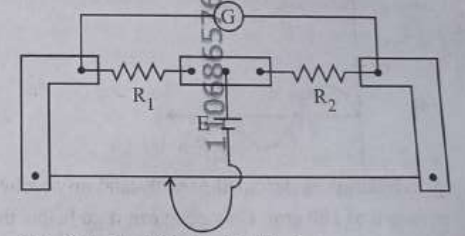
In a metre bridge experiment, the positions of the cell, E, and galvanometer, G, are interchanged. We shall observe in the galvanometer :
- In a vernier callipers, 20 VSD coincide with 16 MSD (each division of length $1 \text{ mm}$). The least count of the vernier callipers is :
- Savitha, a XI standard student, while conducting an experiment to determine the effective length of a simple pendulum L, notes down the data of time taken to complete 30 oscillations as $60 \text{ s}$ and hence calculates the length of the simple pendulum as :
(Take $\pi^2 = 9.8$, and $g = 9.8 \text{ m/s}^2$) - One main scale division of a Vernier calliper is equal to $1\text{ mm}$ and the number of divisions on the Vernier scale is $10$. When both the jaws touch each other, the Vernier scale shifts to the left of zero of the main scale in such a way that $4^{\text{th}}$ Vernier division coincides with a division of the main scale. If this Vernier calliper measures the length of a wire to be $1\text{ cm}$, the actual length of the wire is :
Important Questions from Practical Physics
- For the determination of refractive index of glass slab, a travelling microscope is used whose main scale contains 300 equal divisions equals to 15 cm. The vernier scale attached to the microscope has 25 divisions equals to 24 divisions of main scale. The least count (LC) of the travelling microscope is (in cm) :
In a metre bridge experiment, the positions of the cell, E, and galvanometer, G, are interchanged. We shall observe in the galvanometer :
- In a vernier callipers, 20 VSD coincide with 16 MSD (each division of length $1 \text{ mm}$). The least count of the vernier callipers is :
- Savitha, a XI standard student, while conducting an experiment to determine the effective length of a simple pendulum L, notes down the data of time taken to complete 30 oscillations as $60 \text{ s}$ and hence calculates the length of the simple pendulum as :
(Take $\pi^2 = 9.8$, and $g = 9.8 \text{ m/s}^2$) - One main scale division of a Vernier calliper is equal to $1\text{ mm}$ and the number of divisions on the Vernier scale is $10$. When both the jaws touch each other, the Vernier scale shifts to the left of zero of the main scale in such a way that $4^{\text{th}}$ Vernier division coincides with a division of the main scale. If this Vernier calliper measures the length of a wire to be $1\text{ cm}$, the actual length of the wire is :