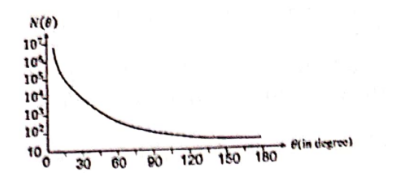
The Geiger-Marsden experiment, also known as the Rutherford gold foil experiment, was crucial in developing the nuclear model of the atom. In this experiment, α-particles were scattered by a thin foil of gold, and the scattering pattern was studied.
One of the key findings was the distribution of scattered α-particles with respect to the scattering angle θ. According to the Rutherford scattering formula, the number of α-particles scattered at an angle θ is inversely proportional to the fourth power of the sine of half the angle, given by:
\(N(\theta) \propto \frac{1}{\sin^4(\theta/2)}\)
This implies that as the scattering angle increases, the number of scattered α-particles decreases significantly. Therefore, the plot of \(N(\theta)\) as a function of θ should show a sharp decrease as θ increases.
Let's analyze the given options. The correct plot should depict the rapid decline of \(N(\theta)\) with increasing θ. Among the given options, the correct plot is:
This plot correctly captures the steep inverse relationship, showing that very few α-particles are scattered at larger angles, with most particles scattered at smaller angles.
In conclusion, the correct plot corresponds to the sharp decrease in the number of scattered α-particles as the scattering angle increases, which is consistent with the predictions of Rutherford's scattering formula.
Similar Questions
In the first excited state of hydrogen atom, the energy of its electron is $-3.4 \text{ eV}$. The radial distance of the electron from the hydrogen nucleus in this case is approximately :
(Take $1 \text{ eV} = 1.6 \times 10^{-19} \text{ J}, \text{ e} = 1.6 \times 10^{-19} \text{ C}$ and $\frac{1}{4\pi\varepsilon_0} = 9 \times 10^9 \text{ N m}^2/\text{C}^2$)- An unknown nucleus has a nuclear density of $2.29 \times 10^{17} \text{ kg/m}^3$ and mass of $19.926 \times 10^{-27} \text{ kg}$. Its mass number A is approximately :
(Take $R_0 = 1.2 \times 10^{-15} \text{ m}$, $4\pi = 12.56$) Four statements are given (A is mass number) :
A. The volume of a nucleus is proportional to $A^{1/3}$.
B. The volume of a nucleus is proportional to A.
C. The difference in mass of an atom and its nucleus is called the mass defect.
D. The difference in mass of a nucleus and its constituent nucleons is called the mass defect.
Choose the correct answer from the options given below :- For a metal of work function $6.6 \text{ eV}$, which of the following wavelengths of incident radiation does not give rise to the photoelectric effect?
(Take Planck's constant as $6.6 \times 10^{-34} \text{ J s}$) Match List I with List II :
List I List II A. $E = h\nu$ I. de Broglie wavelength B. Interference II. Particle nature of light C. $\lambda = h/p$ III. Wave nature of light D. Compton effect IV. Energy of photon
Choose the correct answer from the options given below :- A beam of light falls on a metal surface such that photo-electrons are generated. If power of the light source starts to decrease linearly with time $t$, then variation of the photocurrent $I$ and magnitude of the stopping potential $|V|$ with time is best represented by :
- A ray of light with wavelength $\lambda$ is incident on three different photo-electric cells namely 1, 2 and 3. The threshold wavelength of these photo-electric cells are $\lambda_1$, $\lambda_2$, and $\lambda_3$, respectively and the magnitude of stopping potentials of these cells are $V_1$, $V_2$ and $V_3$, respectively. The relation between $\lambda$ and threshold wavelengths are $\lambda_1 < \lambda$, $\lambda_2 > \lambda$ and $\lambda_3 \gg \lambda$. The correct option is :
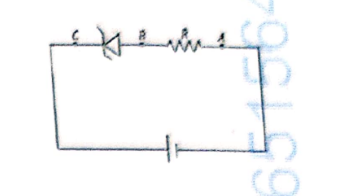
An ideal Zener diode with breakdown voltage of $-3\text{ V}$ is reverse biased with a negative input voltage $V_i = -5\text{ V}$. The magnitude of voltage difference between points B and A is :
- Consider the following nuclear reaction :
$$^{238}\text{U} \rightarrow ^{234}\text{Th} + ^{4}\text{He}$$
Take masses of $^{238}\text{U}$, $^{234}\text{Th}$ and $^{4}\text{He}$ as $238.050\text{ u}$, $234.043\text{ u}$ and $4.003\text{ u}$, respectively. The Q value for the reaction, in keV, is :
[Given : $1\text{ u} = 931.5\text{ MeV c}^{-2}$] - A photon and an electron, each of $20\text{ eV}$ energy, move in free space. The ratio of linear momentum of electron $p_e$ to that of photon $p_{ph}$, $\frac{p_e}{p_{ph}}$ is :
(Take speed of light $= 3 \times 10^8\text{ ms}^{-1}$, charge of electron $= -1.6 \times 10^{-19}\text{ C}$ and mass of electron $= 9 \times 10^{-31}\text{ kg}$)
Important Questions from Modern Physics
- A voltage regulating circuit consisting of Zener diode, having break-down voltage of 10 V and maximum power dissipation of 0.4 W, is operated at 15 V. The approximate value of protective resistance in this circuit is ______ $\Omega$.
The binding energy for the following nuclear reactions are expressed in MeV.
${}_2\text{He}^3 + {}_0\text{n}^1 \rightarrow {}_2\text{He}^4 + 20 \text{ MeV}$
${}_2\text{He}^4 + {}_0\text{n}^1 \rightarrow {}_2\text{He}^5 - 0.9 \text{ MeV}$
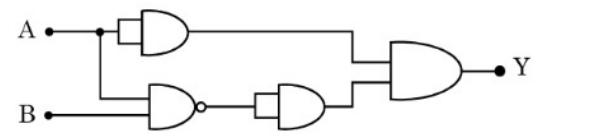
If $\text{X}_3, \text{X}_4, \text{X}_5$ denote the stability of ${}_2\text{He}^3, {}_2\text{He}^4$ and ${}_2\text{He}^5$, respectively, then the correct order is :Identify the correct truth table of the given logic circuit.
- When a light of a given wavelength falls on a metallic surface the stopping potential for photoelectrons is $3.2 \text{ V}$. If a second light having wavelength twice of first light is used, the stopping potential drops to $0.7 \text{ V}$. The wavelength of first light is _______ m.
($h = 6.63 \times 10^{-34} \text{ J.s}, e = 1.6 \times 10^{-19} \text{ C}, c = 3 \times 10^8 \text{ m/s}$) - A particle having electric charge $3 \times 10^{-19}\text{ C}$ and mass $6 \times 10^{-27}\text{ kg}$ is accelerated by applying an electric potential of $1.21\text{ V}$. Wavelength of the matter wave associated with the particle is $\alpha \times 10^{-12}\text{ m}$. The value of $\alpha$ is __________. (Take Planck's constant $= 6.6 \times 10^{-34}\text{ J.s}$)