
The current $I$ in the circuit shown below is :
(All diodes are ideal and identical. 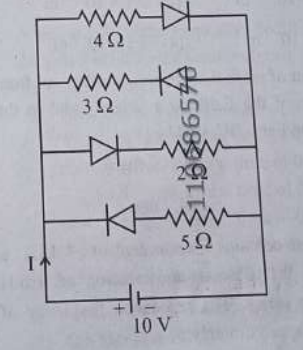
To find the current \( I \) in the circuit shown, we need to analyze the configuration of resistors and diodes. All diodes are ideal; therefore, they only allow current to flow in one direction (forward-biased) with no voltage drop across them.
Given the circuit, the diodes are oriented such that they only allow current to pass in the direction depicted by the direction of the current \( I \).
Let's analyze each branch:
- The diode in the upper branch is forward-biased, allowing current to pass through the 4Ω resistor.
- Current through the 4Ω resistor: it contributes to the total current with no obstruction.
- The diode in the middle branch is also forward-biased, allowing current through the 3Ω resistor.
- Current through the 3Ω resistor: it adds to the net current.
- The diode in the lower branch is forward-biased, allowing current through the 2Ω and 5Ω resistors in series.
- Current through the 2Ω + 5Ω resistors: contributes to the total current.
In total, each branch allows a portion of the current to contribute to the net current. Applying Kirchhoff's Voltage Law gives:
- Voltage across each resistor is the same due to diodes being ideal: \( V = 10 \, \text{V} \).
The equivalent resistance \( R_{\text{eq}} \) can be calculated by treating each branch separately:
- Upper branch: \( 4 \, \text{Ω} \)
- Middle branch: \( 3 \, \text{Ω} \)
- Lower branch: equivalent of 2Ω and 5Ω in series = 7Ω
This makes them in parallel:
\(\frac{1}{R_{\text{eq}}} = \frac{1}{4} + \frac{1}{3} + \frac{1}{7}\)
Calculating this gives:
\(R_{\text{eq}} = \frac{84}{41} \, \text{Ω} \approx 2.05 \, \text{Ω}\)
Now calculating the total current \( I \):
\(I = \frac{V}{R_{\text{eq}}} = \frac{10 \, \text{V}}{\frac{84}{41} \, \text{Ω}} = \frac{410}{84} \approx \frac{15}{2} \, \text{A}\)
Therefore, the correct answer is:
- \(\frac{15}{2} \, \text{A}\)
Similar Questions
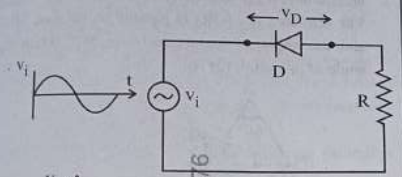
In the circuit shown below, the voltage appearing across the diode D will be of the form :
A 100-turn closely wound circular coil of radius $10 \text{ cm}$ has a magnetic field of $3.14 \times 10^{-3} \text{ T}$ at its centre. The current passing through the coil, and the magnitude of the magnetic moment of this coil are, respectively :
(Take $\mu_0 = 4\pi \times 10^{-7} \text{ T m/A}$)- A galvanometer of resistance $100 \ \Omega$ gives full scale deflection for a current of $1 \text{ mA}$. It is converted into an ammeter of range $0 - 10 \text{ A}$. The shunt required is :
- An ac circuit contains a resistance of $1 \text{ k}\Omega$, a capacitor of $0.1 \ \mu\text{F}$ and an inductor of $1 \text{ mH}$ connected in series. The resonance frequency of the circuit is approximately :
- Consider two uncharged capacitors of equal capacitance $200 \text{ pF}$. One of them is charged by a $100 \text{ V}$ supply and disconnected. Now this capacitor is connected to the uncharged capacitor. The amount of electrostatic energy lost in the process is :
- Two statements are given below :
A. When the forward bias voltage across a p-n junction diode increases above a certain threshold voltage, the diode current increases significantly.
B. This current is called reverse saturation current.
Choose the correct answer from the options given below : - A rectangular wire loop of sides $8 \text{ cm}$ and $3 \text{ cm}$ with a small cut, is moving out of a region of uniform magnetic field of magnitude $0.3 \text{ T}$ directed normal to the plane of the loop. The emf developed across the cut, if the velocity of the loop is $2 \text{ cm s}^{-1}$ in a direction normal to the shorter side of the loop, will be :
- A resistor is connected to a battery of $12 \text{ V}$ emf and internal resistance $2 \ \Omega$. If the current in the circuit is $0.6 \text{ A}$, the terminal voltage of the battery is :
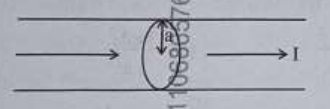
The figure given below shows a long straight solid wire of circular cross-section of radius 'a' carrying steady current I. The current I is uniformly distributed across its cross-section. The plot which correctly represents the variation of magnetic field (B) with distance (r) from the axis of the conductor in the region is :
Five capacitors of capacitances $C_1 = C_2 = C_3 = C_4 = 10 \ \mu\text{F}$ and $C_5 = 2.5 \ \mu\text{F}$ are connected as shown along with a battery of $50 \text{ V}$.
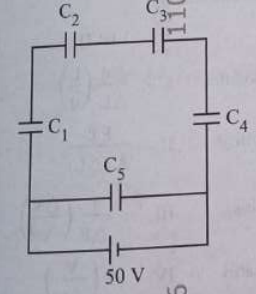
The equivalent capacitance and the charges on each capacitor respectively are :
Important Questions from Electricity and Magnetism
- The electric current in the circuit is given as $i = i_o(t/T)$. The r.m.s current for the period $t = 0$ to $t = T$ is ________.
- In the potentiometer, when the cell in the secondary circuit is shunted with $4\text{ }\Omega$ resistance, the balance is obtained at the length $120\text{ cm}$ of wire. Now when the same cell is shunted with $12\text{ }\Omega$ resistance, the balance is shifted to a length of $180\text{ cm}$. The internal resistance of cell is ________$\Omega$
- The electric field of an electromagnetic wave travelling through a medium is given by $\vec{E}(x,t) = 25 \sin(2.0 \times 10^{15} t - 10^7 x) \hat{n}$
then the refractive index of the medium is ________.
(All given measurement are in SI units) Three long straight wires carrying current are arranged mutually parallel as shown in the figure. The force experienced by $15 \text{ cm}$ length of wire $Q$ is________.
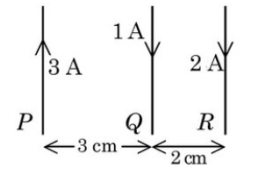
$(\mu_o = 4\pi \times 10^{-7} \text{ T.m/A})$- For the two cells having same EMF $E$ and internal resistance $r$, the current passing through the external resistor $6\text{ }\Omega$ is same when both the cells are connected either in parallel or in series. The value of internal resistance $r$ is ________$\Omega$.


