Calculate Acceleration Magnitude and Direction for Perpendicular Forces
This solution explains how to find the acceleration's magnitude and direction when forces act perpendicularly on an object.
Given Information
- Mass of the body, $m = 5 \text{ kg}$
- First force, $F_1 = 8 \text{ N}$
- Second force, $F_2 = 6 \text{ N}$
- The forces $F_1$ and $F_2$ are mutually perpendicular.
Calculate Net Force
Since the forces are perpendicular, we find the magnitude of the resultant net force ($F_{net}$) using the Pythagorean theorem:
$ F_{net} = \sqrt{F_1^2 + F_2^2} $
Substituting the values:
$ F_{net} = \sqrt{(8 \text{ N})^2 + (6 \text{ N})^2} $
$ F_{net} = \sqrt{64 \text{ N}^2 + 36 \text{ N}^2} $
$ F_{net} = \sqrt{100 \text{ N}^2} $
$ F_{net} = 10 \text{ N} $
Calculate Acceleration Magnitude
Using Newton's second law, $F_{net} = m \times a$, we can find the acceleration ($a$):
$ a = \frac{F_{net}}{m} $
Substituting the values:
$ a = \frac{10 \text{ N}}{5 \text{ kg}} $
$ a = 2 \text{ m s}^{-2} $
Determine Acceleration Direction
The acceleration is in the direction of the net force. We find the angle $\theta$ the net force makes with the $8 \text{ N}$ force.
The tangent of this angle is the ratio of the perpendicular force ($F_2$) to the force it's measured against ($F_1$):
$ \tan(\theta) = \frac{F_2}{F_1} $
$ \tan(\theta) = \frac{6 \text{ N}}{8 \text{ N}} $
$ \tan(\theta) = \frac{3}{4} $
Therefore, the angle is:
$ \theta = \tan^{-1}\left(\frac{3}{4}\right) $
The direction is $\tan^{-1}(3/4)$ with the $8 \text{ N}$ force.
Final Result
The magnitude of the acceleration is $2 \text{ m s}^{-2}$ and its direction is $\tan^{-1}(3/4)$ with the $8 \text{ N}$ force.
Similar Questions
- The amount of work done to raise a mass 'm' from the surface of the Earth to a height equal to the radius of the Earth 'R', will be :
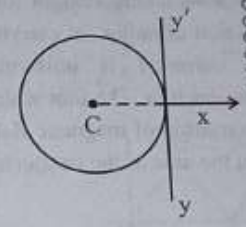
A thin wire of length 'L' and linear mass density 'm' is bent into a circular ring (in x-y plane) with centre 'C' as shown in figure. The moment of inertia of the ring about an axis yy' (tangent in the plane) will be :
- When a ruler falls vertically, 5 different persons catch it with different reaction times. ($g = 9.8 \text{ m s}^{-2}$)
A. Person A has reaction time of $0.20 \text{ s}$.
B. Person B has reaction time of $0.22 \text{ s}$.
C. Person C has reaction time of $0.18 \text{ s}$.
D. Person D has reaction time of $0.19 \text{ s}$.
E. Person E has reaction time of $0.21 \text{ s}$.
What is the correct order of the distance travelled by the ruler for each person ? - The angular speed of a flywheel is increased from $600 \text{ rpm}$ to $1200 \text{ rpm}$ in $10 \text{ s}$. The number of revolutions completed by the flywheel during this time is :
The power of a crane, which lifts a mass of $1000 \text{ kg}$ to a height of $20 \text{ m}$ in $10 \text{ s}$ is :
($g = 9.8 \text{ m/s}^2$)- A box of mass $15 \text{ kg}$ is kept on the floor of a stationary trolley. The coefficient of static friction between the box and the trolley is $0.12$. Keeping the box in stationary state over the trolley, the maximum acceleration with which the trolley can be moved horizontally is : ($g = 10 \text{ m/s}^2$)
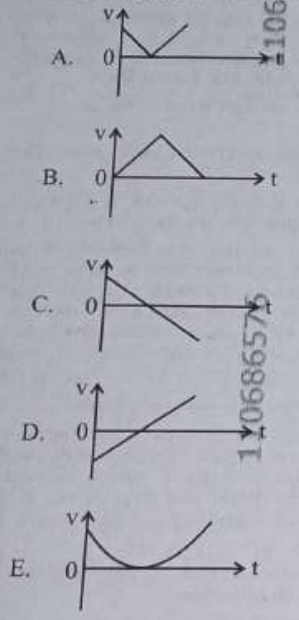
The following plots show variation of velocity ($v$) with time ($t$) of a ball thrown vertically upward, and falling back. Which of the following plots is/are correct?
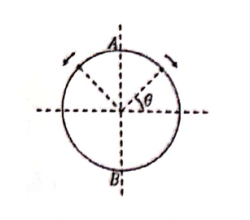
A frictionless circular wire of unit radius is fixed on the horizontal plane. Two point particles of unit mass start moving simultaneously from point $A \left( \theta = \frac{\pi}{2} \right)$ with identical uniform angular speeds in opposite directions, and meet again at point $B \left( \theta = -\frac{\pi}{2} \right)$. During this time, which of the following figures schematically represent the magnitude of the total linear momentum $\vec{P}$ of the system, as a function of $\theta$?
- Two planets $P_1$ and $P_2$ with equal mass have radii $R_1$ and $R_2$, respectively, where $R_2 = \frac{R_1}{2}$. The escape speeds of $P_1$ and $P_2$ are $v_1$ and $v_2$, respectively. Then $\frac{v_2}{v_1}$ is :
- A car travels on a circular racetrack of radius $50\text{ m}$, which is banked at an angle $\theta$. If the car travels at a speed $10\text{ ms}^{-1}$, then the wear and tear on its tyres is minimum. Taking the acceleration due to gravity to be $10\text{ ms}^{-2}$, the value of $\theta$ is :
Important Questions from Mechanics
- Two masses $m$ and $2m$ are connected by a light string going over a pulley (disc) of mass $30m$ with radius $r=0.1 \text{ m}$. The pulley is mounted in a vertical plane and it is free to rotate about its axis. The $2m$ mass is released from rest and its speed when it has descended through a height of 3.6 m is _________ m/s. (Assume string does not slip and $g = 10 \text{ m/s}^2$)
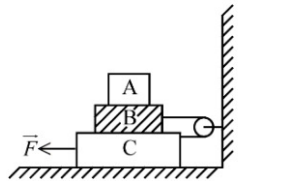
In the given figure the blocks $A$, $B$ and $C$ weigh 4 kg, 6 kg and 8 kg respectively. The co-efficient of sliding friction between any two surfaces is 0.5. The force $\vec{F}$ required to slide the block $C$ with constant speed is ______ N. (Use $g = 10 \text{ m/s}^2$)
- The fifth harmonic of a closed organ pipe is found to be in unison with the first harmonic of an open pipe. The ratio of lengths of closed pipe to that of the open pipe is $5/x$. The value of $x$ is _______.
- In a vernier callipers, 50 vernier scale divisions are equal to 48 main scale divisions. If one main scale division $= 0.05 \text{ mm}$, then the least count of the vernier callipers is _______ mm.
- A flexible chain of mass $m$ hangs between two fixed points at the same level. The inclination of the chain with the horizontal at the two points of support is $30^\circ$. Considering the equilibrium of each half of the chain, the tension of the chain at the lowest point is _______.