Physics Problem: Tension in a Flexible Chain
This solution details the calculation for the tension at the lowest point of a flexible chain based on the provided equilibrium conditions.
Chain Equilibrium Analysis
We analyze the forces acting on one half of the flexible chain hanging between two fixed points at the same level.
- Let the angle of inclination of the chain with the horizontal at the support be $\theta = 30^\circ$.
- We assume the mass of the considered half of the chain is $m$.
- The weight of this half chain is $W_{half} = mg$, acting vertically downwards.
- Let $T_0$ be the tension at the lowest point of the chain. This tension acts horizontally.
- Let $T_S$ be the tension at the point of support. This tension acts along the chain towards the support.
Calculating Tension at the Lowest Point
Applying the conditions for equilibrium to the half chain:
- Vertical Equilibrium: The upward vertical component of the tension at the support must balance the weight of the half chain. $ T_S \sin(\theta) = W_{half} $ Substituting the values $\theta = 30^\circ$ and $W_{half} = mg$: $ T_S \sin(30^\circ) = mg $ $ T_S \times \frac{1}{2} = mg $ $ T_S = 2mg $
- Horizontal Equilibrium: The tension at the lowest point ($T_0$) must balance the horizontal component of the tension at the support. $ T_0 = T_S \cos(\theta) $ Substituting the calculated $T_S = 2mg$ and $\theta = 30^\circ$: $ T_0 = (2mg) \cos(30^\circ) $ $ T_0 = 2mg \times \frac{\sqrt{3}}{2} $ $ T_0 = \sqrt{3}mg $
Therefore, the tension of the chain at the lowest point is $\sqrt{3}mg$.
Similar Questions
- Two masses $m$ and $2m$ are connected by a light string going over a pulley (disc) of mass $30m$ with radius $r=0.1 \text{ m}$. The pulley is mounted in a vertical plane and it is free to rotate about its axis. The $2m$ mass is released from rest and its speed when it has descended through a height of 3.6 m is _________ m/s. (Assume string does not slip and $g = 10 \text{ m/s}^2$)
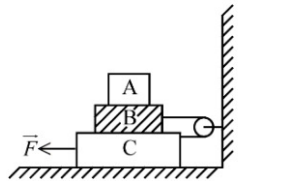
In the given figure the blocks $A$, $B$ and $C$ weigh 4 kg, 6 kg and 8 kg respectively. The co-efficient of sliding friction between any two surfaces is 0.5. The force $\vec{F}$ required to slide the block $C$ with constant speed is ______ N. (Use $g = 10 \text{ m/s}^2$)
- The fifth harmonic of a closed organ pipe is found to be in unison with the first harmonic of an open pipe. The ratio of lengths of closed pipe to that of the open pipe is $5/x$. The value of $x$ is _______.
- In a vernier callipers, 50 vernier scale divisions are equal to 48 main scale divisions. If one main scale division $= 0.05 \text{ mm}$, then the least count of the vernier callipers is _______ mm.
A thin uniform rod ($X$) of mass $M$ and length $L$ is pivoted at a height $\left(\frac{L}{3}\right)$ as shown in the figure. The rod is allowed to fall from a vertical position and lie horizontally on the table. The angular velocity of this rod when it hits the table top, is __________.
($g = \text{gravitational acceleration}$)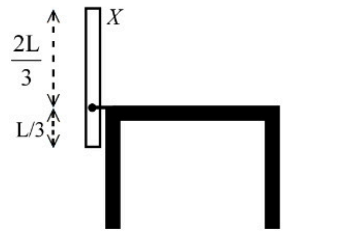
- A soap bubble of surface tension $0.04 \text{ N/m}$ is blown to a diameter of $7 \text{ cm}$. If $(15000 - x) \text{ }\mu\text{J}$ of work is done in blowing it further to make its diameter $14 \text{ cm}$, then the value of $x$ is _______.
($\pi = 22/7$) - A uniform solid cylinder of length $L$ and radius $R$ has moment of inertia about its axis equal to $I_1$. A small co-centric cylinder of length $L/2$ and radius $R/3$ carved from this cylinder has moment of inertia about its axis equals to $I_2$. The ratio $I_1/I_2$ is _______.
- Surface tension of two liquids (having same densities), $T_1$ and $T_2$, are measured using capillary rise method utilizing two tubes with inner radii of $r_1$ and $r_2$ where $r_1 > r_2$. The measured liquid heights in these tubes are $h_1$ and $h_2$ respectively. [Ignore the weight of the liquid about the lowest point of meniscus]. The heights $h_1$ and $h_2$ and surfaces tensions $T_1$ and $T_2$ satisfy the relation :
- Two cars $A$ and $B$ each of mass $10^3\text{ kg}$ are moving on parallel tracks separated by a distance of $10\text{ m}$, in same direction with speeds $72\text{ km/h}$ and $36\text{ km/h}$. The magnitude of angular momentum of car $A$ with respect to car $B$ is __________ $\text{J.s}$.
- A spherical body of radius $r$ and density $\sigma$ falls freely through a viscous liquid having density $\rho$ and viscosity $\eta$ and attains a terminal velocity $v_0$. Estimated maximum error in the quantity $\eta$ is : (Ignore errors associated with $\sigma, \rho$ and $g$, gravitational acceleration)
Important Questions from Mechanics
- Two masses $m$ and $2m$ are connected by a light string going over a pulley (disc) of mass $30m$ with radius $r=0.1 \text{ m}$. The pulley is mounted in a vertical plane and it is free to rotate about its axis. The $2m$ mass is released from rest and its speed when it has descended through a height of 3.6 m is _________ m/s. (Assume string does not slip and $g = 10 \text{ m/s}^2$)
In the given figure the blocks $A$, $B$ and $C$ weigh 4 kg, 6 kg and 8 kg respectively. The co-efficient of sliding friction between any two surfaces is 0.5. The force $\vec{F}$ required to slide the block $C$ with constant speed is ______ N. (Use $g = 10 \text{ m/s}^2$)
- The fifth harmonic of a closed organ pipe is found to be in unison with the first harmonic of an open pipe. The ratio of lengths of closed pipe to that of the open pipe is $5/x$. The value of $x$ is _______.
- In a vernier callipers, 50 vernier scale divisions are equal to 48 main scale divisions. If one main scale division $= 0.05 \text{ mm}$, then the least count of the vernier callipers is _______ mm.
A thin uniform rod ($X$) of mass $M$ and length $L$ is pivoted at a height $\left(\frac{L}{3}\right)$ as shown in the figure. The rod is allowed to fall from a vertical position and lie horizontally on the table. The angular velocity of this rod when it hits the table top, is __________.
($g = \text{gravitational acceleration}$)