
Thermodynamics First Law Principle
The First Law of Thermodynamics relates heat, work, and internal energy. For a system, the rate of change of internal energy is equal to the rate at which heat is supplied minus the rate at which work is done by the system.
Mathematically, this is expressed as: $ \frac{dU}{dt} = \frac{dQ}{dt} - \frac{dW}{dt} $ Or using rate notation: $ \dot{U} = \dot{Q} - \dot{W} $ Where:
- $ \dot{U} $ is the rate of change of internal energy (in Watts, W).
- $ \dot{Q} $ is the rate of heat supplied to the system (in Watts, W).
- $ \dot{W} $ is the rate of work done by the system (in Watts, W or Joules per second, J/s).
Calculating Rate of Internal Energy Increase
Given:
- Rate of heat supplied, $ \dot{Q} = 100 \text{ W} $.
- Rate of work done by the system, $ \dot{W} = 75 \text{ J/s} = 75 \text{ W} $.
Substitute the given values into the First Law equation:
$ \dot{U} = 100 \text{ W} - 75 \text{ W} $ $ \dot{U} = 25 \text{ W} $Therefore, the rate at which the internal energy of the system increases is $ 25 \text{ W} $.
Answer Selection
The calculated rate of increase in internal energy is $ 25 \text{ W} $, which corresponds to Option D.
Similar Questions
A flask contains argon and chlorine in the ratio of $2:1$ by mass. The temperature of the mixture is $27^\circ\text{C}$. The ratio of root mean square speed of the molecules of the two gases $(\frac{V_{rms}^{Ar}}{V_{rms}^{Cl}})$ is :
(Atomic mass of argon = $40 \text{ u}$ and molecular mass of chlorine = $70 \text{ u}$)- An ideal gas is made of polyatomic molecules. Each of the molecules has three translational, three rotational and $f$ number of vibrational modes. If the ratio of heat capacities $C_P/C_V$ of the gas is 8/7, then the value of $f$ is :
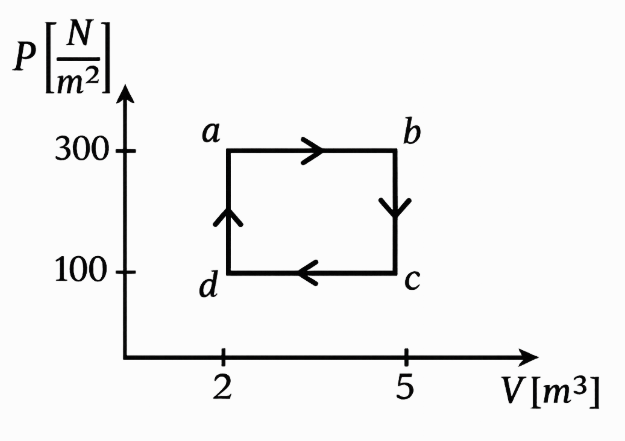
One mole of an ideal monatomic gas undergoes a cyclic process as shown in the figure. The total heat supplied to the gas is :
- The mean free path of molecules in an ideal gas A is half that of another ideal gas B. The diameter of the spherical molecules of gas A is twice the diameter of the molecules of B. If number densities of the gases A and B are $n_A$ and $n_B$, respectively, then the correct option is :
- In an adiabatic expansion, the temperature of one mole of an ideal monatomic gas ($\gamma = 5/3$) decreases from $60\text{K}$ to $50\text{K}$. The work done by the gas in the process is :
(Take the universal gas constant as $R = 8.3\text{ J mol}^{-1}\text{ K}^{-1}$)
Important Questions from Heat and Thermodynamics
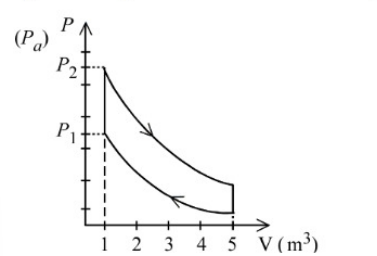
10 mole of an ideal gas is undergoing the process shown in the figure. The heat involved in the process from $P_1$ to $P_2$ is $\alpha \text{ Joule}$ ($P_1 = 21.7 \text{ Pa}$ and $P_2 = 30 \text{ Pa}, C_v = 21 \text{ J/K.mol}, R = 8.3 \text{ J/mol.K}$). The value of $\alpha$ is _______.
- When $300 \text{ J}$ of heat given to an ideal gas with $C_p = \frac{7}{2} R$ its temperature raises from $20^\circ\text{C}$ to $50^\circ\text{C}$ keeping its volume constant. The mass of the gas is (approximately) _______ g. ($R = 8.314 \text{ J/mol.K}$)
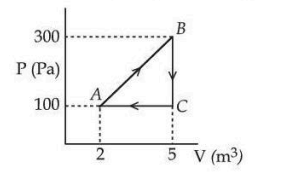
A thermodynamic system is taken through the cyclic process ABC as shown in the figure. The total work done by the system during the cycle $ABC$ is _________ $\text{J}$.
- The heat extracted out of $x$ gram of water initially at $50 \ ^{\circ}\text{C}$ to cool it down to $0 \ ^{\circ}\text{C}$ is sufficient to evaporate $(1000 - x)$ gram of water also initially at $50 \ ^{\circ}\text{C}$. The value of $x$ (closest integer) is ___________.
(Take latent heat of water $2256 \text{ kJ/kg. K}$, specific heat capacity of water $4200 \text{ J/kg. K}$) - Two identical metal bars are heated in two different temperatures and allowed to cool in the same surroundings. Which one of the following figures correctly shows their cooling curves?


