Problem Analysis
We are given the following information for an ideal gas:
- Heat supplied, $Q = 300 \text{ J}$
- Specific heat at constant pressure, $C_p = \frac{7}{2} R$
- Initial temperature, $T_1 = 20^\circ\text{C}$
- Final temperature, $T_2 = 50^\circ\text{C}$
- Process: Constant volume (isochoric)
- Universal gas constant, $R = 8.314 \text{ J/mol.K}$
We need to find the approximate mass ($m$) of the gas in grams.
Calculating Specific Heat at Constant Volume ($C_v$)
For an ideal gas, the relationship between specific heats is given by Mayer's relation: $C_p - C_v = R$
Using the given $C_p = \frac{7}{2} R$: $\frac{7}{2} R - C_v = R$ $C_v = \frac{7}{2} R - R = \frac{5}{2} R$
Substituting the value of $R$: $C_v = \frac{5}{2} \times 8.314 \text{ J/mol.K} \approx 20.785 \text{ J/mol.K}$
Calculating Temperature Change ($\Delta T$)
The change in temperature is: $\Delta T = T_2 - T_1 = 50^\circ\text{C} - 20^\circ\text{C} = 30^\circ\text{C}$
Since the difference is the same in Celsius and Kelvin, $\Delta T = 30 \text{ K}$.
Calculating Number of Moles ($n$)
For a constant volume (isochoric) process, the heat absorbed is given by: $Q = n C_v \Delta T$
Substituting the known values: $300 \text{ J} = n \times (20.785 \text{ J/mol.K}) \times (30 \text{ K})$ $300 = n \times 623.55$ $n = \frac{300}{623.55} \approx 0.481 \text{ mol}$
Calculating Gas Mass ($m$)
The value $C_p = \frac{7}{2} R$ is characteristic of a diatomic ideal gas (considering translational and rotational modes). Common diatomic gases like Nitrogen ($N_2$) have a molar mass ($M$) of approximately $28$ g/mol.
The mass of the gas is calculated using the number of moles ($n$) and the molar mass ($M$): $m = n \times M$
Assuming the gas is diatomic with $M \approx 28$ g/mol: $m \approx 0.481 \text{ mol} \times 28 \text{ g/mol}$ $m \approx 13.47 \text{ g}$
This value is approximately 13 g, consistent with the provided answer range.
Similar Questions
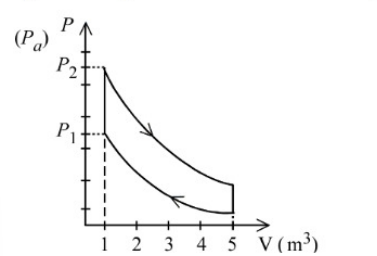
10 mole of an ideal gas is undergoing the process shown in the figure. The heat involved in the process from $P_1$ to $P_2$ is $\alpha \text{ Joule}$ ($P_1 = 21.7 \text{ Pa}$ and $P_2 = 30 \text{ Pa}, C_v = 21 \text{ J/K.mol}, R = 8.3 \text{ J/mol.K}$). The value of $\alpha$ is _______.
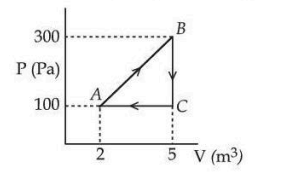
A thermodynamic system is taken through the cyclic process ABC as shown in the figure. The total work done by the system during the cycle $ABC$ is _________ $\text{J}$.
- The heat extracted out of $x$ gram of water initially at $50 \ ^{\circ}\text{C}$ to cool it down to $0 \ ^{\circ}\text{C}$ is sufficient to evaporate $(1000 - x)$ gram of water also initially at $50 \ ^{\circ}\text{C}$. The value of $x$ (closest integer) is ___________.
(Take latent heat of water $2256 \text{ kJ/kg. K}$, specific heat capacity of water $4200 \text{ J/kg. K}$) - A vessel contains $0.15\text{ m}^3$ of a gas at pressure $8\text{ bar}$ and temperature $140^{\circ}\text{C}$ with $c_p = 3R$ and $c_v = 2R$. It is expanded adiabatically till pressure falls to $1\text{ bar}$. The work done during this process is ________ $\text{kJ}$. (R is gas constant)
- The r.m.s. speed of oxygen molecules at $47^\circ\text{C}$ is equal to that of the hydrogen molecules kept at __________ $^\circ\text{C}$. (Mass of oxygen molecule/mass of hydrogen molecule $= 32/2$)
- A body takes 10 minutes to cool from $60^\circ C$ to $50^\circ C$. The temperature of surroundings is constant at $25^\circ C$. Then, the temperature of the body after next 10 minutes will be approximately :
- The value closest to the thermal velocity of a Helium atom at room temperature (300 K) in $ms^{-1}$ is : [$k_B = 1.4 \times 10^{-23}$ J/K; $m_{He} = 7 \times 10^{-27}$ kg]
- Two cornot engines A and B are operated in series. Engine A receives heat from a reservoir at 600 K and rejects heat to a reservoir at temperature T. Engine B receives heat rejected by engine A and in turn rejects it to a reservoir at 100 K. If the efficiencies of the two engines A and B are represented by $\eta_A$ and $\eta_B$, respectively, then what is the value of $\frac{\eta_B}{\eta_A}$ ?
- In 5 minutes, a body cools from $75^{\circ}C$ to $65^{\circ}C$ at room temperature of $25^{\circ}C$. The temperature of body at the end of next 5 minutes is __________ $^{\circ}C$.
- The area of cross-section of a railway track is $0.01 \text{ m}^2$. The temperature variation is $10^{\circ}C$. Coefficient of linear expansion of material of track is $10^{-5}/^{\circ}C$. The energy stored per meter in the track is __________ J/m.<br>(Young's modulus of material of track is $10^{11} \text{ Nm}^{-2}$)
Important Questions from Heat and Thermodynamics
10 mole of an ideal gas is undergoing the process shown in the figure. The heat involved in the process from $P_1$ to $P_2$ is $\alpha \text{ Joule}$ ($P_1 = 21.7 \text{ Pa}$ and $P_2 = 30 \text{ Pa}, C_v = 21 \text{ J/K.mol}, R = 8.3 \text{ J/mol.K}$). The value of $\alpha$ is _______.
A thermodynamic system is taken through the cyclic process ABC as shown in the figure. The total work done by the system during the cycle $ABC$ is _________ $\text{J}$.
- The heat extracted out of $x$ gram of water initially at $50 \ ^{\circ}\text{C}$ to cool it down to $0 \ ^{\circ}\text{C}$ is sufficient to evaporate $(1000 - x)$ gram of water also initially at $50 \ ^{\circ}\text{C}$. The value of $x$ (closest integer) is ___________.
(Take latent heat of water $2256 \text{ kJ/kg. K}$, specific heat capacity of water $4200 \text{ J/kg. K}$) - Two identical metal bars are heated in two different temperatures and allowed to cool in the same surroundings. Which one of the following figures correctly shows their cooling curves?
- $2\text{ moles}$ of an ideal gas with $\frac{C_{p}}{C_{v}} = \frac{5}{3}$ are mixed with $3\text{ moles}$ of another ideal gas with $\frac{C_{p}}{C_{v}} = \frac{4}{3}$. The value of $\frac{C_{p}}{C_{v}}$ for the mixture is