
Ideal Gas Mixture Adiabatic Index Calculation
This solution details the calculation of the adiabatic index ($\gamma = \frac{C_p}{C_v}$) for a mixture of two ideal gases.
Given Information
- Gas 1: Moles $n_1 = 2$, Adiabatic index $\gamma_1 = \frac{5}{3}$
- Gas 2: Moles $n_2 = 3$, Adiabatic index $\gamma_2 = \frac{4}{3}$
Adiabatic Index Formula for Mixture
For a mixture of ideal gases, the adiabatic index ($\gamma_{\text{mix}}$) can be calculated using the individual moles ($n_i$) and adiabatic indices ($\gamma_i$) of the components. The formula is derived from the mixing of total internal energy and total enthalpy:
$ \gamma_{\text{mix}} = \frac{\sum_{i} n_i \frac{\gamma_i}{\gamma_i-1}}{\sum_{i} n_i \frac{1}{\gamma_i-1}} $
This formula relies on the relationships $C_{v,i} = \frac{R}{\gamma_i-1}$ and $C_{p,i} = \frac{\gamma_i R}{\gamma_i-1}$ for each ideal gas component $i$, where $R$ is the ideal gas constant.
Calculation Steps
-
Calculate $\gamma_i - 1$ for each gas:
- Gas 1: $\gamma_1 - 1 = \frac{5}{3} - 1 = \frac{2}{3}$
- Gas 2: $\gamma_2 - 1 = \frac{4}{3} - 1 = \frac{1}{3}$
-
Calculate the terms $n_i / (\gamma_i - 1)$:
- Gas 1: $\frac{n_1}{\gamma_1 - 1} = \frac{2}{2/3} = 2 \times \frac{3}{2} = 3$
- Gas 2: $\frac{n_2}{\gamma_2 - 1} = \frac{3}{1/3} = 3 \times 3 = 9$
- Calculate the sum of the denominator terms: $ \sum n_i \frac{1}{\gamma_i-1} = 3 + 9 = 12 $
-
Calculate the terms $n_i \gamma_i / (\gamma_i - 1)$:
- Gas 1: $\frac{n_1 \gamma_1}{\gamma_1 - 1} = \frac{2 \times (5/3)}{2/3} = \frac{10/3}{2/3} = 5$
- Gas 2: $\frac{n_2 \gamma_2}{\gamma_2 - 1} = \frac{3 \times (4/3)}{1/3} = \frac{4}{1/3} = 12$
- Calculate the sum of the numerator terms: $ \sum n_i \frac{\gamma_i}{\gamma_i-1} = 5 + 12 = 17 $
- Compute the mixture adiabatic index $\gamma_{\text{mix}}$: $ \gamma_{\text{mix}} = \frac{17}{12} $
Final Result
The calculated value is:
$ \gamma_{\text{mix}} = \frac{17}{12} \approx 1.4167 $This value is approximately 1.42.
Similar Questions
- Two identical metal bars are heated in two different temperatures and allowed to cool in the same surroundings. Which one of the following figures correctly shows their cooling curves?
Important Questions from Heat and Thermodynamics
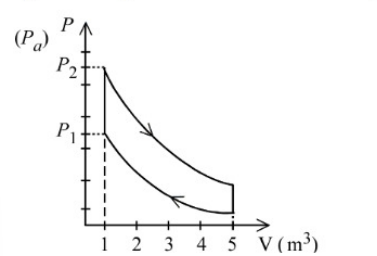
10 mole of an ideal gas is undergoing the process shown in the figure. The heat involved in the process from $P_1$ to $P_2$ is $\alpha \text{ Joule}$ ($P_1 = 21.7 \text{ Pa}$ and $P_2 = 30 \text{ Pa}, C_v = 21 \text{ J/K.mol}, R = 8.3 \text{ J/mol.K}$). The value of $\alpha$ is _______.
- When $300 \text{ J}$ of heat given to an ideal gas with $C_p = \frac{7}{2} R$ its temperature raises from $20^\circ\text{C}$ to $50^\circ\text{C}$ keeping its volume constant. The mass of the gas is (approximately) _______ g. ($R = 8.314 \text{ J/mol.K}$)
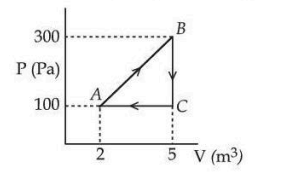
A thermodynamic system is taken through the cyclic process ABC as shown in the figure. The total work done by the system during the cycle $ABC$ is _________ $\text{J}$.
- The heat extracted out of $x$ gram of water initially at $50 \ ^{\circ}\text{C}$ to cool it down to $0 \ ^{\circ}\text{C}$ is sufficient to evaporate $(1000 - x)$ gram of water also initially at $50 \ ^{\circ}\text{C}$. The value of $x$ (closest integer) is ___________.
(Take latent heat of water $2256 \text{ kJ/kg. K}$, specific heat capacity of water $4200 \text{ J/kg. K}$) - Two identical metal bars are heated in two different temperatures and allowed to cool in the same surroundings. Which one of the following figures correctly shows their cooling curves?


