Two substances A and B of same mass are heated at constant rate. The variation of temperature θ of the substances with time t is shown in the figure. Choose the correct statement.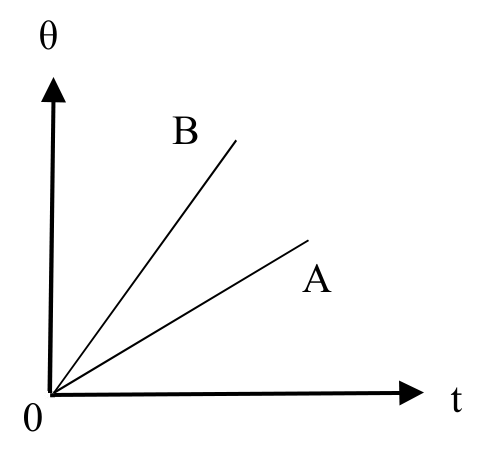
Specific heat of A is greater than that of B.
When heat is supplied at a constant rate to a body without change of state, the temperature rises linearly with time, and the rate of rise is inversely proportional to the heat capacity of the body. For equal masses, the steeper graph belongs to the substance with the smaller specific heat.
Step 1 — Heat supplied in time t at rate P: \(Pt = mc\,\theta\), so \(\theta = \dfrac{P}{mc}\,t\).
Step 2 — Slope of the θ–t line: \(\dfrac{d\theta}{dt} = \dfrac{P}{mc} \propto \dfrac{1}{c}\) for the same P and m.
Step 3 — The line for B is steeper than the line for A, so \(\dfrac{1}{c_B} \gt \dfrac{1}{c_A}\), i.e. \(c_A \gt c_B\).
B having the larger specific heat would require B's line to be the gentler one, which is the reverse of the figure. Equal specific heats would make the two lines coincide, and since a definite comparison follows from the graph, the statement that none is true also fails.
Specific heat of A is greater than that of B. option is correct.
Similar Questions
- Two identical metal bars are heated in two different temperatures and allowed to cool in the same surroundings. Which one of the following figures correctly shows their cooling curves?
- $2\text{ moles}$ of an ideal gas with $\frac{C_{p}}{C_{v}} = \frac{5}{3}$ are mixed with $3\text{ moles}$ of another ideal gas with $\frac{C_{p}}{C_{v}} = \frac{4}{3}$. The value of $\frac{C_{p}}{C_{v}}$ for the mixture is
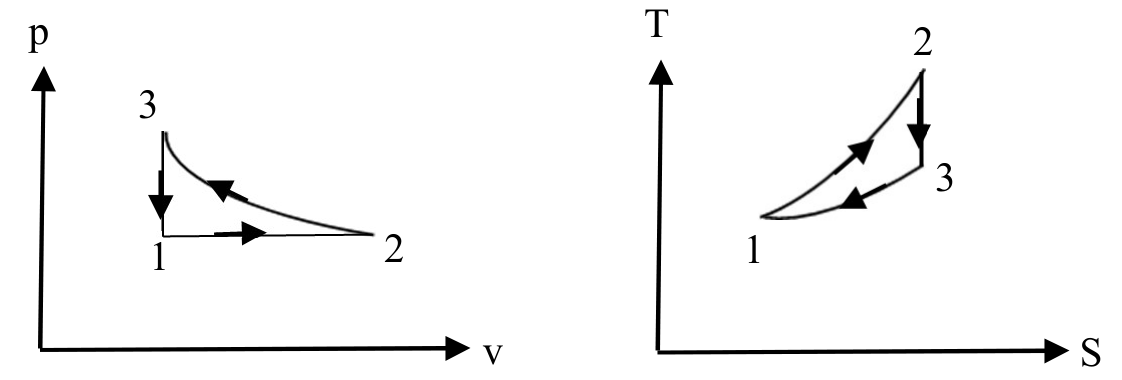
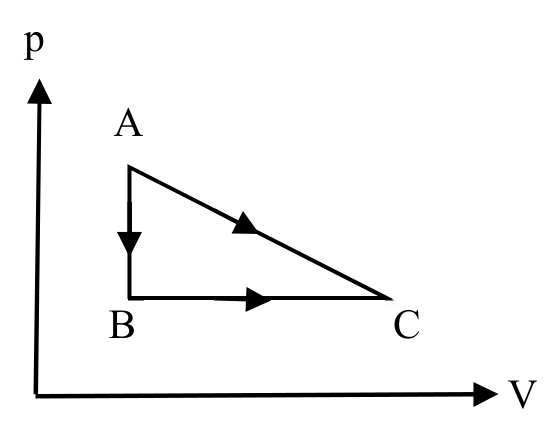
A cyclic process is shown in p-v diagram and T-S diagram. Which of the following statement(s) is/are true ?
A given quantity of gas is taken from A to C in two ways; a) directly from A → C along a straight line and b) in two steps, from A → B and then from B → C. Work done and heat absorbed along the direct path A→C is 200 J and 280 J respectively.
If the work done along A→B→C is 80 J, then heat absorbed along this path is,
Six molecules of an ideal gas have velocities 1, 3, 5, 5, 6 and 5 m/s respectively. At any given temperature, if \(\bar{V}\) and Vrms represent average and rms speed of the molecules, then
Let \(\overline{V}\), Vrms, Vp denotes the mean speed, root mean square speed and most probable speed of the molecules each of mass m in an ideal monoatomic gas at absolute temperature T Kelvin. Which statement(s) is/are correct?
The apparent coefficient of expansion of a liquid, when heated in a copper vessel is C and when heated in silver vessel is S. If A is linear coefficient of expansion of copper, then linear coefficient of expansion of silver is
Temperature of a body θ is slightly more than the temperature of the surrounding θ0. Its rate of cooling (R) versus temperature of the body (θ) is plotted. Its shape would be
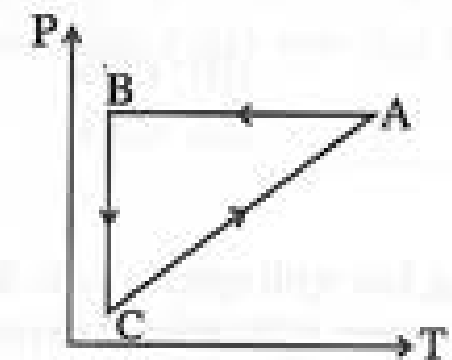
For an ideal gas, a cyclic process ABCA as shown in P–T diagram, when presented in P–V plot, it would be
A solid rectangular sheet has two different coefficients of linear expansion \(\alpha_1\) and \(\alpha_2\) along its length and breadth respectively. The coefficient of surface expansion is (for \(\alpha_1 t \ll 1, \alpha_2 t \ll 1\))
Important Questions from Heat and Thermodynamics
- When $300 \text{ J}$ of heat given to an ideal gas with $C_p = \frac{7}{2} R$ its temperature raises from $20^\circ\text{C}$ to $50^\circ\text{C}$ keeping its volume constant. The mass of the gas is (approximately) _______ g. ($R = 8.314 \text{ J/mol.K}$)
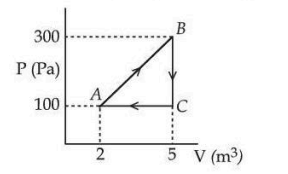
A thermodynamic system is taken through the cyclic process ABC as shown in the figure. The total work done by the system during the cycle $ABC$ is _________ $\text{J}$.
- Two identical metal bars are heated in two different temperatures and allowed to cool in the same surroundings. Which one of the following figures correctly shows their cooling curves?
- In 5 minutes, a body cools from $75^{\circ}C$ to $65^{\circ}C$ at room temperature of $25^{\circ}C$. The temperature of body at the end of next 5 minutes is __________ $^{\circ}C$.
- The area of cross-section of a railway track is $0.01 \text{ m}^2$. The temperature variation is $10^{\circ}C$. Coefficient of linear expansion of material of track is $10^{-5}/^{\circ}C$. The energy stored per meter in the track is __________ J/m.<br>(Young's modulus of material of track is $10^{11} \text{ Nm}^{-2}$)