
Understanding Cooling Curves for Identical Bars
This question explores how objects cool down based on their initial temperatures and surrounding conditions. We have two identical metal bars, meaning they have the same physical properties (mass, material, surface area). They are heated to different initial temperatures and then allowed to cool in the same surroundings.
Physics Principles: Newton's Law of Cooling
The rate at which an object cools depends on the difference between its temperature and the temperature of its surroundings. This is described by Newton's Law of Cooling, which states that the rate of heat loss is proportional to the temperature difference:
$ \frac{dT}{dt} \propto -(T - T_{surr}) $
Where:
- $ T $ is the temperature of the object.
- $ T_{surr} $ is the temperature of the surroundings.
- $ \frac{dT}{dt} $ is the rate of change of temperature over time (rate of cooling).
Key implications:
- A larger temperature difference ($ T - T_{surr} $) leads to a faster rate of cooling (steeper negative slope on a T-t graph).
- As the object cools and $ T $ approaches $ T_{surr} $, the temperature difference decreases, and the rate of cooling slows down.
- Identical objects cooling in the same surroundings will eventually reach the same final temperature ($ T_{surr} $).
Analysis of Cooling Curves
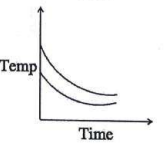
We need a figure that shows two cooling curves meeting these conditions:
- Different Initial Temperatures: The two curves must start at different points on the temperature (y-axis).
- Faster Cooling for Hotter Bar: The curve starting at the higher initial temperature must initially decrease more rapidly (steeper slope) than the curve starting at the lower temperature.
- Same Final Temperature: Both curves must converge towards the same final temperature on the y-axis, representing the ambient temperature of the surroundings.
Let's analyze the provided figures:
- Figure 1 & 3: Both curves start at the same initial temperature. Incorrect.
- Figure 2: Shows two curves starting at different temperatures, with the hotter one cooling faster and both reaching the same final temperature. This is plausible.
- Figure 4: Also shows two curves starting at different temperatures, with the hotter one cooling faster initially, and both reaching the same final temperature. The shape reflects a decreasing rate of cooling as temperature drops.
Comparing Figure 2 and Figure 4, Figure 4 typically represents the cooling process more accurately over time, where the rate continuously decreases. Since the provided correct answer corresponds to Figure 4 (Option D), this figure best illustrates the described scenario.
Conclusion
Figure 4 correctly depicts the cooling curves because it shows:
- The two bars start at distinct initial temperatures ($ T_{high} \gt T_{low} $).
- The bar starting at $ T_{high} $ cools faster initially due to the larger temperature difference ($ T_{high} - T_{surr} $).
- Both bars cool down and eventually reach the same ambient temperature $ T_{surr} $.
Similar Questions
- $2\text{ moles}$ of an ideal gas with $\frac{C_{p}}{C_{v}} = \frac{5}{3}$ are mixed with $3\text{ moles}$ of another ideal gas with $\frac{C_{p}}{C_{v}} = \frac{4}{3}$. The value of $\frac{C_{p}}{C_{v}}$ for the mixture is
Important Questions from Heat and Thermodynamics
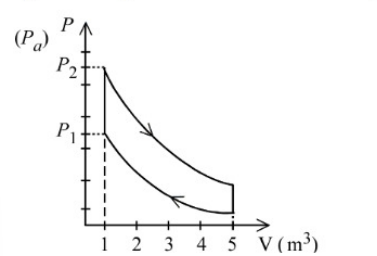
10 mole of an ideal gas is undergoing the process shown in the figure. The heat involved in the process from $P_1$ to $P_2$ is $\alpha \text{ Joule}$ ($P_1 = 21.7 \text{ Pa}$ and $P_2 = 30 \text{ Pa}, C_v = 21 \text{ J/K.mol}, R = 8.3 \text{ J/mol.K}$). The value of $\alpha$ is _______.
- When $300 \text{ J}$ of heat given to an ideal gas with $C_p = \frac{7}{2} R$ its temperature raises from $20^\circ\text{C}$ to $50^\circ\text{C}$ keeping its volume constant. The mass of the gas is (approximately) _______ g. ($R = 8.314 \text{ J/mol.K}$)
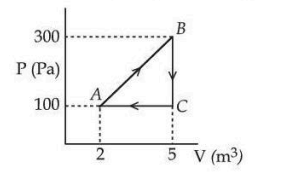
A thermodynamic system is taken through the cyclic process ABC as shown in the figure. The total work done by the system during the cycle $ABC$ is _________ $\text{J}$.
- The heat extracted out of $x$ gram of water initially at $50 \ ^{\circ}\text{C}$ to cool it down to $0 \ ^{\circ}\text{C}$ is sufficient to evaporate $(1000 - x)$ gram of water also initially at $50 \ ^{\circ}\text{C}$. The value of $x$ (closest integer) is ___________.
(Take latent heat of water $2256 \text{ kJ/kg. K}$, specific heat capacity of water $4200 \text{ J/kg. K}$) - $2\text{ moles}$ of an ideal gas with $\frac{C_{p}}{C_{v}} = \frac{5}{3}$ are mixed with $3\text{ moles}$ of another ideal gas with $\frac{C_{p}}{C_{v}} = \frac{4}{3}$. The value of $\frac{C_{p}}{C_{v}}$ for the mixture is


