
Cylindrical Rods Heat Conduction Analysis
The problem requires finding the interface temperature ($T_{int}$) between two cylindrical rods (A and B) made of different materials when they are joined end-to-end and subjected to different temperatures at their free ends. This is a problem of steady-state heat conduction.
Physics Principle: Steady State Heat Flow
Under steady-state conditions, the rate of heat transfer ($H$) is constant throughout the composite system. The heat flow rate through a cylindrical rod is given by the formula:
$H = \frac{KA \Delta T}{L}$
Where:
- $K$ represents the thermal conductivity.
- $A$ is the cross-sectional area ($A = \pi r^2$).
- $\Delta T$ is the temperature difference across the rod.
- $L$ is the length of the rod.
Applying Heat Flow Equality
For the joined rods A and B, the rate of heat flow must be the same at the interface:
$H_A = H_B$
Using the heat flow formula:
$\frac{K_A A_A (T_A - T_{int})}{L_A} = \frac{K_B A_B (T_{int} - T_B)}{L_B}$
Since the cross-sectional area $A = \pi r^2$, we can substitute this in:
$\frac{K_A (\pi r_A^2) (T_A - T_{int})}{L_A} = \frac{K_B (\pi r_B^2) (T_{int} - T_B)}{L_B}$
Canceling $\pi$ from both sides yields:
$\frac{K_A r_A^2 (T_A - T_{int})}{L_A} = \frac{K_B r_B^2 (T_{int} - T_B)}{L_B}$
Substituting Given Ratios and Values
The problem provides the following information:
- Length ratio: $\frac{L_A}{L_B} = 1$, which implies $\frac{L_B}{L_A} = 1$.
- Radius ratio: $\frac{r_A}{r_B} = 2$, which implies $\frac{r_A^2}{r_B^2} = (\frac{r_A}{r_B})^2 = 2^2 = 4$.
- Thermal conductivity ratio: $\frac{K_A}{K_B} = \frac{1}{2}$.
- Temperatures: $T_A = 400$ K and $T_B = 200$ K.
Rearranging the equation to group the ratios:
$\frac{K_A}{K_B} \times \frac{r_A^2}{r_B^2} \times \frac{L_B}{L_A} \times (T_A - T_{int}) = (T_{int} - T_B)$
Calculation of Interface Temperature
Substitute the known ratios and temperatures into the equation:
$(\frac{1}{2}) \times (4) \times (1) \times (400 \text{ K} - T_{int}) = (T_{int} - 200 \text{ K})$
Simplify the left side:
$2 \times (400 - T_{int}) = (T_{int} - 200)$
Expand the terms:
$800 - 2 T_{int} = T_{int} - 200$
Rearrange to solve for $T_{int}$:
$800 + 200 = T_{int} + 2 T_{int}$
Combine terms:
$1000 = 3 T_{int}$
Calculate the final value:
$T_{int} = \frac{1000}{3}$ K
$T_{int} \approx 333.33$ K
The calculated interface temperature is $\frac{1000}{3}$ K.
Similar Questions
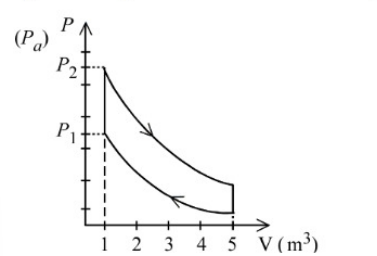
10 mole of an ideal gas is undergoing the process shown in the figure. The heat involved in the process from $P_1$ to $P_2$ is $\alpha \text{ Joule}$ ($P_1 = 21.7 \text{ Pa}$ and $P_2 = 30 \text{ Pa}, C_v = 21 \text{ J/K.mol}, R = 8.3 \text{ J/mol.K}$). The value of $\alpha$ is _______.
- When $300 \text{ J}$ of heat given to an ideal gas with $C_p = \frac{7}{2} R$ its temperature raises from $20^\circ\text{C}$ to $50^\circ\text{C}$ keeping its volume constant. The mass of the gas is (approximately) _______ g. ($R = 8.314 \text{ J/mol.K}$)
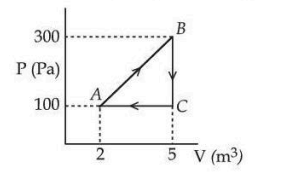
A thermodynamic system is taken through the cyclic process ABC as shown in the figure. The total work done by the system during the cycle $ABC$ is _________ $\text{J}$.
- The heat extracted out of $x$ gram of water initially at $50 \ ^{\circ}\text{C}$ to cool it down to $0 \ ^{\circ}\text{C}$ is sufficient to evaporate $(1000 - x)$ gram of water also initially at $50 \ ^{\circ}\text{C}$. The value of $x$ (closest integer) is ___________.
(Take latent heat of water $2256 \text{ kJ/kg. K}$, specific heat capacity of water $4200 \text{ J/kg. K}$) - The r.m.s. speed of oxygen molecules at $47^\circ\text{C}$ is equal to that of the hydrogen molecules kept at __________ $^\circ\text{C}$. (Mass of oxygen molecule/mass of hydrogen molecule $= 32/2$)
- A body takes 10 minutes to cool from $60^\circ C$ to $50^\circ C$. The temperature of surroundings is constant at $25^\circ C$. Then, the temperature of the body after next 10 minutes will be approximately :
- The value closest to the thermal velocity of a Helium atom at room temperature (300 K) in $ms^{-1}$ is : [$k_B = 1.4 \times 10^{-23}$ J/K; $m_{He} = 7 \times 10^{-27}$ kg]
- Two cornot engines A and B are operated in series. Engine A receives heat from a reservoir at 600 K and rejects heat to a reservoir at temperature T. Engine B receives heat rejected by engine A and in turn rejects it to a reservoir at 100 K. If the efficiencies of the two engines A and B are represented by $\eta_A$ and $\eta_B$, respectively, then what is the value of $\frac{\eta_B}{\eta_A}$ ?
- In 5 minutes, a body cools from $75^{\circ}C$ to $65^{\circ}C$ at room temperature of $25^{\circ}C$. The temperature of body at the end of next 5 minutes is __________ $^{\circ}C$.
- The area of cross-section of a railway track is $0.01 \text{ m}^2$. The temperature variation is $10^{\circ}C$. Coefficient of linear expansion of material of track is $10^{-5}/^{\circ}C$. The energy stored per meter in the track is __________ J/m.<br>(Young's modulus of material of track is $10^{11} \text{ Nm}^{-2}$)
Important Questions from Heat and Thermodynamics
10 mole of an ideal gas is undergoing the process shown in the figure. The heat involved in the process from $P_1$ to $P_2$ is $\alpha \text{ Joule}$ ($P_1 = 21.7 \text{ Pa}$ and $P_2 = 30 \text{ Pa}, C_v = 21 \text{ J/K.mol}, R = 8.3 \text{ J/mol.K}$). The value of $\alpha$ is _______.
- When $300 \text{ J}$ of heat given to an ideal gas with $C_p = \frac{7}{2} R$ its temperature raises from $20^\circ\text{C}$ to $50^\circ\text{C}$ keeping its volume constant. The mass of the gas is (approximately) _______ g. ($R = 8.314 \text{ J/mol.K}$)
A thermodynamic system is taken through the cyclic process ABC as shown in the figure. The total work done by the system during the cycle $ABC$ is _________ $\text{J}$.
- The heat extracted out of $x$ gram of water initially at $50 \ ^{\circ}\text{C}$ to cool it down to $0 \ ^{\circ}\text{C}$ is sufficient to evaporate $(1000 - x)$ gram of water also initially at $50 \ ^{\circ}\text{C}$. The value of $x$ (closest integer) is ___________.
(Take latent heat of water $2256 \text{ kJ/kg. K}$, specific heat capacity of water $4200 \text{ J/kg. K}$) - Two identical metal bars are heated in two different temperatures and allowed to cool in the same surroundings. Which one of the following figures correctly shows their cooling curves?



