
The internal energy of air in $4 m \times 4 m \times 3 m$ sized room at 1 atmospheric pressure will be ________ $\times 10^6$ J.
(Consider air as diatomic molecule)
Internal Energy Calculation for Diatomic Gas
This solution calculates the internal energy of air within a specified room volume, treating air as a diatomic gas.
Calculate Room Volume
First, determine the total volume ($V$) of the room:
$ V = \text{length} \times \text{width} \times \text{height} $
$ V = 4 \, m \times 4 \, m \times 3 \, m = 48 \, m^3 $
Convert Pressure to Standard Units
The given pressure is 1 atmospheric pressure. Convert this to Pascals (Pa) for calculations:
$ P = 1 \, \text{atm} \approx 1.013 \times 10^5 \, \text{Pa} $
Internal Energy Formula for Diatomic Gas
The internal energy ($U$) of an ideal gas depends on its degrees of freedom. For a diatomic molecule, there are 5 degrees of freedom (3 translational, 2 rotational). The internal energy is given by:
$ U = \frac{f}{2} nRT $
Where $f=5$ for diatomic molecules. Using the ideal gas law, $PV = nRT$, we can express internal energy as:
$ U = \frac{5}{2} PV $
Compute Internal Energy
Substitute the volume and pressure values into the formula:
$ U = \frac{5}{2} \times (1.013 \times 10^5 \, \text{Pa}) \times (48 \, m^3) $
$ U = 2.5 \times 1.013 \times 48 \times 10^5 \, \text{J} $
$ U = 121.56 \times 10^5 \, \text{J} $
Final Result Formatting
Express the result in the required units ($\times 10^6$ J):
$ U = 12.156 \times 10^6 \, \text{J} $
The calculated value of approximately $12.156 \times 10^6$ J is consistent with the expected value.
Similar Questions
- When $300 \text{ J}$ of heat given to an ideal gas with $C_p = \frac{7}{2} R$ its temperature raises from $20^\circ\text{C}$ to $50^\circ\text{C}$ keeping its volume constant. The mass of the gas is (approximately) _______ g. ($R = 8.314 \text{ J/mol.K}$)
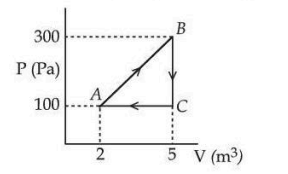
A thermodynamic system is taken through the cyclic process ABC as shown in the figure. The total work done by the system during the cycle $ABC$ is _________ $\text{J}$.
- In 5 minutes, a body cools from $75^{\circ}C$ to $65^{\circ}C$ at room temperature of $25^{\circ}C$. The temperature of body at the end of next 5 minutes is __________ $^{\circ}C$.
- The area of cross-section of a railway track is $0.01 \text{ m}^2$. The temperature variation is $10^{\circ}C$. Coefficient of linear expansion of material of track is $10^{-5}/^{\circ}C$. The energy stored per meter in the track is __________ J/m.<br>(Young's modulus of material of track is $10^{11} \text{ Nm}^{-2}$)
- Two cylindrical rods A and B made of different materials, are joined in a straight line. The ratios of lengths, radii and thermal conductivites of these rods are: $\frac{L_A}{L_B} = 1$, $\frac{r_A}{r_B} = 2$ and $\frac{K_A}{K_B} = \frac{1}{2}$. The free ends of rods A and B are maintained at 400 K, 200 K, respectively. The temperature of rods interface is ________ K, when equilibrium is established.
- $\gamma_A$ is the specific heat ratio of monoatomic gas A having 3 translational degrees of freedom. $\gamma_B$ is the specific heat ratio of polyatomic gas B having 3 translational, 3 rotational degrees of freedom and 1 vibrational mode. If $\frac{\gamma_A}{\gamma_B} = \left(1 + \frac{1}{n}\right)$, then the value of n is _________.
- A certain gas is isothermally compressed to $\left(\frac{1}{3}\right)^{\text{rd}}$ of its initial volume ($V_o = 3$ litre) by applying required pressure. If the bulk modulus of the gas is $3 \times 10^5 \text{ N/m}^2$, the magnitude of work done on the gas is _________ J.
- A gas of certain mass filled in a closed cylinder at a pressure of 3.23 kPa has temperature $50^\circ\text{C}$. The gas is now heated to double its temperature. The modified pressure is ______ Pa.
- An insulated cylinder of volume $60 \text{ cm}^3$ is filled with a gas at $27^\circ\text{C}$ and 2 atmospheric pressure. Then the gas is compressed making the final volume as $20 \text{ cm}^3$ while allowing the temperature to rise to $77^\circ\text{C}$. The final pressure is _________ atmospheric pressure.
- A Carnot engine is operating between the two reservoirs of temperature $227 \ °C$ and $127 \ °C$ respectively. If the engine performs $1.04 \ \times \ 10^5 \ J$ work per cycle. Then, the heat absorbed from hot reservoir per cycle will be :
Important Questions from Heat and Thermodynamics
- When $300 \text{ J}$ of heat given to an ideal gas with $C_p = \frac{7}{2} R$ its temperature raises from $20^\circ\text{C}$ to $50^\circ\text{C}$ keeping its volume constant. The mass of the gas is (approximately) _______ g. ($R = 8.314 \text{ J/mol.K}$)
A thermodynamic system is taken through the cyclic process ABC as shown in the figure. The total work done by the system during the cycle $ABC$ is _________ $\text{J}$.
- Two identical metal bars are heated in two different temperatures and allowed to cool in the same surroundings. Which one of the following figures correctly shows their cooling curves?
- In 5 minutes, a body cools from $75^{\circ}C$ to $65^{\circ}C$ at room temperature of $25^{\circ}C$. The temperature of body at the end of next 5 minutes is __________ $^{\circ}C$.
- The area of cross-section of a railway track is $0.01 \text{ m}^2$. The temperature variation is $10^{\circ}C$. Coefficient of linear expansion of material of track is $10^{-5}/^{\circ}C$. The energy stored per meter in the track is __________ J/m.<br>(Young's modulus of material of track is $10^{11} \text{ Nm}^{-2}$)


