A cyclic process is shown in p-v diagram and T-S diagram. Which of the following statement(s) is/are true ?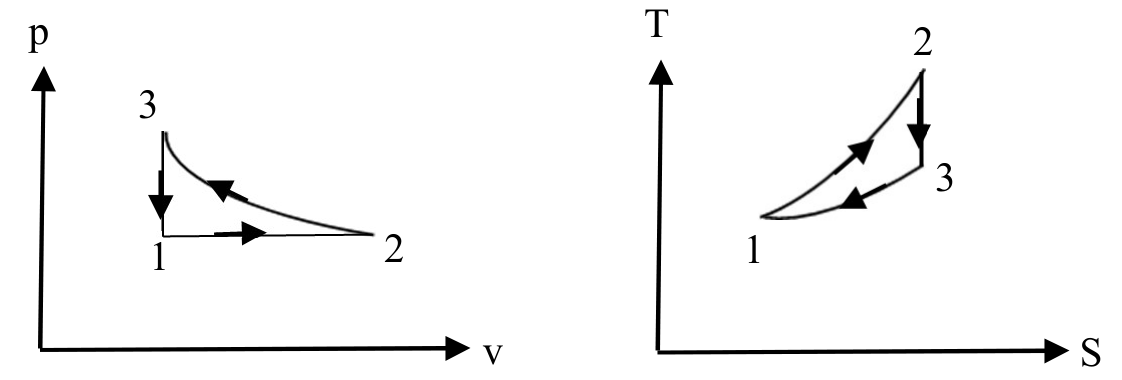
On a p-v diagram a horizontal line is constant pressure and a vertical line is constant volume; on a T-S diagram a vertical line is constant entropy, i.e. a reversible adiabatic process. For a full cycle the internal energy returns to its starting value.
Step 1 — In the p-v diagram 1→2 is horizontal (isobaric) and 3→1 is vertical (isochoric).
Step 2 — In the T-S diagram 2→3 is a vertical line: entropy stays constant while temperature changes, so 2→3 is adiabatic, not isothermal.
Step 3 — The net work is \(W=\oint p\,dV\), the area enclosed by the loop on the p-v diagram; the loop encloses a finite area, so the work is non-zero.
Step 4 — The net heat is \(Q=\oint T\,dS\), the area enclosed by the loop on the T-S diagram, which is also finite. Consistently, for the cycle \(\Delta U=0\;\Rightarrow\;Q=W\).
The statement calling 2→3 isothermal fails because temperature falls along 2→3 on the T-S diagram. The statement on isochoric 3→1 and adiabatic 2→3 holds, as does the non-zero net work and the non-zero net heat absorbed.
3→1: Isochoric, 2→3: adiabatic., Work done by the system in the complete cyclic process is non-zero. and The heat absorbed by the system in the complete cyclic process is non-zero. options are correct.
Similar Questions
- Two identical metal bars are heated in two different temperatures and allowed to cool in the same surroundings. Which one of the following figures correctly shows their cooling curves?
- $2\text{ moles}$ of an ideal gas with $\frac{C_{p}}{C_{v}} = \frac{5}{3}$ are mixed with $3\text{ moles}$ of another ideal gas with $\frac{C_{p}}{C_{v}} = \frac{4}{3}$. The value of $\frac{C_{p}}{C_{v}}$ for the mixture is
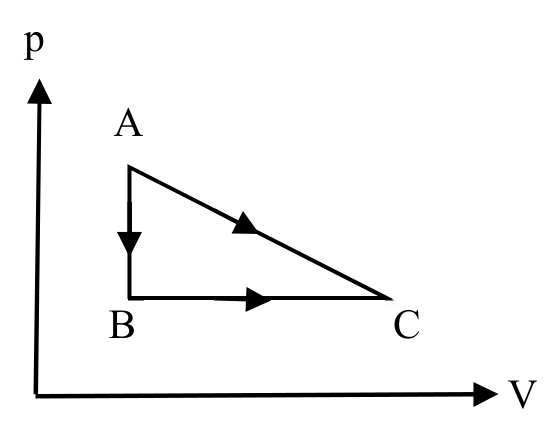
A given quantity of gas is taken from A to C in two ways; a) directly from A → C along a straight line and b) in two steps, from A → B and then from B → C. Work done and heat absorbed along the direct path A→C is 200 J and 280 J respectively.
If the work done along A→B→C is 80 J, then heat absorbed along this path is,
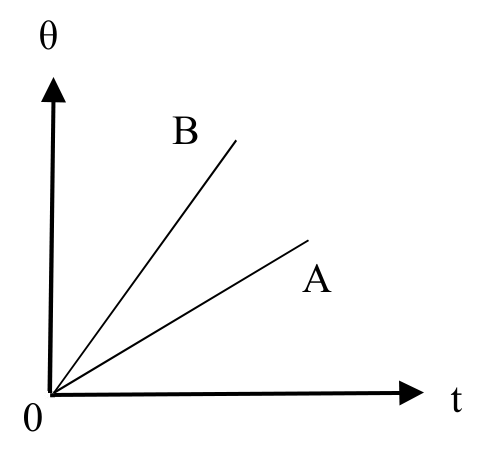
Two substances A and B of same mass are heated at constant rate. The variation of temperature θ of the substances with time t is shown in the figure. Choose the correct statement.
Six molecules of an ideal gas have velocities 1, 3, 5, 5, 6 and 5 m/s respectively. At any given temperature, if \(\bar{V}\) and Vrms represent average and rms speed of the molecules, then
Let \(\overline{V}\), Vrms, Vp denotes the mean speed, root mean square speed and most probable speed of the molecules each of mass m in an ideal monoatomic gas at absolute temperature T Kelvin. Which statement(s) is/are correct?
The apparent coefficient of expansion of a liquid, when heated in a copper vessel is C and when heated in silver vessel is S. If A is linear coefficient of expansion of copper, then linear coefficient of expansion of silver is
Temperature of a body θ is slightly more than the temperature of the surrounding θ0. Its rate of cooling (R) versus temperature of the body (θ) is plotted. Its shape would be
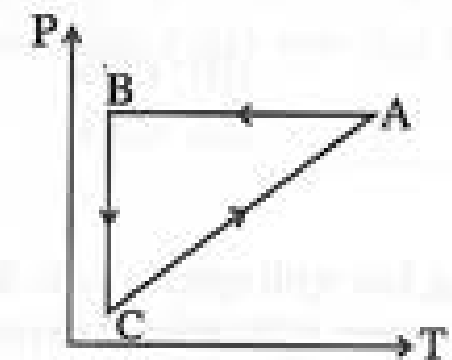
For an ideal gas, a cyclic process ABCA as shown in P–T diagram, when presented in P–V plot, it would be
A solid rectangular sheet has two different coefficients of linear expansion \(\alpha_1\) and \(\alpha_2\) along its length and breadth respectively. The coefficient of surface expansion is (for \(\alpha_1 t \ll 1, \alpha_2 t \ll 1\))
Important Questions from Heat and Thermodynamics
- When $300 \text{ J}$ of heat given to an ideal gas with $C_p = \frac{7}{2} R$ its temperature raises from $20^\circ\text{C}$ to $50^\circ\text{C}$ keeping its volume constant. The mass of the gas is (approximately) _______ g. ($R = 8.314 \text{ J/mol.K}$)
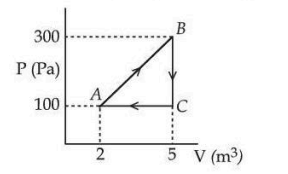
A thermodynamic system is taken through the cyclic process ABC as shown in the figure. The total work done by the system during the cycle $ABC$ is _________ $\text{J}$.
- Two identical metal bars are heated in two different temperatures and allowed to cool in the same surroundings. Which one of the following figures correctly shows their cooling curves?
- In 5 minutes, a body cools from $75^{\circ}C$ to $65^{\circ}C$ at room temperature of $25^{\circ}C$. The temperature of body at the end of next 5 minutes is __________ $^{\circ}C$.
- The area of cross-section of a railway track is $0.01 \text{ m}^2$. The temperature variation is $10^{\circ}C$. Coefficient of linear expansion of material of track is $10^{-5}/^{\circ}C$. The energy stored per meter in the track is __________ J/m.<br>(Young's modulus of material of track is $10^{11} \text{ Nm}^{-2}$)