
Problem Analysis:
The question asks for the number of vibrational modes ($f$) for an ideal polyatomic gas, given its heat capacities ratio ($C_P/C_V$) is $8/7$. The gas molecules have 3 translational, 3 rotational, and $f$ vibrational modes.
Degrees of Freedom and Heat Capacity
For an ideal gas molecule:
- Translational degrees of freedom = 3. Contribution to $C_V$ = $\frac{3}{2}R$.
- Rotational degrees of freedom = 3. Contribution to $C_V$ = $\frac{3}{2}R$.
- Vibrational modes = $f$. Each vibrational mode contributes $R$ to $C_V$ (assuming high temperature where vibrations are active). Contribution to $C_V$ = $fR$.
The specific heat at constant volume ($C_V$) per mole is the sum of contributions from all degrees of freedom:
$ C_V = \left(\frac{3}{2} + \frac{3}{2} + f\right) R = (3 + f) R $
Calculating Heat Capacity Ratio ($\gamma$)
Using Mayer's relation, the specific heat at constant pressure ($C_P$) is:
$ C_P = C_V + R $
$ C_P = (3 + f) R + R = (4 + f) R $
The ratio of heat capacities ($\gamma$) is:
$ \gamma = \frac{C_P}{C_V} = \frac{(4 + f) R}{(3 + f) R} = \frac{4 + f}{3 + f} $
Solving for Vibrational Modes ($f$)
We are given that $\gamma = C_P/C_V = 8/7$. Setting the derived formula equal to the given value:
$ \frac{4 + f}{3 + f} = \frac{8}{7} $
Cross-multiplying to solve for $f$:
$ 7(4 + f) = 8(3 + f) $
$ 28 + 7f = 24 + 8f $
Rearranging the terms:
$ 8f - 7f = 28 - 24 $
$ f = 4 $
Conclusion
The value of $f$, representing the number of vibrational modes, is 4. This corresponds to Option D.
Similar Questions
- An electric heater supplies heat to a system at a rate of $100 \text{ W}$. If the system performs work at a rate of $75 \text{ J/s}$, then the rate at which internal energy increases will be :
A flask contains argon and chlorine in the ratio of $2:1$ by mass. The temperature of the mixture is $27^\circ\text{C}$. The ratio of root mean square speed of the molecules of the two gases $(\frac{V_{rms}^{Ar}}{V_{rms}^{Cl}})$ is :
(Atomic mass of argon = $40 \text{ u}$ and molecular mass of chlorine = $70 \text{ u}$)- In an adiabatic expansion, the temperature of one mole of an ideal monatomic gas ($\gamma = 5/3$) decreases from $60\text{K}$ to $50\text{K}$. The work done by the gas in the process is :
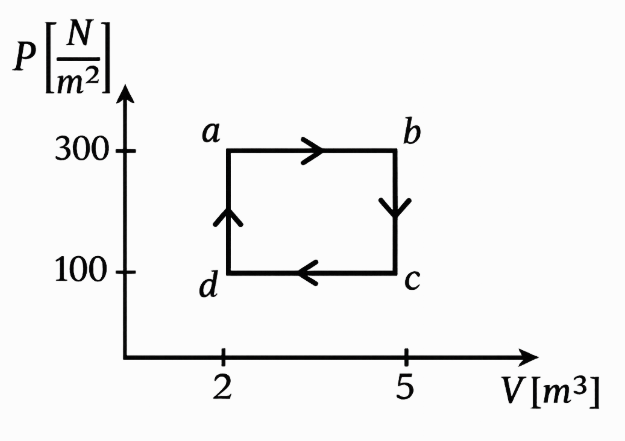
(Take the universal gas constant as $R = 8.3\text{ J mol}^{-1}\text{ K}^{-1}$) One mole of an ideal monatomic gas undergoes a cyclic process as shown in the figure. The total heat supplied to the gas is :
- The mean free path of molecules in an ideal gas A is half that of another ideal gas B. The diameter of the spherical molecules of gas A is twice the diameter of the molecules of B. If number densities of the gases A and B are $n_A$ and $n_B$, respectively, then the correct option is :
Important Questions from Heat and Thermodynamics
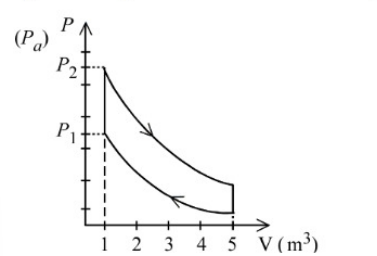
10 mole of an ideal gas is undergoing the process shown in the figure. The heat involved in the process from $P_1$ to $P_2$ is $\alpha \text{ Joule}$ ($P_1 = 21.7 \text{ Pa}$ and $P_2 = 30 \text{ Pa}, C_v = 21 \text{ J/K.mol}, R = 8.3 \text{ J/mol.K}$). The value of $\alpha$ is _______.
- When $300 \text{ J}$ of heat given to an ideal gas with $C_p = \frac{7}{2} R$ its temperature raises from $20^\circ\text{C}$ to $50^\circ\text{C}$ keeping its volume constant. The mass of the gas is (approximately) _______ g. ($R = 8.314 \text{ J/mol.K}$)
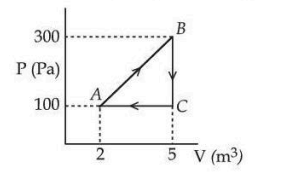
A thermodynamic system is taken through the cyclic process ABC as shown in the figure. The total work done by the system during the cycle $ABC$ is _________ $\text{J}$.
- The heat extracted out of $x$ gram of water initially at $50 \ ^{\circ}\text{C}$ to cool it down to $0 \ ^{\circ}\text{C}$ is sufficient to evaporate $(1000 - x)$ gram of water also initially at $50 \ ^{\circ}\text{C}$. The value of $x$ (closest integer) is ___________.
(Take latent heat of water $2256 \text{ kJ/kg. K}$, specific heat capacity of water $4200 \text{ J/kg. K}$) - Two identical metal bars are heated in two different temperatures and allowed to cool in the same surroundings. Which one of the following figures correctly shows their cooling curves?


