
This problem involves calculating the energy lost when a charged capacitor is connected to an identical uncharged capacitor.
Initial State Analysis
We start with two capacitors, each with capacitance $C = 200 \text{ pF}$. One capacitor is charged to an initial voltage $V_0 = 100 \text{ V}$.
- The initial charge $Q_0$ on the first capacitor is calculated using $Q = CV$: $Q_0 = C \times V_0 = (200 \times 10^{-12} \text{ F}) \times (100 \text{ V}) = 2 \times 10^{-8} \text{ C}$.
- The initial electrostatic energy $U_0$ stored in this capacitor is calculated using $U = \frac{1}{2}CV^2$: $U_0 = \frac{1}{2} C V_0^2 = \frac{1}{2} \times (200 \times 10^{-12} \text{ F}) \times (100 \text{ V})^2$ $U_0 = \frac{1}{2} \times 200 \times 10^{-12} \times 10000 \text{ J} = 1 \times 10^{-6} \text{ J}$.
Connecting the Capacitors
The charged capacitor is then connected to an identical uncharged capacitor. The total charge $Q_0$ is conserved and redistributed between the two capacitors.
- Since the capacitors have equal capacitance $C$, they will share the charge equally after connection. The total capacitance becomes $C_{total} = C + C = 2C$.
- The final voltage $V_f$ across both capacitors will be half the initial voltage: $V_f = \frac{V_0}{2} = \frac{100 \text{ V}}{2} = 50 \text{ V}$. Alternatively, using total charge and total capacitance: $V_f = \frac{Q_0}{C_{total}} = \frac{2 \times 10^{-8} \text{ C}}{2 \times (200 \times 10^{-12} \text{ F})} = \frac{2 \times 10^{-8}}{400 \times 10^{-12}} \text{ V} = 50 \text{ V}$.
Final Energy Calculation
The total electrostatic energy $U_f$ stored in the system of two parallel capacitors is:
- Using the total capacitance and final voltage: $U_f = \frac{1}{2} C_{total} V_f^2 = \frac{1}{2} \times (400 \times 10^{-12} \text{ F}) \times (50 \text{ V})^2$ $U_f = \frac{1}{2} \times 400 \times 10^{-12} \times 2500 \text{ J} = 500000 \times 10^{-12} \text{ J} = 0.5 \times 10^{-6} \text{ J}$.
- Alternatively, calculate energy in each capacitor: $U_f = 2 \times \left( \frac{1}{2} C V_f^2 \right) = C V_f^2 = (200 \times 10^{-12} \text{ F}) \times (50 \text{ V})^2$ $U_f = 200 \times 10^{-12} \times 2500 \text{ J} = 500000 \times 10^{-12} \text{ J} = 0.5 \times 10^{-6} \text{ J}$.
Energy Lost Calculation
The electrostatic energy lost during this process is the difference between the initial and final energies:
- $U_{lost} = U_0 - U_f$ $U_{lost} = (1 \times 10^{-6} \text{ J}) - (0.5 \times 10^{-6} \text{ J}) = 0.5 \times 10^{-6} \text{ J}$.
This energy is dissipated primarily as heat due to the current flow during charge redistribution.
Similar Questions
In the circuit shown below, the voltage appearing across the diode D will be of the form :
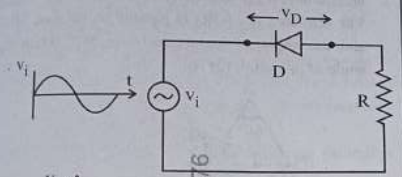
A 100-turn closely wound circular coil of radius $10 \text{ cm}$ has a magnetic field of $3.14 \times 10^{-3} \text{ T}$ at its centre. The current passing through the coil, and the magnitude of the magnetic moment of this coil are, respectively :
(Take $\mu_0 = 4\pi \times 10^{-7} \text{ T m/A}$)The current $I$ in the circuit shown below is :
(All diodes are ideal and identical.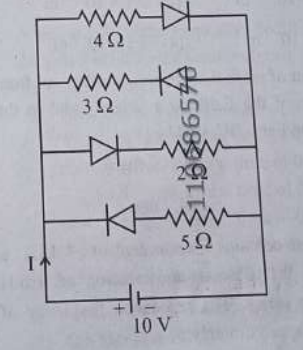
- A galvanometer of resistance $100 \ \Omega$ gives full scale deflection for a current of $1 \text{ mA}$. It is converted into an ammeter of range $0 - 10 \text{ A}$. The shunt required is :
- An ac circuit contains a resistance of $1 \text{ k}\Omega$, a capacitor of $0.1 \ \mu\text{F}$ and an inductor of $1 \text{ mH}$ connected in series. The resonance frequency of the circuit is approximately :
- Two statements are given below :
A. When the forward bias voltage across a p-n junction diode increases above a certain threshold voltage, the diode current increases significantly.
B. This current is called reverse saturation current.
Choose the correct answer from the options given below : - A rectangular wire loop of sides $8 \text{ cm}$ and $3 \text{ cm}$ with a small cut, is moving out of a region of uniform magnetic field of magnitude $0.3 \text{ T}$ directed normal to the plane of the loop. The emf developed across the cut, if the velocity of the loop is $2 \text{ cm s}^{-1}$ in a direction normal to the shorter side of the loop, will be :
- A resistor is connected to a battery of $12 \text{ V}$ emf and internal resistance $2 \ \Omega$. If the current in the circuit is $0.6 \text{ A}$, the terminal voltage of the battery is :
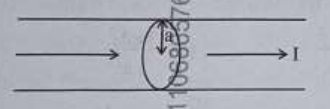
The figure given below shows a long straight solid wire of circular cross-section of radius 'a' carrying steady current I. The current I is uniformly distributed across its cross-section. The plot which correctly represents the variation of magnetic field (B) with distance (r) from the axis of the conductor in the region is :
Five capacitors of capacitances $C_1 = C_2 = C_3 = C_4 = 10 \ \mu\text{F}$ and $C_5 = 2.5 \ \mu\text{F}$ are connected as shown along with a battery of $50 \text{ V}$.
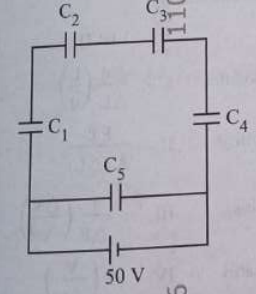
The equivalent capacitance and the charges on each capacitor respectively are :
Important Questions from Electricity and Magnetism
- The electric current in the circuit is given as $i = i_o(t/T)$. The r.m.s current for the period $t = 0$ to $t = T$ is ________.
- In the potentiometer, when the cell in the secondary circuit is shunted with $4\text{ }\Omega$ resistance, the balance is obtained at the length $120\text{ cm}$ of wire. Now when the same cell is shunted with $12\text{ }\Omega$ resistance, the balance is shifted to a length of $180\text{ cm}$. The internal resistance of cell is ________$\Omega$
- The electric field of an electromagnetic wave travelling through a medium is given by $\vec{E}(x,t) = 25 \sin(2.0 \times 10^{15} t - 10^7 x) \hat{n}$
then the refractive index of the medium is ________.
(All given measurement are in SI units) Three long straight wires carrying current are arranged mutually parallel as shown in the figure. The force experienced by $15 \text{ cm}$ length of wire $Q$ is________.
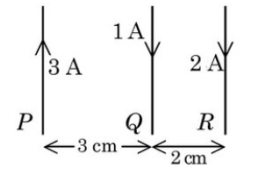
$(\mu_o = 4\pi \times 10^{-7} \text{ T.m/A})$- For the two cells having same EMF $E$ and internal resistance $r$, the current passing through the external resistor $6\text{ }\Omega$ is same when both the cells are connected either in parallel or in series. The value of internal resistance $r$ is ________$\Omega$.


