
Electron Energy States: Speed vs. Quantum Number
For electrons in hydrogen-like atoms, speed ($v_n$) is proportional to $Z/n$ and radius ($r_n$) is proportional to $n^2/Z$. Here, $Z$ is the atomic number and $n$ is the principal quantum number.
- Speed dependency: $v_n \propto \frac{Z}{n}$
- Radius dependency: $r_n \propto \frac{n^2}{Z}$
We are given the speeds of two electrons: $v_1 = 3 \times 10^5 \text{ m/s}$ and $v_2 = 2.5 \times 10^5 \text{ m/s}$. The ratio of their speeds is:
$ \frac{v_1}{v_2} = \frac{3 \times 10^5 \text{ m/s}}{2.5 \times 10^5 \text{ m/s}} = \frac{3}{2.5} = \frac{30}{25} = \frac{6}{5} $
The problem states that the radii of their orbits are nearly the same ($r_1 \approx r_2$). This implies:
$ \frac{r_1}{r_2} \approx 1 \implies \frac{n_1^2/Z_1}{n_2^2/Z_2} \approx 1 \implies \frac{Z_1}{Z_2} \approx \frac{n_1^2}{n_2^2} $
Now, consider the ratio of speeds in terms of atomic numbers ($Z_1, Z_2$) and principal quantum numbers ($n_1, n_2$):
$ \frac{v_1}{v_2} = \frac{Z_1/n_1}{Z_2/n_2} = \frac{Z_1}{Z_2} \times \frac{n_2}{n_1} $
Substitute the relationship $\frac{Z_1}{Z_2} \approx \frac{n_1^2}{n_2^2}$ derived from the equal radii condition:
$ \frac{v_1}{v_2} \approx \left( \frac{n_1^2}{n_2^2} \right) \times \frac{n_2}{n_1} = \frac{n_1}{n_2} $
Equating the calculated speed ratio with the derived quantum number ratio:
$ \frac{n_1}{n_2} \approx \frac{6}{5} $
We need to find the pair $(n_1, n_2)$ from the options that matches this ratio. The pair $(6, 5)$ gives $\frac{6}{5}$, which matches our result.
The possible order of energy states (principal quantum numbers) is 6 and 5.
Similar Questions
Assuming in forward bias condition there is a voltage drop of $0.7 \text{ V}$ across a silicon diode, the current through diode $D_1$ in the circuit is ________$\text{mA}$.
(Assume all diodes in the given circuit are identical)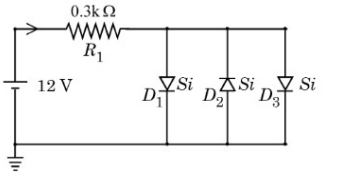
- The ratio of de Broglie wavelength of a deutron with kinetic energy $E$ to that of an alpha particle with kinetic energy $2E$, is $n : 1$. The value of $n$ is ________.
(Assume mass of proton = mass of neutron) : - The wave numbers of three spectral lines of H atom are considered. Identify the set of spectral lines belonging to Balmer series.
(R = Rydberg constant) - 7.9 MeV $\alpha$-particle scatters from a target material of atomic number 79. From the given data the estimated diameter of nuclei of the target material is (approximately) _________ m.
$\left[ \frac{1}{4\pi\epsilon_0} = 9 \times 10^9 \text{ Nm}^2/\text{C}^2 \text{ and electron charge} = 1.6 \times 10^{-19} \text{ C} \right]$ Find the correct combination of A, B, C and D inputs which can cause the LED to glow.
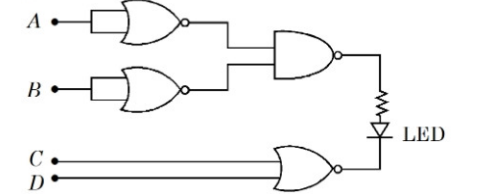
- The minimum frequency of photon required to break a particle of mass 15.348 amu into 4 $\alpha$ particles is _________ kHz.
[mass of He nucleus = 4.002 amu, $1 \text{ amu} = 1.66 \times 10^{-27} \text{ kg}, h = 6.6 \times 10^{-34} \text{ J.s} \text{ and } c = 3 \times 10^8 \text{ m/s}$] The correct truth table for the given input data of the following logic gate is :
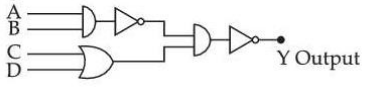
- Light is incident on a metallic plate having work function $110 \times 10^{-20} \text{ J}$. If the produced photoelectrons have zero kinetic energy then the angular frequency of the incident light is _________ rad/s.
(h = $6.63 \times 10^{-34} \text{ J.s}$). - The smallest wavelength of Lyman series is 91 nm. The difference between the largest wavelengths of Paschen and Balmer series is nearly _________ nm.
- Given below are two statements:
Statement I: For all elements, greater the mass of the nucleus, greater is the binding energy per nucleon.
Statement II: For all elements, nuclei with less binding energy per nucleon transforms to nuclei with greater binding energy per nucleon.
In the light of the above statements, choose the correct answer from the options given below
Important Questions from Modern Physics
Assuming in forward bias condition there is a voltage drop of $0.7 \text{ V}$ across a silicon diode, the current through diode $D_1$ in the circuit is ________$\text{mA}$.
(Assume all diodes in the given circuit are identical)- The ratio of de Broglie wavelength of a deutron with kinetic energy $E$ to that of an alpha particle with kinetic energy $2E$, is $n : 1$. The value of $n$ is ________.
(Assume mass of proton = mass of neutron) : - The wave numbers of three spectral lines of H atom are considered. Identify the set of spectral lines belonging to Balmer series.
(R = Rydberg constant) - 7.9 MeV $\alpha$-particle scatters from a target material of atomic number 79. From the given data the estimated diameter of nuclei of the target material is (approximately) _________ m.
$\left[ \frac{1}{4\pi\epsilon_0} = 9 \times 10^9 \text{ Nm}^2/\text{C}^2 \text{ and electron charge} = 1.6 \times 10^{-19} \text{ C} \right]$ Find the correct combination of A, B, C and D inputs which can cause the LED to glow.


