For a free radical containing two equivalent protons, lines occur at 330.2 mT, 332.5 mT and 334.8 mT. What is the hyperline coupling constant for each proton ?
2.3 mT
First confirm the pattern matches the description. Two equivalent protons give \(n + 1 = 3\) lines in a 1 : 2 : 1 intensity ratio, and three lines are indeed observed.
The hyperfine coupling constant is the spacing between adjacent lines. Taking both gaps:
\(332.5 - 330.2 = 2.3\) mT, and \(334.8 - 332.5 = 2.3\) mT.
The two spacings are equal, exactly as required for equivalent nuclei, and this consistency confirms the assignment. So \(a = 2.3\) mT.
Three points settle the remaining options.
The value is the single spacing, not the total width. The full span from the first line to the last is \(334.8 - 330.2 = 4.6\) mT, which is \(2a\) — the total spread for two equivalent protons, not the coupling constant itself.
The units matter. 2.3 T would be a thousand times larger, comparable to the entire applied field of the spectrometer, which is physically impossible for a hyperfine splitting.
The sign convention. A coupling constant quoted from a spectrum in this way is reported as a positive magnitude; the negative value has no meaning as a measured splitting.
As a check, the centre of the multiplet, \(\frac{330.2 + 334.8}{2} = 332.5\) mT, coincides with the middle line as a symmetric 1 : 2 : 1 pattern requires, and that centre field is what is used to extract the g value.
Hence the hyperfine coupling constant is 2.3 mT.
Similar Questions
The species that contain a vacant d x2 - y2 orbital is :
FeCl2 . 4H2O and FeCl3 . 6H2O can be distinguished by 57Fe Mössbauer spectroscopy. The INCORRECT statement from the following is :
The solutions of
(i) [Cr(OH2)6]3+ ions are pale blue-green, but the chromite ion
(ii) [CrO4]2- is an intense yellow due to :
The major product of the following reaction in :
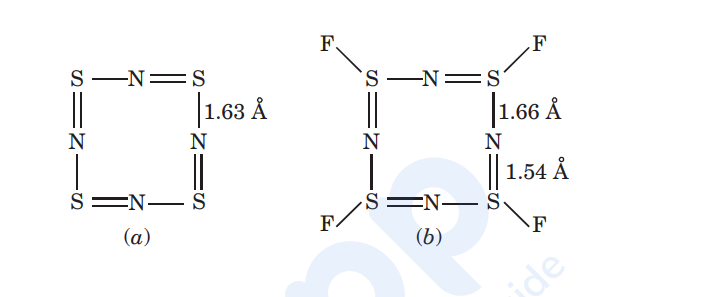
The structures of tetrasulphur tetranitride (a) and tetrathiazyl tetrafluoride (b) are given below. The statement that correctly describes the structures is :
In an axially symmetric field, the first NQR transition energy for I = $\frac{3}{2}$ is :
In the 19F NMR spectrum of ClF3, the number of signals and multiplicity at room temperature are (19F; I = \(\tfrac{1}{2}\)) :
Between NF3 and NH3 :
Identify (X) and (Y) in the following transformation :

The oxyacids of sulphur having direct S-S bonds are :
Important Questions from Structure of Atom
According to J.J. Thomson model of atom, positive charge is - Idenfity
- How many moles of He atoms are present in its 20 u mass ?
Which of the following electron transition in hydrogen atom will require largest amount of energy?
A species having 8 electrons in the third shell is very reactive while the other species having 8 electrons in the third shell is very inactive they are :
Which of the following is the general formula for saturated hydrocarbons?