For a butadiene molecule, the energy values of levels obtained by using HMO theory are : (1) α - 1.6β (2) α + 1.6β (3) α + 0.6β (4) α - 0.6β What is the sequence of levels in the order of increasing energy ?
(2), (3), (4), (1)
The whole question turns on one easily forgotten fact: β is negative.
In Hückel theory \(\alpha\) is the Coulomb integral (the energy of an electron in an isolated 2p orbital) and \(\beta\) is the resonance integral. Because bonding lowers the energy, \(\beta\) is a negative quantity, of the order of -75 kJ mol-1.
The consequence is that a term \(+n\beta\) lowers the energy while \(-n\beta\) raises it, and the larger the coefficient the greater the effect. So ordering from lowest to highest energy:
\(\alpha + 1.6\beta \;<\; \alpha + 0.6\beta \;<\; \alpha - 0.6\beta \;<\; \alpha - 1.6\beta\)
which corresponds to the labels (2), (3), (4), (1).
The pattern is exactly what is expected for a linear conjugated system. The four π molecular orbitals are arranged symmetrically about \(\alpha\): two bonding levels below it, at \(\alpha + 1.618\beta\) and \(\alpha + 0.618\beta\), and two antibonding levels the same distances above.
Butadiene's four π electrons fill the two bonding orbitals, so the HOMO is \(\alpha + 0.618\beta\) and the LUMO is \(\alpha - 0.618\beta\). The total π energy is \(2(\alpha + 1.618\beta) + 2(\alpha + 0.618\beta) = 4\alpha + 4.472\beta\), compared with \(4\alpha + 4\beta\) for two isolated ethene units — the difference of \(0.472\beta\) being the delocalisation energy that makes conjugation favourable.
Hence the order of increasing energy is (2), (3), (4), (1).
Similar Questions
The species that contain a vacant d x2 - y2 orbital is :
FeCl2 . 4H2O and FeCl3 . 6H2O can be distinguished by 57Fe Mössbauer spectroscopy. The INCORRECT statement from the following is :
The solutions of
(i) [Cr(OH2)6]3+ ions are pale blue-green, but the chromite ion
(ii) [CrO4]2- is an intense yellow due to :
The major product of the following reaction in :
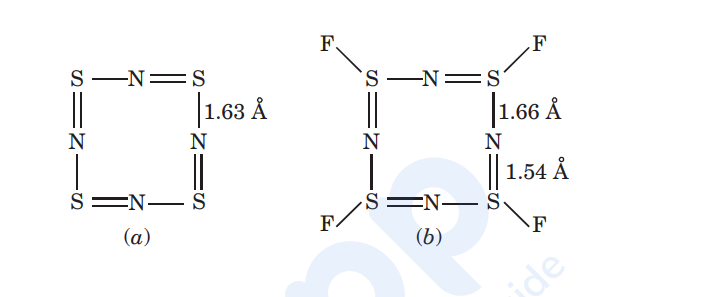
The structures of tetrasulphur tetranitride (a) and tetrathiazyl tetrafluoride (b) are given below. The statement that correctly describes the structures is :
In an axially symmetric field, the first NQR transition energy for I = $\frac{3}{2}$ is :
In the 19F NMR spectrum of ClF3, the number of signals and multiplicity at room temperature are (19F; I = \(\tfrac{1}{2}\)) :
Between NF3 and NH3 :
Identify (X) and (Y) in the following transformation :

The oxyacids of sulphur having direct S-S bonds are :
Important Questions from Structure of Atom
According to J.J. Thomson model of atom, positive charge is - Idenfity
- How many moles of He atoms are present in its 20 u mass ?
Which of the following electron transition in hydrogen atom will require largest amount of energy?
A species having 8 electrons in the third shell is very reactive while the other species having 8 electrons in the third shell is very inactive they are :
Which of the following is the general formula for saturated hydrocarbons?