
Assertion (A) : Asynchronous sequential circuit is also called event driven circuit. Reason (R) : Event driven circuit does not have clock to trigger change of state. The states are changed by the change in input signal of the previous stage. Select your answer using the codes given below.
Both (A) and (R) are true and (R) is the correct explanation of (A).
The question involves understanding the concepts of asynchronous sequential circuits and their behavior.
- Understanding Assertion (A):
- An asynchronous sequential circuit is referred to as an event-driven circuit. This is because these circuits do not rely on a clock signal to change states, unlike synchronous circuits.
- Understanding Reason (R):
- An event-driven circuit changes its state in response to changes in input signals. These inputs trigger the transition from one state to another, independently of any clock signal. Hence, clock signals are not required to control the timing of state changes.
- Evaluating the Combination of (A) and (R):
- Both Assertion (A) and Reason (R) provide accurate descriptions of asynchronous sequential circuits.
- The reason (R) correctly explains that the change in states is triggered by inputs, which justifies why such circuits are called event-driven. Hence, (R) is not only true but also correctly explains (A).
Thus, the correct answer is: Both (A) and (R) are true and (R) is the correct explanation of (A).
Similar Questions
Read the following statements :
i. Gate is a combinational logic.
ii. JK Flip-flop in toggle mode is not combinational logic.
iii. MSJK FF suffers from race-around.
iv. Counters are sequential circuits.Which is correct ?
Which flip-flop can be used as latch ?
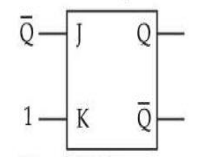
In a J-K FF, if J = Q and K = 1 (see figure). Assuming the flip flop was initially cleared and then clocked for 6 pulses, the sequence at the Q output will be :
Consider the following statements regarding registers and latches :
(A) Registers are made of edge triggered flip-flops whereas latches are made from level triggered flip flops
(B) Registers are temporary storage devices whereas latches are not
(C) A latch employs cross coupled feed back connections
(D) A register stores a binary word whereas a latch does notChoose the most appropriate answer from the options given below :
The toggle condition appears in J-K flip-flop when
A. J=1, K=1
B. J=0, K=0
C. J=0, K=1
D. J=1, K=0
E. J=0, K=1 and J=1, K=0
Choose the correct answer from the options given below :
Match List I with List II
LIST I (Diagram) LIST II (Sequential Circuit) A. 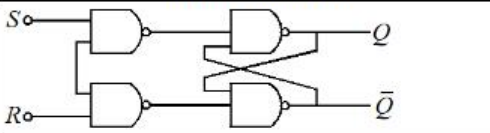
I. Edge triggered S-R flip flop B. 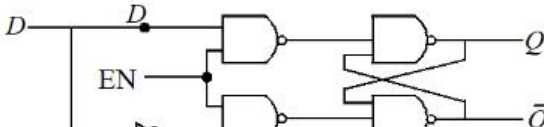
II. D Flip flop to SR flip flop C. 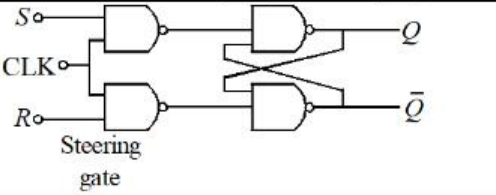
III. Gated Latch clocked flip flop D. 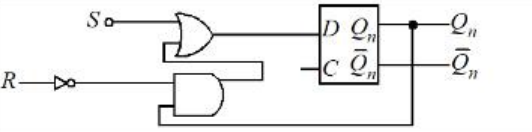
IV. Gated D Latch Choose the correct answer from the options given below:
The truth table of D flip-flop is given below:
C D Qn+1 O X Qn (Last State) $\uparrow$ 0 0 $\uparrow$ 1 1 Choose exact characteristic equation based on above Truth Table
Assertion (A) : Delay flip flop is used to store a single bit either 0 or 1.
Reason (R) : It has only one input, when clock is high and D input is also high, the output resets.
For the circuit shown below consider the two statements :
Assertion (A) : The circuit is sequential.
Reason (R) : There is a loop in circuit.
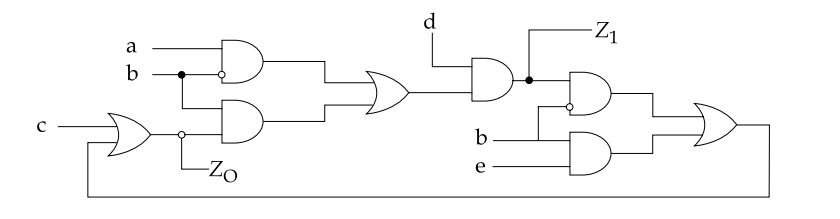
Select your answer using the codes given below.
Flip Flop can be used to make :
(a) Latches
(b) Bounce-elimination switches
(c) ADDER
(d) Encoder
Which of the statements given above are correct ?
Important Questions from Sequential Circuits
The basic sequential logic building block in which the output follows the data input as long as the ENABLE input is active, is
What can be the maximum clock frequency of a 10-bit ripple counter which will not cause a count to skip, considering 10 ns propagation delay for each of the edge-triggered flip flops?
The output of a sequential circuit depends on
The basic building block of a sequential logic circuit is
A 4bit synchronous counter uses flip-flops with a propagation delay time of 25ns each. The maximum possible time required for change of state will be



