
Assertion (A) : Any sudden change that might occur in a circuit without an inductor are smoothened out by the presence of an inductor. Reason (R) : Because the inductor filter depends on the fundamental property to oppose any change of current. Select your answer using the codes given below :
Both (A) and (R) are true and (R) is the correct explanation of (A)
Both statements are true, and the reason states exactly the property that produces the effect.
The defining relation for an inductor is
\(v=L\dfrac{di}{dt}\)
A sudden change in current would mean a very large \(\dfrac{di}{dt}\) and therefore a very large induced voltage, whose polarity — by Lenz's law — opposes the change that produced it. An instantaneous change would need infinite voltage and is therefore impossible: the current through an inductor cannot change abruptly. That is the smoothing action the assertion describes, and (R) is its direct cause, so the code is 1.
In a rectifier filter this works as follows. The choke is placed in series with the load, so the load current must also flow through it. When the rectifier output rises, the inductor absorbs energy in its magnetic field and limits the rise; when the output falls between peaks, the collapsing field maintains the current. The result is a load current far smoother than the pulsating voltage driving it. For a full-wave rectifier with a choke input filter the ripple factor is
\(RF=\dfrac{R_{L}}{3\sqrt{2}\,\omega L}\)
— note that it falls as the load current increases (smaller RL), which is the opposite of a capacitor filter's behaviour.
| Inductor (choke) filter | Capacitor filter | |
|---|---|---|
| Position | Series with load | Parallel with load |
| Opposes change in | Current | Voltage |
| Best at | Heavy load | Light load |
| Output voltage | Lower, near the average | Near the peak |
| Diode current | Smooth, low peak | Short, tall pulses |
The complementary nature of the two elements is the practical point: a capacitor holds the voltage steady and a choke holds the current steady, so combining them as an L-section or π-section filter gives smoothing far better than either alone. High-current supplies favour the choke input for its gentle diode current and its good regulation; low-current supplies favour the capacitor for its higher output voltage and lower cost.
The dual statement is worth remembering alongside: a capacitor's voltage cannot change instantaneously, since \(i=C\dfrac{dv}{dt}\) would demand infinite current. The two facts together are what make the initial conditions of every transient problem well defined.
Hence, both (A) and (R) are true and (R) is the correct explanation of (A).
Similar Questions
Consider the following rectifier circuits :
1. Half-wave rectifier without filter
2. Full-wave rectifier without filter
3. Full-wave rectifier with series inductance filter
4. Full-wave rectifier with capacitance filterThe sequence of these rectifier circuits in decreasing order of the ripple factor is
Assertion (A) : Capacitor input filter gives a high output voltage which drops as the load is increased.
Reason (R) : Capacitor input filters produce more heating in the rectifiers.
For the different values of 'L' while keeping 'RL' as constant, following graph is obtained from the given circuit.
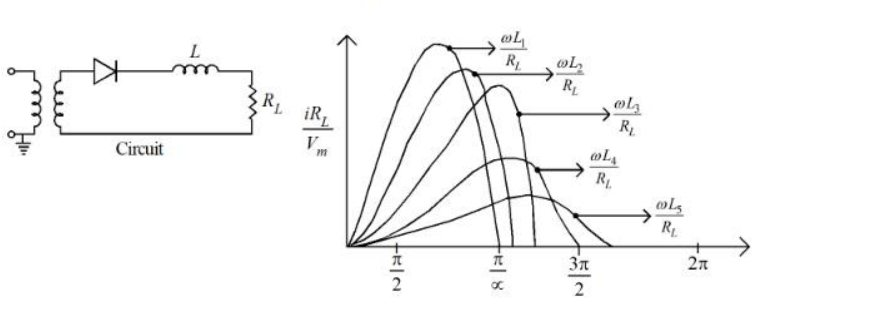
Choose the correct ascending order from the options given below for the different values of ' L ' :
The ratio of peak to peak input ripple voltage to peak to peak ripple output voltage is known as:
Read the statements:
A. The O/P frequency of a half wave rectifier is equal to the input frequency
B. The O/P frequency of a full wave rectifier is double to the input frequency
C. The regulation of an excellent rectifier should be zero.
D. ripple factor in the full wave rectifier is 1.2.
Choose the correct statements from the options given below:
Statements regarding rectifier are :
A. RMS value of current in a half wave rectifier is \(\frac{I_m}{\sqrt{2}}\)
B. PIV of diode in a full wave bridge rectifier is Vm volts.
C. TUF and rectification efficiency for a rectifier are same parametrs.
D. Rectifier converts A.C. to rippled DC not pure D.C.
Choose the correct answer from the options given below:
In a rectifier the ripple factor can be expressed as
(a) \(\dfrac{I_{rms}}{I_{dc}}\) (b) \(\sqrt\dfrac{I_{dc}}{I_{rms}}\) (c) \(\sqrt{\left(\dfrac{I_{rms}}{I_{dc}}\right)^{2}-1}\) (d) \(\sqrt{1-\left(\dfrac{I_{rms}}{I_{dc}}\right)^{2}}\)
Which one of the above is correct ?
For a full-wave rectifier, which of the following statements are correct ?
(a) \(V_{dc}=\dfrac{2V_P}{\pi}\)
(b) \(f_{out}=2f_{in}\)
(c) \(V_{dc}=\dfrac{2\pi}{V_P}\)
(d) \(I_{dc}=\dfrac{I_m}{\sqrt{\pi}}\)
Options :
As compared to a full-wave rectifier using two diodes, the four diode bridge rectifier has the dominant advantage of :
In rectifiers :
(a) The efficiency of rectification is given by \(\eta=\dfrac{P_{ac}}{P_{dc}}\)
(b) The AC component on the output side : \(V_{ac}=\sqrt{V_{rms}^{2}-V_{dc}^{2}}\)
(c) Form factor is given by : \(FF=\dfrac{V_{dc}}{V_{rms}}\)
(d) Ripple factor is given by : \(RF=\sqrt{\left(\dfrac{V_{rms}}{V_{dc}}\right)^{2}-1}\)
Of these statements :
Important Questions from Rectifier Circuits
PIV of a non conducting diode in a bridge rectifier is
The no-load output voltage of an ideal half wave rectifier is _______.
What is the minimum PIV required for a diode used in a full-wave rectifier circuit using a center-tapped transformer with a secondary voltage of 50V-0-50 V (rms)?
One of the following is a negative resistance device
Which of the following is NOT true for a rectifier?



