A compound shows a peak at 240 Hz down field relative to reference peak on NMR instrument working at 60 MHz. What is the chemical shift (τ) of the compound ?
4 ppm
Chemical shift is defined so that it does not depend on the strength of the spectrometer:
\(\delta = \frac{\text{shift from reference (Hz)}}{\text{operating frequency (MHz)}}\) ppm.
Substitute the values. The peak is 240 Hz downfield of the reference and the instrument runs at 60 MHz:
\(\delta = \frac{240\ \mathrm{Hz}}{60\ \mathrm{MHz}} = \frac{240}{60 \times 10^{6}} = 4 \times 10^{-6} = 4\) ppm.
The units work out because the ratio is dimensionless; expressing it in parts per million is what turns \(4 \times 10^{-6}\) into the convenient figure 4.
Why the definition is framed this way. The absolute separation in hertz scales with the applied field, so the same proton would appear 400 Hz from the reference on a 100 MHz instrument and 1200 Hz on a 300 MHz instrument. Dividing by the operating frequency removes that dependence, so \(\delta = 4\) ppm on any spectrometer. This is what makes chemical shift tables transferable between laboratories.
A note on the symbol: the question writes \(\tau\), an older scale related to the modern one by \(\tau = 10 - \delta\). On the numbers given, the quantity actually computed from the data is the \(\delta\) value of 4 ppm, which is the intended answer.
The reference itself is tetramethylsilane, assigned \(\delta = 0\) because its twelve equivalent, highly shielded protons give a single sharp upfield peak.
Hence the chemical shift is 4 ppm.
Similar Questions
The species that contain a vacant d x2 - y2 orbital is :
FeCl2 . 4H2O and FeCl3 . 6H2O can be distinguished by 57Fe Mössbauer spectroscopy. The INCORRECT statement from the following is :
The solutions of
(i) [Cr(OH2)6]3+ ions are pale blue-green, but the chromite ion
(ii) [CrO4]2- is an intense yellow due to :
The major product of the following reaction in :
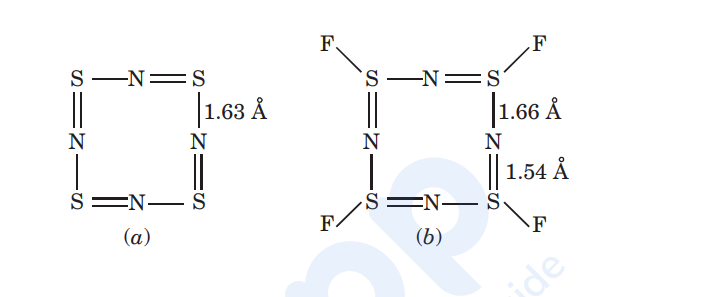
The structures of tetrasulphur tetranitride (a) and tetrathiazyl tetrafluoride (b) are given below. The statement that correctly describes the structures is :
In an axially symmetric field, the first NQR transition energy for I = $\frac{3}{2}$ is :
In the 19F NMR spectrum of ClF3, the number of signals and multiplicity at room temperature are (19F; I = \(\tfrac{1}{2}\)) :
Between NF3 and NH3 :
Identify (X) and (Y) in the following transformation :

The oxyacids of sulphur having direct S-S bonds are :
Important Questions from Structure of Atom
According to J.J. Thomson model of atom, positive charge is - Idenfity
- How many moles of He atoms are present in its 20 u mass ?
Which of the following electron transition in hydrogen atom will require largest amount of energy?
A species having 8 electrons in the third shell is very reactive while the other species having 8 electrons in the third shell is very inactive they are :
Which of the following is the general formula for saturated hydrocarbons?