
Uniform Civil Code - Indian Polity Notes
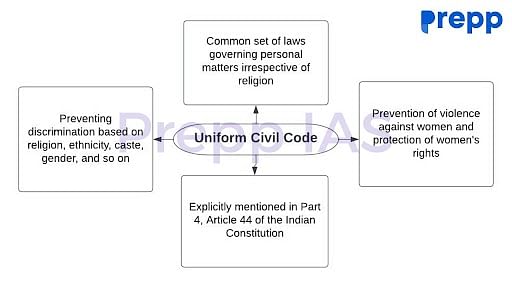
Uniform Civil Code means a common set of laws governing personal matters irrespective of religion. The term "Uniform Civil Code" addresses matters such as marriage, divorce, child support, inheritance, adoption, and property succession.
Article 44 of the Indian Constitution specifically mentions the term "Uniform Civil Code." Shah Bano case (1985) was a step forward in the implementation of the UCC and sparked a debate concerning women's rights and the interpretation of the equality principle. This article explains the Uniform Civil Code which is important for UPSC Indian Polity Preparation.
|
Table of Contents |
Uniform Civil Code - Concept
- Uniform Civil Code (UCC) is a concept for a consistently constructed legislative in India that will preserve all areas revolving around the personal religious and civil laws of every faith.
- To achieve secularism, the UCC would give standard personal laws to all religions and will supersede personal laws of other religions, ethnicities, castes, and so on.
- It involves the uniformity of in-laws for marriage, divorce, succession, adoption, guardianship, and the equitable distribution of property and assets to all residents.
- One of the Directive Principles of the Constitution, Article 44, states that the state must endeavour to secure a UCC for citizens across India's territory.
- These, as stated in Article 37, are not justiciable (no court can enforce them), yet the ideas they establish are vital in government.
- Goa is the only state in India that has a UCC in the form of common family law.
- The Portuguese Civil Code, which is still in effect today, was implemented in Goa in the nineteenth century and was not changed following its emancipation.
| Other Relevant Links | |
|---|---|
| Socialistic Directive Principles | Directive Principles of State Policy |
| Gandhian Principles | Classification of directive Principles of State Policy |
Uniform Civil Code - Historical Background
Uniform Civil code evolved since the colonial time as follows;
Pre-Independence (colonial era)
- The October 1840 Lex Loci Report emphasised the need and necessity of uniformity in the codification of Indian law, particularly in the areas of crimes, proof, and contract. However, it was also recommended that Hindu and Muslim personal laws be left out of such codification.
- The Proclamation of the Queen of 1859 pledged complete non-interference in religious affairs.
- As a result, while criminal laws were codified and made uniform across the country, personal laws are still governed by individual codes for different regions.
- In 1941, the government formed the B N Rau Committee to codify Hindu law due to an increase in laws dealing with personal concerns after the end of British rule.
- Based on these proposals, a measure known as the Hindu Succession Act was passed in 1956 to reform and codify the legislation governing intestate or unwilled succession among Hindus, Buddhists, Jains, and Sikhs.
Post-Colonial era (1947-1985)
- During the drafting of the constitution, prominent leaders like Jawaharlal Nehru and Dr B.R Ambedkar pushed for a uniform civil code. However, they included the UCC in the Directive Principles of State Policy (DPSP, Article 44) mainly due to opposition from religious fundamentalists and a lack of awareness among the masses during the time.
- However, Muslim officials highlighted the need of upholding personal religious regulations based on religious practises.
- As a result, only Article 44 of the Indian Constitution may include the notion of UCC.
Some of the reforms of this period were:-
- The Hindu code Bill - Dr. B R Ambedkar authored the Hindu Code Bill to change Hindu laws, which legalised divorce, outlawed polygamy, and provided daughters inheritance rights. Despite fierce opposition, a reduced form of the code was passed through four different statutes.
- Succession Act - The Hindu Succession Act of 1956 did not grant daughters inheritance rights in ancestral property at first. They could only beg for a right to food from a Hindu family that lived together. However, on September 9, 2005, an amendment to the Act was passed, which eliminated the difference.
- The Hindu Marriage Act
- Minority and Guardianship Act
- Adoptions and Maintenance Act
- Special Marriage Act: It was enacted in 1954 and allows legal marriages to take place outside of any religious personal law.
|
Shah Bano case (1985):
Facts about the case:
|
Uniform Civil Code and the Indian Constitution
- According to Part IV, Article 44 of the Constitution, "the State shall endeavour to provide to the citizen a Uniform Civil Code throughout the territory of India."
- However, according to Article 37 of the Constitution, the DPSP "must not be enforced by any court." Nonetheless, they are "essential to the country's government."
- This means that, while our constitution thinks that a Uniform Civil Code should be adopted in some way, it does not make it necessary.
- The word "secularism" was added to the preamble of the 42nd Constitutional Amendment Act.
- In the case of S.R.Bommai vs Union of India, the Supreme Court declared secularism to be a fundamental feature of the constitution.
Uniform Civil Code Bill 2018
- The Uniform Civil Code in India Bill, 2018, is law proposed by the Bharatiya Janata Party in the Lok Sabha in the year 2018 with the goal of providing a common civil code or common law for every citizen residing in India, regardless of religion, race, cast, or other factors, across the entire geographical territory of India.
- Implementing the right to equality entrenched in Article 14 of the Indian Constitution, as well as the prohibition on discrimination based on religion, race, caste, gender, or place of birth enshrined in Article 15.
- Eliminating personal laws that are founded on religious convictions and give a consistent legal framework.
- Discrimination against women may be prohibited owing to insufficient and disparate regulations in the Indian legal system.
Need for a Uniform Civil Code
- Different types of personal laws encourage communalism, which results in discrimination on two levels:
- The first is between members of various religions.
- Second, there is a difference between the sexes.
- In areas pertaining to marriage, divorce, maintenance, child custody, inheritance rights, adoption, and other matters, the Uniform Civil Code will provide women with the right to equality and fairness in courts of law, regardless of their religion.
- A uniform civil code is a hallmark of a contemporary progressive nation. It demonstrates that the country has moved away from caste and religion politics. Indeed, it is possible to argue that we have degenerated to the point where we are neither contemporary or traditional.
- A uniform civil code would assist the society progress and propel India closer to its objective of being a developed nation.
- The goal and premise of having a consistent civil code controlling personal laws is to treat everyone equally and to have rules that are reasonable, fair, and predictable.
- Furthermore, an unified civil code would provide a collection of rules that would govern the personal affairs of all individuals, regardless of faith, which is the foundation of secularism.
- It would allow for the abolition of religiously based gender discrimination, the strengthening of the secular fabric, and the promotion of togetherness.
Uniform Civil Code and Women Empowerment
- A uniform civil code would also aid in the advancement of women's rights in India.
- Because our society is very patriarchal and permitting outdated religious traditions to regulate family life condemns all Indian women to subjugation and cruelty.
- A uniform civil code would aid in the transformation of these age-old customs, which have no place in today's society, when we recognise that women should be treated equally and given equal rights.
- The Muslim Women (Protection of Rights on Marriage) Bill, 2019, was just enacted by Parliament, criminalising the practise of quick Triple Talaq.
- The practice of Triple Talaq (talaq-e-bidat) was deemed unlawful by the Supreme Court in the Shayara Bano case (2017).
- Declaring Triple Talaq unlawful is a step toward establishing an unified civil code, but criminalising it goes against the spirit of fundamental rights, including articles 25 and 26 on religious freedom.
Uniform Civil code - International scenario
- Israel, Japan, France, and Russia are powerful today because of a sense of unity that we have yet to establish and spread. Almost every country has a uniform civil code or, for that matter, uniform law—civil or criminal.
- The European Union and the United States have secular laws that apply equally and equitably to all people, regardless of faith.
- Islamic nations have a consistent law based on Shariah that applies to all persons, regardless of faith.
Advantages of Uniform Civil code
- India has various faiths, however the republic of India awards itself the position of Secular state by the preamble of the Indian Constitution.
- Promote Secularism - It respects and tends not to meddle in the personal religious practices of every religion, and a UCC is a perfect strategy to achieve this secularism.
- Articles 25 and 26 ensure religious freedom, and the UCC is not opposed to secularism.
- UCC would create a secular Indian society that will improve the administration of justice by the court.
- Harmonisation of the personal laws - A more cohesive legal system will result from the codification and harmonisation of the many personal laws. This will reduce existing confusion and allow the judiciary to administer laws more easily and efficiently.
- Will help in the reduction of Vote Bank Politics - A UCC will also aid in the reduction of vote bank politics, which most political parties engage in during every election.
- Personal laws are a Loophole - By legalising personal laws, we have created another judicial system that still functions on values that date back thousands of years. A unified civil code would affect all of that.
- End of Discrimination - Preventing discrimination based on religion, ethnicity, caste, gender, and so on, UCC will also stop discriminating in areas of succession, inheritance, marriage, divorce, adoption, and guardianship, among other things.
- Preventing complication in the application and comprehension of numerous religious personal rules,
- Prevention of violence against women - Prevention of violence against women and protection of women's rights in India, because numerous personal laws, such as marriage, divorce, and religious succession, violate women's fundamental rights.
- Right to equality - UCC will offer women the right to equality and legal protection in areas like marriage, divorce, child adoption, succession, and property inheritance, among others.
- All rules governing marriage, inheritance, family, and land should be the same for all Indians. The only way to ensure that all Indians are treated equally is via UCC.
Other Important Judgements
Daniel Latifi Case
- The Muslim Women's Act (MWA) was challenged on the grounds that it infringed on Articles 14 and 15 of the Constitution, as well as Article 21 of the Constitution.
- While upholding the statute, the Supreme Court harmonised it with section 125 of the CrPC, ruling that the sum received by a woman during the iddat time should be sufficient to maintain her throughout the iddat period as well as provide for her future.
- As a result of the law of the nation, a divorced Muslim woman is entitled to maintenance for the rest of her life or until she remarries.
Sarla Mudgal Case
- In this case, the question was whether a Hindu husband who had been married under Hindu law may marry again after converting to Islam.
- The Hindu marriage solemnised under Hindu law can only be dissolved on one of the grounds stated in the Hindu Marriage Act 1955, according to the court.
- Converting to Islam and remarrying would not automatically invalidate the Hindu marriage under the act, hence a second marriage solemnised after converting to Islam would be illegal under section 494 of the Indian Penal Code (IPC).
Pannalal Bansilal Patil v. State of Andhra Pradesh (1996)
- The Supreme Court of India ruled in this case that "a uniform legislation, while extremely desirable, implementation thereof in one go may be counter-productive to the unity and integrity of the nation."
- A democracy controlled by the rule of law should bring about steady progressive development and order.
- Making legislation or amending a statute is a long procedure, and the legislature tries to address the most pressing needs."
John Vallamattom and Ors. v. Union of India (2003)
- The Supreme Court of India decided in this case that there is no required relationship between religion and personal law in a civilised society.
- There is little doubt that marriage, succession, and other secular subjects cannot be brought within the guarantee established in Articles 25 and 26 of the Constitution.
- Any law that brings succession and other secular subjects under the purview of Articles 25 and 26 is questionable.
Uniform Civil Code – Challenges
Constitutional challenges
- The right to religious freedom clashes with the right to equality.
- Article 25 establishes a person's fundamental right to religion.
- Article 26(b) protects each religious denomination or section's ability to "conduct its own business in religious matters.
- " The right to preserve distinctive culture is defined in Article 29.
- These rights are incompatible with the equality before the law guaranteed by articles 14 and 15.
- Furthermore, under Article 25, an individual's religious freedom is subject to "public order, health, and morals."
- According to a report released by India's Law Commission in 2018, the Uniform Civil Code is "not necessary nor desirable at this time" in the country. According to the Commission, secularism cannot be incompatible with the country's diversity.
Social-political challenges
- Minorities fear that the majority's culture will be pushed on them in the name of uniformity.
- Given India's immense cultural diversity, getting all of these people together will be a huge challenge.
- The patriarchal worldview of Indian society makes the application of the Uniform Civil Code difficult.
- This may be seen in the fact that, despite the fact that the Hindu code bill has been in existence since the mid-1950s, Hindu women only inherit a fraction of the land to which they are entitled.
- The tension between religious freedom and equality before the law and the right to equality
- The most serious issue is people's ignorance about the objects of UCC, which is caused by a lack of education, fake news, illogical religious views, and so on.
Way forward
- The government of India and those who fear that UCC would violate their religious freedom must work together to improve the laws and society. This can be accomplished through discussions with persons who fear UCC would violate their religious freedom, polls, camps, and other means.
- The government must raise effective public awareness about the advantages of UCC.
- To improve the existing UCC, the government must gradually introduce new elements such as marriage, divorce, succession, and inheritance, among others.
- The government and society will have to work hard to restore confidence, but more crucially, they will have to unite with social reformers rather than religious conservatives.
- Rather than an all-encompassing approach, the government might gradually include discrete features like marriage, adoption, succession, and maintenance into a UCC.
- Due to the elements it incorporates, the Supreme Court of India has referred to Goa's UCC as a "Shining Example."
- The UCC in Goa includes elements such as obligatory marriage registration, restriction of polygamy or bigamy, uniform age of marriage for men and women, consent of men and women to execute a marriage, consent of both men and women to achieve legitimate separation, and so on.
- These characteristics can be used to justify establishing UCC at the national level.
Conclusion
India has a unique blend of Hindu, Muslim, Christian, and Parsi personal laws codified. There is no single family-related law for all Indians in a single statute book that is acceptable to all religious faiths that coexist in India. However, the majority of them agree that UCC is unquestionably desirable and would contribute significantly to the building and consolidation of Indian nationhood. Differences of opinion exist over the timing and method in which it should be implemented. Rather than utilising it as an emotional issue to gain electoral benefit, political and intellectual leaders should work to reach an agreement. The issue is not one of minority protection or even national unity; rather, it is one of treating each human being with dignity, something that personal laws have failed to do thus far.
FAQs
Question. What is the Uniform Civil Code (UCC)?
Answer: The Uniform Civil Code (UCC) refers to a proposal in India to replace personal laws based on the religious scriptures and customs of each community with a common set of laws governing marriage, divorce, inheritance, adoption, and maintenance. The idea is to ensure equality before the law for all citizens, irrespective of their religion, caste, or gender.
Question. Why is the Uniform Civil Code a contentious issue in India?
Answer: The UCC is a contentious issue because it seeks to replace or modify personal laws based on religious practices, which some groups argue would infringe upon their religious freedom and cultural practices. While advocates of UCC argue that it would promote gender equality and national integration, opponents fear it could undermine the pluralistic nature of Indian society.
Question. What are the main objectives of the UCC?
- To promote equality by ensuring that all citizens are governed by the same set of laws.
- To promote gender justice by ensuring that personal laws do not discriminate against women.
- To foster national unity and integrate diverse communities under a common legal framework.
Question. Which Article of the Indian Constitution mentions the Uniform Civil Code?
Answer: Article 44 of the Directive Principles of State Policy (DPSP) of the Indian Constitution mentions the Uniform Civil Code. It states that "The State shall endeavor to secure for the citizens a uniform civil code throughout the territory of India."
Question. How has the Uniform Civil Code been implemented in India?
Answer: While Article 44 encourages the implementation of a Uniform Civil Code, it is not enforceable as it is part of the Directive Principles of State Policy. The implementation of the UCC has not been realized so far, though certain aspects like the adoption of the Hindu Marriage Act and the Special Marriage Act have been steps towards a more unified legal system. The debate on the UCC continues in political and legal circles.
MCQs
- Under which Article of the Indian Constitution is the Uniform Civil Code mentioned?
A) Article 32
B) Article 44
C) Article 21
D) Article 25
Answer: (B) See the Explanation
Article 44 of the Indian Constitution, under the Directive Principles of State Policy, mentions the need for a Uniform Civil Code for all citizens of India.
- Which of the following is an argument in favor of the Uniform Civil Code?
A) Promoting religious pluralism
B) Ensuring gender equality and social justice
C) Promoting cultural diversity
D) Maintaining separate personal laws for each community
Answer: (B) See the Explanation
Advocates of the UCC argue that it would ensure gender equality by removing discriminatory provisions in personal laws and promote social justice for all citizens.
- Which community’s personal laws have been most debated in the context of the Uniform Civil Code in India?
A) Sikh
B) Hindu
C) Muslim
D) Christian
Answer: (C) See the Explanation
Muslim personal laws, particularly those related to marriage, divorce, and inheritance, have been at the center of debates regarding the implementation of the UCC in India.
- Which Act allows people from different religions to marry under the same law in India?
A) Muslim Personal Law (Shariat) Application Act
B) Hindu Marriage Act
C) Special Marriage Act
D) Marriage and Divorce Act
Answer: (C) See the Explanation
The Special Marriage Act allows individuals from different religions to marry under a secular legal framework, without the need for conversion or following religious customs.
- What is the main criticism of implementing a Uniform Civil Code in India?
A) It would make all laws religious
B) It would undermine the diversity of India’s culture
C) It would eliminate all personal laws
D) It would promote gender inequality
Answer: (B) See the Explanation
Critics argue that the UCC may undermine India’s cultural and religious diversity, as it seeks to standardize personal laws across communities, potentially disregarding their traditional practices.
GS Mains Questions and Model Answers
Q1: Explain the role of the Uniform Civil Code in promoting national integration and gender equality in India.
Answer: The Uniform Civil Code (UCC) has the potential to promote national integration by ensuring that all citizens, regardless of their religion, are governed by the same set of laws. This could foster unity and reduce the divisive influence of personal laws based on religious practices. In terms of gender equality, the UCC can address issues where personal laws discriminate against women, such as unequal inheritance rights, polygamy, and practices like triple talaq in Muslim personal law. By implementing a uniform code, the government could provide equal rights to all women, regardless of their religion, thus advancing the cause of gender justice.
Q2: Discuss the challenges in implementing the Uniform Civil Code in India.
Answer: The implementation of the Uniform Civil Code (UCC) in India faces several challenges: Religious Sensitivities: Many communities view personal laws as an integral part of their religious identity. Any attempt to impose a common code could be perceived as an infringement on religious freedom and autonomy. Political Opposition: The UCC has been a politically sensitive issue, with various political parties either supporting or opposing it based on their constituencies and electoral considerations. Cultural Diversity: India is a diverse country with a rich history of pluralism, and enforcing a uniform set of laws may undermine this diversity, leading to social unrest. Legal and Constitutional Constraints: While Article 44 of the Constitution encourages the implementation of the UCC, it is not legally enforceable, as it is part of the Directive Principles of State Policy. Therefore, it remains non-binding.
Q3: Analyze the relevance of the Uniform Civil Code in the context of India’s pluralistic society.
Answer: India’s pluralistic society is built on the coexistence of multiple religions, cultures, and traditions, and personal laws have traditionally reflected this diversity. While the Uniform Civil Code (UCC) is seen as a step towards ensuring equal rights for all, its implementation has been debated because it could challenge the deeply ingrained cultural and religious practices. Advocates argue that a uniform code would provide a common framework for justice, ensuring that citizens of all religions are treated equally under the law, particularly in matters related to marriage, inheritance, and divorce. However, critics argue that the imposition of a single code could lead to the erosion of religious freedom and disrupt the harmonious coexistence of different communities. Balancing equality and religious diversity remains a major challenge in implementing the UCC.
Previous Year Questions on Uniform Civil Code
1. UPSC CSE 2020
Question: Critically examine the debate surrounding the implementation of the Uniform Civil Code in India.
Answer: The debate surrounding the implementation of the Uniform Civil Code (UCC) in India revolves around issues of equality, religious freedom, and cultural diversity. Proponents of the UCC argue that it would promote gender equality, ensure justice for all citizens, and promote national integration by unifying the country under a common legal framework. However, critics argue that the UCC could undermine the pluralistic nature of India’s society, where religious communities follow their own personal laws. Additionally, there is concern about the perceived infringement on the religious freedoms of minorities, particularly Muslims. Balancing these conflicting perspectives has made the implementation of the UCC a complex and contentious issue in India.
2. UPSC CSE 2019
Question: What are the arguments in favor of the Uniform Civil Code, and what challenges does it face in India?
Answer: Arguments in favor of the Uniform Civil Code (UCC) include the promotion of equality, particularly gender justice, by ensuring that all citizens are treated equally under the law, irrespective of their religion. The UCC is also seen as a way to foster national integration by providing a common legal framework for all citizens. However, the UCC faces challenges such as political opposition, religious sensitivities, and concerns about the erosion of cultural diversity. The resistance to reform within personal laws based on religious traditions has made the implementation of the UCC a politically sensitive and legally challenging issue in India.
Download the PREPP App and attempt FREE IAS Exam Mock Tests and get complete study material!


Comments