Why Is The Monetary Policy Committee Likely To Leave Repo Rate Unchanged?
Relevance: GS3 - Indian Economy and issues relating to planning, mobilization, of resources, growth, development, and employment GS2 - Statutory, regulatory, and various quasi-judicial bodies.
(Source: Indian Express, 12/04/2023)
Click here for Daily Current Affairs
Why in the news?
- This article discusses the possibility of the RBI maintaining its repo rate at 6.5% at the Monetary Policy Committee to counter rising inflation.
- Concerns have been raised about the rise in prices of food commodities like onions and tomatoes which could affect inflation in other sectors as well.
Table of Contents
- What is the Repo Rate?
- Present conditions
- Why is the RBI expected to keep the repo rate unchanged?
- Instruments of Monetary Policy Committee
- Steps taken by the RBI for inflation control
- Will the RBI change the policy stance?
- What will happen to lending rates in case of a pause by RBI?
- Conclusion
- FAQs
- MCQs
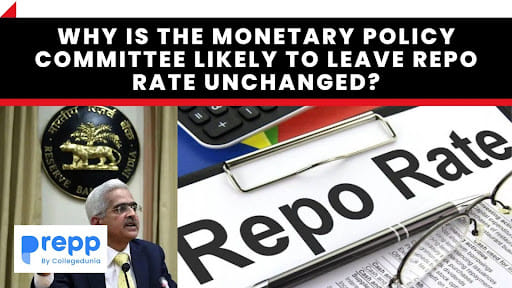
What is the Repo Rate?
- Repo rate or Re-purchase rate is the rate at which the RBI lends to other banks by buying securities based on an agreement that the bank will repurchase the securities at a later date.
- It is used by the RBI as a tool to control inflation by regulating the money supply in the economy.
- When the Repo rate is increased: Banks will have to pay higher interest to the RBI which in turn will be collected from its retail borrowers..
- Thus loans in general will become costlier.
- When the Repo rate is decreased: Banks can lower down their lending rate which is beneficial for retail loan borrowers.
- This will help improve the growth and economic development of the country.
Present conditions
- According to experts, the repo rates are unlikely to be changed by the RBI in the monetary policy committee meeting in December 2023.
- The repo rate has been unchanged at 6.5% in the last four Monetary Policy Committee meetings.
- The previous rate hike in the repo rate was in February 2023 when the repo rate was raised from 6.25% to 6.5%.
- The policy rate was raised by 250 basis points (bps) between May 2022 and February 2023.
To know more about the Repo rate, click the link.
Why is the RBI expected to keep the repo rate unchanged?
- Food inflation: The major reason for maintaining the status quo is the risk of rising inflation associated with the rise in the prices of vegetables.
- Food inflation is expected to increase as seen in the prices of onions and tomatoes, which could result in increasing inflation.
- Core inflation: Since core inflation was around 4%, it was not necessary to lower the repo rate.
- Retail inflation: Consumer price-based inflation (CPI) dropped from 5.02% in September to 4.87% in October 2023 but retail inflation was above the RBI’s target of 4%.
- The FY’24 CPI forecast is expected to remain unchanged at 5.4% due to expected volatility in food inflation in 2024.
- This has made it likely for the RBI to retain its stance of monetary policy as ‘withdrawal of accommodation’.
- This means that the money supply in the system will be reduced to control inflation.
- The RBI’s hawkish approach is likely to continue due to the indications of food price volatility.
- RBI Governor Shaktikanta Das had claimed that headline inflation was vulnerable to recurring and overlapping food price shocks despite moderating.
- The vulnerabilities were due to both global factors and adverse weather events.
- It was therefore necessary to adopt a watchful and actively disinflationary monetary policy approach while supporting growth.
- Effective rate hike: In addition to maintaining the present repo rate, experts predict that the RBI will continue with tight liquidity norms and short-term rates of around 6.85-6.90%.
- This will result in an effective rate hike.
- Growth estimates: However, the RBI is projected to increase the growth estimate for FY24 on account of the improved GDP in the second quarter (7.6%).
- The real GDP growth for FY’24 is projected at 6.5%, therefore the RBI may not revise the headline inflation (5.4%).
- The RBI will likely increase the FY’24 GDP forecast to 6.8% y-o-y from 6.5% y-o-y.
Why did the previous MPC not make changes to the policy rates?
|
Monetary Policy
Classification of Monetary Policy
To learn more, click the link Monetary Policy Committee (MPC)
Instruments of Monetary Policy Committee
Steps taken by the RBI for inflation control
|
Will the RBI change the policy stance?
- In the previous policy meeting, the RBI stated that the transmission of (250 bps hike in) the repo rate has not happened.
- It claimed that the withdrawal of the accommodation stance would continue as there was a 50 bps in the lending rates of banks.
- Lending: The weighted average lending rates (WALRs) on fresh and outstanding loans of banks increased by 187 bps and 111 bps, respectively, from May 2022 to September 2023.
- Deposits: The weighted average domestic term deposit rates (WADTDRs) on fresh and outstanding rupee deposits increased by 229 bps and 166 bps, respectively.
- Since May 2022, banks have revised their repo-linked external benchmark-based lending rates (EBLRs) in response to the 250 bps hike in policy rate.
- The one-year median marginal cost of funds-based lending rate (MCLR) increased by 152 bps from May 2022 to October 2023.
What will happen to lending rates in case of a pause by RBI?
- If the RBI maintains an unchanged policy rate (6.5%), none of the external benchmark lending rates linked to the repo rate will rise.
- This will benefit borrowers by ensuring that the cost of borrowing does not increase.
- This means that their monthly EMIs do not increase and will not discourage people from seeking new loans.
- Homebuyers are also likely to benefit from stable or unchanged interest rates as it helps them plan property purchases or refinance existing home loans.
Conclusion
- The maintenance of the status quo on the repo rate due to the risk of rising inflation due to rising vegetable prices was a reflection of its commitment to inflation management, economic resilience, and economic growth.
(*Click this link to read prelims specific weekly current affairs articles)
FAQs
Question: What is the repo rate?
Answer:
The repo rate is the rate at which the RBI lends money to commercial banks. It is used by monetary authorities as a tool to control inflation.
Question: What is a hawkish approach?
Answer:
A Hawk or an inflation Hawk is a financial policymaker who believes monetary policies should maintain high interest rates to curb inflation. They are not generally concerned with economic growth but support an economy operating at a level below its full-employment capacity.
UPSC Mains Practice Question:
|
MCQs
Question: With reference to the Indian economy, consider the following: (2015)
- Bank rate
- Open market operations
- Public debt
- Public revenue
Which of the above is/are component/ components of Monetary Policy?
(a) 1 only
(b) 2, 3 and 4
(c) 1 and 2
(d) 1, 3 and 4
Answer: (c) See the Explanation
- Monetary policy refers to the macroeconomic policy laid down by the central bank related to the management of money supply and interest rates.
- The RBI implements the monetary policy through open market operations (OMOs), bank rate policy, reserve system, credit control policy, moral persuasion, etc.
Therefore, option (c) is the correct answer.
Question: If the RBI decides to adopt an expansionist monetary policy, which of the following would it not do? (2020)
- Cut and optimize the Statutory Liquidity Ratio
- Increase the Marginal Standing Facility Rate
- Cut the Bank Rate and Repo Rate
Select the correct answer using the code given below:
(a) 1 and 2 only
(b) 2 only
(c) 1 and 3 only
(d) 1, 2 and 3
Answer: (c) See the Explanation
- The Reserve Bank of India (RBI) can adopt an expansionist monetary policy by taking the following measures:
- Cut and optimize the Statutory Liquidity Ratio (SLR): This means banks will have more money to lend, which will increase the money supply in the economy.
- Cut the Bank Rate and Repo Rate: It will become cheaper for banks to borrow from the RBI and lend to the public, which will increase the money supply in the economy.
- However, if the RBI decides to increase the Marginal Standing Facility (MSF) Rate, banks will then have less incentive to borrow from the RBI and lend to the public, which will reduce the money supply in the economy. Hence statement 3 is incorrect.
Therefore, option (c) is the correct answer.
Question: Which of the following statements is/are correct regarding the Monetary Policy Committee (MPC)? (2017)
- It decides the RBI’s benchmark interest rates.
- It is a 12-member body including the Governor of RBI and is reconstituted every year.
- It functions under the chairmanship of the Union Finance Minister.
Select the correct answer using the code given below:
(a) 1 only
(b) 1 and 2 only
(c) 3 only
(d) 2 and 3 only
Answer: (a) See the Explanation
- The Monetary Policy Committee (MPC) is a six-member body that decides the benchmark interest rates in India. Hence statement 2 is incorrect.
- The MPC was established in 2016 by amending the Reserve Bank of India Act with the primary objective of maintaining price stability in the economy. Hence statement 1 is correct.
- The MPC is an independent body and functions under the Chairmanship of the Governor of RBI. Hence statement 3 is incorrect.
Therefore, option (a) is the correct answer.
Download the PREPP App and attempt FREE IAS Exam Mock Tests and get complete study material!

Full Test - 04: UPSC CSE Prelims CSAT (Paper-II)
Full Test - 03: UPSC CSE Prelims CSAT (Paper-II)
UPSC CSE Prelims 2026 GS Paper 1 Question Paper (24-May-2026)
UPSC CSE Prelims 2026 CSAT Paper 2 Question Paper (24-May-2026)

17 February 2025 | The Hindu Must Read Articles | Current Affairs

16 February 2026 | The Hindu Must Read Articles | Current Affairs

13 February 2026 | The Hindu Must Read Articles | Current Affairs









Comments