What Is Article 99 Of The UN Charter, Invoked For The First Time In Decades As Israel Attacks Gaza
Relevance: GS2 - Important International institutions, agencies and fora- their structure, mandate.
(Source: Indian Express, 12/08/2023)
Click here for Daily Current Affairs
Why in the news?
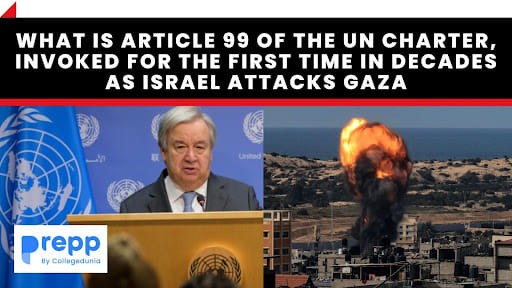
- Recently, the UN Secretary-General, Antonio Guterres, invoked Article 99 of the UN Charter to establish a ceasefire in Gaza.
- According to reports, thousands of people including women and children have been killed and more than a million people displaced in Gaza since the hostilities began in October 2023.
- The Secretary-General has repeatedly condemned the October 7 Hamas attacks that led to the deaths of more than 1,200 people, and called for the release of more than 130 people still held captive.
Table of Contents
What is Article 99 of the UN Charter?
- Article 99 of the UN Charter is related to the power of the UN Secretary-General to raise issues before the UN Security Council when necessary.
- It states that the Secretary-General may bring any matter to the attention of the Council which in the opinion of the Secretary-General may threaten the maintenance of international peace and security.
- It is a discretionary power granted to the Secretary-General by the Charter.
- As per a report of the Preparatory Commission of the United Nations (1945),
- The Secretary-General must employ political judgment, tact, and integrity when exercising their highest responsibilities under Article 99.
- When a matter is brought to the attention of the Council by the Secretary-General under Article 99, the President of the Security Council is obliged to call a meeting of the Council.
- Article 99 has been invoked very rarely over the years as it has been treated as a move of last resort.
- Previous instances of invocation of Article 99:
- Upheaval in the Republic of the Congo in 1960 post-Belgian colonial rule
- Complaint by Tunisia in 1961 against an attack by French naval and air forces
UN Charter
UN Secretary-General
|
How has it been invoked?
- Guterres wrote to the Security Council under Article 99 to raise the matter of the situation in Gaza as it might aggravate existing threats to the maintenance of international peace and security.
- He cited the appalling human suffering, physical destruction, and collective trauma that has taken place across Israel and the Occupied Palestine Territory.
- More than 15,000 people have been killed since the beginning of Israel’s military operations with 40% of the victims being children.
- The hostilities had led to the collapse of the healthcare system, compromising the ability to provide humanitarian relief, and worsening the displacement challenge.
- As a result of the constant bombardment of the region by the Israel Defense Forces, no part of Gaza was safe for civilians.
- He urged the Security Council to exert the influence and power on all parties to ensure that a humanitarian catastrophe could be averted.
- He reiterated his appeal for an urgent humanitarian ceasefire to spare the civilian population from further harm.
- The ceasefire was essential to restore the means of survival for residents and ensure that humanitarian assistance can be delivered in a safe and timely manner.
Humanitarian crisis in Israel
To learn more click the link. |
What impact could it have on the conflict?
- The UAE submitted a draft resolution based on the Secretary General’s letter demanding an immediate humanitarian ceasefire to the Gaza conflict.
- According to diplomats, the UAE aimed to put the text to a vote when the council was briefed by Guterres on Gaza.
- For the resolution to be adopted, it must receive at least nine votes in favor and no vetoes by any of the five permanent members.
- However, this is unlikely as the US and Britain, both UNSC permanent members, have expressed support for Israel’s military actions since October 7.
Other resolutions related to the conflict
- In October 2023, the UNSC failed to pass four resolutions related to allowing humanitarian access to the Gaza Strip amid the conflict.
- The U.S.A. had proposed a resolution that would have affirmed the right of member states to defend themselves against threats to peace and security posed by acts of terrorism.
- However, it was vetoed by Russia and China.
- Two resolutions proposed by Russia could not gather enough votes in favor while the Brazil-drafted resolution to allow access to the Gaza Strip for aid was vetoed by the U.S.A.
- In November 2023, the UN Security Council recommended an urgent and extended humanitarian pause and the creation of humanitarian corridors in the Gaza Strip.
- It called for all stakeholders to ensure immediate, rapid, and safe humanitarian access to the region consistent with international humanitarian law.
- It stated that UN humanitarian agencies and their implementing partners must be allowed to facilitate the continuous, sufficient, and unhindered provision of essential goods and services in the Gaza Strip.
- It also called for the unconditional and immediate release of all hostages, including children, held by Hamas and other groups.
UNSC
|
Conclusion
The invocation of Article 99 by UN Secretary-General Antonio Guterres underscores the urgency of addressing the humanitarian crisis in Gaza. The potential impact on the conflict remains uncertain, with diplomatic efforts and proposed resolutions facing challenges, emphasizing the complex nature of the situation.
(*Click this link to read prelims specific weekly current affairs articles)
FAQs
Question: What is a humanitarian pause?
Answer:
According to the UN, a humanitarian pause is a temporary cessation of hostilities for humanitarian purposes. It focuses purely on humanitarian relief, unlike a ceasefire which enables dialogue between conflict parties or the implementation of steps toward a peace agreement.
Question: What is the veto power of the UNSC?
Answer:
The UNSC veto power is the power of the five permanent members of the UNSC to strike down any "substantive" resolution. It originates in Article 27 of the UN Charter. It means that a negative vote from any of the permanent members will block the adoption of a draft resolution.
UPSC Mains Practice Question:
|
MCQs
Question: The Security Council of the UN consists of 5 permanent members, and the remaining 10 members are elected by the General Assembly for a term of (UPSC CSE 2009)
(a) 1 year
(b) 2 years
(c) 3 years
(d) 5 years
Answer: (b) See the Explanation
The ten non-permanent members are elected for two-year terms by the General Assembly with five members elected every year.
Therefore, option (b) is the correct answer.
Question: The term "two-state solution" is sometimes mentioned in the news in the context of the affairs of (UPSC CSE 2018)
(a) China
(b) Israel
(c) Iraq
(d) Yemen
Answer: (b) See the Explanation
The two-state solution demands the creation of the Palestine state in the Gaza Strip and West Bank, alongside the state of Israel as a solution to the conflict in the region.
Therefore, option (b) is the correct answer.
Download the PREPP App and attempt FREE IAS Exam Mock Tests and get complete study material!

Full Test - 04: UPSC CSE Prelims CSAT (Paper-II)
Full Test - 03: UPSC CSE Prelims CSAT (Paper-II)
UPSC CSE Prelims 2026 GS Paper 1 Question Paper (24-May-2026)
UPSC CSE Prelims 2026 CSAT Paper 2 Question Paper (24-May-2026)

17 February 2025 | The Hindu Must Read Articles | Current Affairs

16 February 2026 | The Hindu Must Read Articles | Current Affairs

13 February 2026 | The Hindu Must Read Articles | Current Affairs









Comments