G-7 Meet Appeals For Humanitarian Pauses In Gaza
(Source: The Hindu, 11/09/2023)
Click here for Daily Current Affairs
Why in the news?
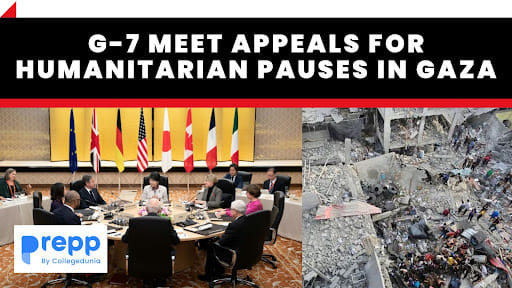
- Recently, at a meeting of G-7 Foreign Ministers in Tokyo, the grouping called for humanitarian pauses in the fighting in order to help release hostages and return to a broader peace process.
- Israel and Hamas have been lodged in conflict since Hamas launched attacks against Israel as part of Operation Toofan-Al-Aqsa.
Table of Contents
What has the G-7 joint statement said?
- Humanitarian pauses: The Foreign Ministers of the G-7 called for a humanitarian pause to the conflict in Gaza in order to permit aid and relief efforts and the return of hostages.
- Humanitarian pauses and corridors for civilian movement will help provide urgent assistance to the people in the region.
- Although Israel has said it will consider humanitarian pauses, it has along with the U.S. and other allies refused calls for a ceasefire.
- Peace process: They also sought a broader peace process in line with internationally agreed parameters.
- The members also committed to preparing sustainable long-term solutions for Gaza.
- Israel’s right to defend itself: The joint statement agreed that Israel had the right to defend itself and reiterated the need to protect civilians and obey international law.
- Two-state solution: The statement reiterated that the “two-state solution” was the only path to a just, lasting, and secure peace in the region.
- On Russia, China, North Korea: The G-7 extended its support for Ukraine in the war with Russia.
- It stressed on the need for engagement with China and condemned North Korea’s military tests and arms transfers to Russia.
Humanitarian crisis & damage
- The Israeli bombardment of Gaza in response to Operation Toofan-Al Aqsa has resulted in over 10,000 deaths over 40% of which are children.
- Displacement: The U.N. Office for the Coordination of Humanitarian Affairs claimed that over 70% of Gaza’s population has already fled their homes.
- Those fleeing consisted of mainly children, the elderly, and people with disabilities.
- Casualties: Attacks by Israel on targets within Gaza have destroyed or damaged 45% of all housing units in the Gaza Strip, internally displaced about 1.5 million people, and killed over 10,000 people, including over 80 UN staff.
- More than 2,300 people – among them 1300 children are reported missing, most of them likely trapped under the rubble.
Violation of International Laws
- Housing: According to the UN Special Rapporteur on the right to adequate housing, systematic bombardment of housing, civilian objects, and infrastructure amounts to crimes against humanity and is prohibited by international humanitarian law, criminal law, and human rights law.
- Denial of access to utilities: Israel has maintained a blockade on the Gaza Strip, thereby cutting off their access to water, food, fuel, and medicine.
- Moreover, the repeated attacks on evacuation routes and safe zones are a clear violation of international laws.
- Apartheid: Human rights organizations such as Human Rights Watch have claimed that Israel is committing crimes against humanity such as apartheid and persecution of Palestinians.
- Use of Prohibited Weapons: Israel has been alleged to have used white phosphorus in the densely populated areas of Gaza.
- It ignites when in contact with oxygen, causing horrific and severe burns and is considered a violation of International Humanitarian Laws due to the indiscriminate suffering caused by it.
- Conduct of Palestinian groups: Palestinian armed groups have been accused of war crimes for the intentional targeting of Israeli civilians, indiscriminate firing of rockets into Israel territories, and the usage of human shields.
War Crimes and Genocide
|
What are the various laws related to war crimes and genocide?
- International Humanitarian Law (IHL): It is also known as the 'law of war' or 'law of armed conflict'.
- It is a set of rules and regulations that restrict the effects of armed conflict, protect civilians during armed conflict, and prohibit deliberate attacks on civilians or civilian structures.
- It obligates armed forces to distinguish between combatants and non-combatants and minimize unnecessary suffering.
- It cites the right of prisoners of war and other detainees to humane treatment and fair trials.
- It has been codified in the form of the Geneva Convention.
- Geneva Convention: The Geneva Conventions (1949) and its Additional Protocols are international treaties that contain the most important rules limiting the barbarity of war.
- The First Geneva Convention protects wounded and sick soldiers on land during war.
- The Second Geneva Convention protects wounded, sick, and shipwrecked military personnel at sea during war.
- The Third Geneva Convention applies to prisoners of war.
- The Fourth Geneva Convention affords protection to civilians, including in occupied territory.
- Protocol I protects victims of international armed conflicts and Protocol II protects victims of non-international armed conflicts.
- India is a party to the Geneva Convention.
- Rendelic Rule: It is a standard used to judge commanders' actions.
- The military necessity of an action must be assessed on the basis of information available to them at that time not subsequently available information.
- International Covenant on Civil and Political Rights (ICCPR): It is a multilateral treaty under which parties commit to respect individuals' civil and political rights.
- It contains provisions providing a guarantee of physical integrity i.e. the right to life and freedom from torture and slavery.
- Although the ICCPR permits some restrictions during an officially proclaimed public emergency that ‘threatens the life of the nation,’ it must be limited and not involve discrimination on grounds of race, religion, and other grounds.
- Convention against Torture and Other Cruel, Inhuman or Degrading Treatment or Punishment: It is a multilateral treaty that aims to prevent torture and inhuman, cruel, or degrading punishments.
- It makes it obligatory for nations to prevent torture in all territories under their jurisdictions.
- The convention states that this prohibition remains absolute and must be upheld even in a state of war and other exceptional circumstances
- UN Genocide Convention: The Convention on the Prevention and Punishment of the Crime of Genocide is an international treaty that criminalizes genocide and obligates state parties to pursue the enforcement of its prohibitions.
- Article 2 of the Convention defines genocide as acts ‘committed with intent to destroy, in whole or in part, a national, ethnic, racial or religious group’ and outlines actions that are considered genocide.
- Rome Statute: It defines genocide and expands the list of activities considered war crimes to include willful torture, killing, forced pregnancy, unlawful deportation, confinement, etc.
- It is the treaty that established the International Criminal Court
Are these laws applicable to Israel and Gaza?
- The International Criminal Court is empowered to prosecute war crimes and genocide when local jurisdictions fail to do so.
- The cross-border attack by Hamas falls under the ICC’s jurisdiction since the group operates from a region under the ICC’s jurisdiction.
- The Court has committed to pursuing its investigations despite Israel’s refusal to cooperate.
- However, only Liechtenstein, Switzerland, and South Africa have expressed their support for the investigation.
- The ICC relies on its member nations to enforce warrants and arrest accused persons.
- Israel’s position: According to Israel, the Fourth Geneva Convention is not applicable to the West Bank since it is a ‘disputed territory’ and not an ‘occupied territory’.
- However, the ICJ has rejected this argument as both Israel and Jordan were parties to the Fourth Convention when the 1967 armed conflict broke out.
- In 2022, the Israeli Supreme Court in Abu Aram v. Minister of Defence reiterated that the Fourth Geneva Convention is not applicable to occupied territories in the West Bank but recognized the applicability of the Hague Regulations of 1907 annexed to the Convention.
- Israel has rejected the jurisdiction of the ICC by claiming that it is not a signatory to the Rome Statute, a position that is backed by the USA.
- In contrast, European governments had demanded that the ICC investigate Russian war crimes in Ukraine, despite neither Russia nor Ukraine being members of the ICC.
- Palestine’s position: Palestine was recognized as a member of the ICC in 2015 and later asked the Court to investigate Israel’s assault on Gaza in 2014 and the occupation of the West Bank and East Jerusalem.
- In 2021, the ICC ruled that it would investigate possible war crimes committed by Israel in occupied Palestinian territory and that its jurisdiction extended to all the Palestinian territories annexed by Israel after the 1967 Arab-Israeli War.
- The ICC’s chief prosecutor in 2019 stated that the building of illegal settlements in the occupied West Bank was a war crime.
- Although non-state armed actors such as Hamas cannot ratify these treaties, they are obligated to observe the norms of IHL the moment they engage in an armed conflict.
What are the long-term plans for Gaza?
- The Foreign Ministers of the G-7 countries also discussed plans for the region after the conflict recedes and steps to be taken to revitalize peace in the region.
Israel:
- Israel has not explicitly outlined its long-term plans for the Gaza region.
- Israel’s Prime Minister Benjamin Netanyahu has sought to have the security responsibility for Gaza for an indefinite period.
- The Foreign Minister of Israel has suggested two possible plans for the territory.
- It can be placed under an international coalition comprising the U.S.A., the European Union, and the Muslim-majority countries.
- It can be administered by Gazan political leaders.
U.S.A:
- U.S. Secretary of State Antony Blinken stated that Gaza could not be under either Hamas or Israeli control.
- He claimed that Israel had no intent to reoccupy Gaza.
Others:
- Diplomats from West Asia and other countries as well as the United Nations have raised the need for evolving a strategy for the post-conflict activities in Gaza. They have suggested the following steps:
- Deployment of a multinational security force
- Interim Palestinian-led administration devoid of Hamas politicians
- Interim security and governance responsibilities for the neighboring Arab states
- Temporary suspension of the Gazan territory by the United Nations
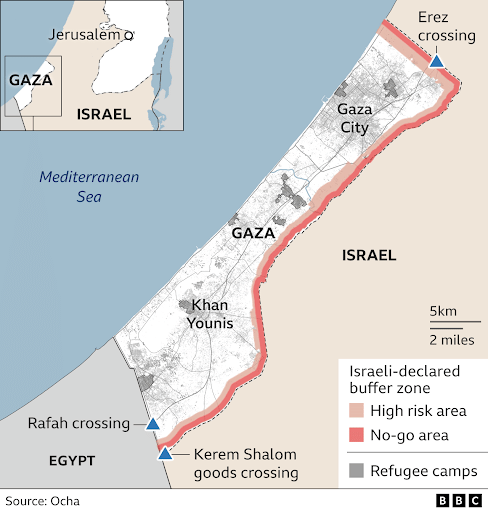
Gaza
|
(*Click this link to read prelims specific weekly current affairs articles)
FAQs
Question: What is the “two-state” solution?
Answer:
The two-state solution refers to a solution to the Israeli–Palestinian conflict in which "two states for two groups of people" will be formed. It envisages an independent State of Palestine alongside the State of Israel, west of the Jordan River. Although it has not been agreed upon by any stakeholders, it is considered the most viable option for peace in the region.
Question: What is the United Nations Office for the Coordination of Humanitarian Affairs?
Answer:
The United Nations Office for the Coordination of Humanitarian Affairs (OCHA) is a UN body established in 1991 by the UN General Assembly to strengthen the international response to complex emergencies and natural disasters. It replaced the Office of the United Nations Disaster Relief Coordinator (UNDRO).
UPSC Mains Practice Question:
|
MCQs
Question: The term "two-state solution" is sometimes mentioned in the news in the context of the affairs of (UPSC CSE 2018)
(a) China
(b) Israel
(c) Iraq
(d) Yemen
Answer: (b) See the Explanation
The two-state solution demands the creation of the Palestine state in the Gaza Strip and West Bank, alongside the state of Israel as a solution to the conflict in the region.
Therefore, option (b) is the correct answer.
Download the PREPP App and attempt FREE IAS Exam Mock Tests and get complete study material!

Full Test - 04: UPSC CSE Prelims CSAT (Paper-II)
Full Test - 03: UPSC CSE Prelims CSAT (Paper-II)
UPSC CSE Prelims 2026 GS Paper 1 Question Paper (24-May-2026)
UPSC CSE Prelims 2026 CSAT Paper 2 Question Paper (24-May-2026)

17 February 2025 | The Hindu Must Read Articles | Current Affairs

16 February 2026 | The Hindu Must Read Articles | Current Affairs

13 February 2026 | The Hindu Must Read Articles | Current Affairs









Comments