UNSC Adopts Resolution Calling For Urgent Humanitarian Pauses Throughout Gaza
Relevance: GS2 - Important International institutions, agencies and fora- their structure, mandate.
(Source: The Hindu, 11/17/2023)
Click here for Daily Current Affairs
Why in the news?
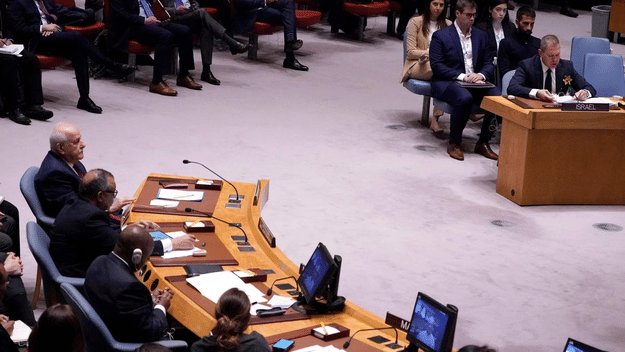
- Recently, the UN Security Council has adopted a resolution in the Israel-Hamas conflict and called for humanitarian pauses in Gaza to permit humanitarian aid to enter the region.
- The UNSC also demanded the immediate and unconditional release of all hostages held by Hamas and other groups.
What is the recent resolution of the UNSC?
- The UN Security Council has recommended an urgent and extended humanitarian pause and the creation of humanitarian corridors in the Gaza Strip.
- It called for all stakeholders to ensure immediate, rapid, and safe humanitarian access to the region consistent with international humanitarian law.
- It stated that UN humanitarian agencies and their implementing partners must be allowed to facilitate the continuous, sufficient, and unhindered provision of essential goods and services in the Gaza Strip.
- The Council also passed a resolution calling for the unconditional and immediate release of all hostages, including children, held by Hamas and other groups.
- Adoption of the resolution:
- The resolution was drafted by Malta and saw 12 countries vote in favor of the resolution.
- The United States, Russia, and the United Kingdom abstained from the resolution while none of the member countries voted against the resolution.
- The resolution was the first resolution adopted by the UNSC which mentions the word “Hamas”.
Shortcomings of the resolution
- Lack of clarity on the length of the pause: A previous version of the draft had recommended an initial pause of five consecutive days within 24 hours of the adoption of the resolution.
- However, the passed resolution does not explicitly mention the duration although UN officials claimed that the pause must be long enough for aid agencies to be able to mobilize necessary resources.
- Lack of ceasefire: The resolution does not call for an immediate ceasefire in the conflict.
- Russia has criticized this as people cannot be evacuated or provided with supplies amid a violent conflict.
- No condemnation of Hamas: The U.S.A. and the U.K. have criticized the resolution for not explicitly condemning cross-border attacks by Hamas.
Why have the U.S.A., U.K., and Russia abstained?
- U.S.A: According to the U.S. Ambassador to the UN, the USA could not vote in favor of a resolution that did not condemn Hamas or reaffirm the right of member states to respond to terrorist attacks against their citizens.
- However, the U.S.A. extended its support for the immediate and unconditional release of all hostages in the region.
- According to UN diplomats, the U.S. had opposed the use of the term “ceasefire” in all negotiations.
- U.K: The U.K.’s Permanent Representative to the UN agreed on the necessity of providing aid to the affected but regretted that it did not condemn Hamas, which was why it abstained from the resolution.
- Russia: The Russian Permanent Representative Ambassador did not vote against the resolution, despite its shortcomings, due to the urgent need for humanitarian aid.
Other resolutions in the UNSC related to the conflict
- In October 2023, the UNSC failed to pass four resolutions related to allowing humanitarian access to the Gaza Strip amid the conflict.
- The U.S.A. had proposed a resolution that would have affirmed the right of member states to defend themselves against threats to peace and security posed by acts of terrorism.
- However, it was vetoed by Russia and China.
- Two resolutions proposed by Russia could not gather enough votes in favor while the Brazil-drafted resolution to allow access to the Gaza Strip for aid was vetoed by the U.S.A.
Humanitarian crisis in Israel
|
Israel’s response to the Resolution
- Israel called for an unequivocal condemnation of Hamas.
- Israel also claimed that a humanitarian pause could not be implemented until all hostages held by Hamas were released.
UNSC
|
(*Click this link to read prelims specific weekly current affairs articles)
FAQs
Question: What is a humanitarian pause?
Answer:
According to the UN, a humanitarian pause is a temporary cessation of hostilities for humanitarian purposes. It focuses purely on humanitarian relief, unlike a ceasefire which enables dialogue between conflict parties or the implementation of steps toward a peace agreement.
Question: What is the UN charter?
Answer:
The Charter of the United Nations is the founding document of the United Nations that was signed after the United Nations Conference on International Organization. It was signed in 1945 and came into force in the same year. It is an instrument of international law by which UN Member States are bound. It codifies the major principles of international relations.
|
UPSC Mains Practice Questions Q.1) Discuss the impediments India is facing in its pursuit of a permanent seat in the UN Security Council. (UPSC GS2 2015) |
MCQs
Question: The Security Council of the UN consists of 5 permanent members, and the remaining 10 members are elected by the General Assembly for a term of (UPSC CSE 2009)
(a) 1 year
(b) 2 years
(c) 3 years
(d) 5 years
Answer: (b) See the Explanation
- The ten non-permanent members are elected for two-year terms by the General Assembly with five members elected every year.
Therefore, option (b) is the correct answer.
Question: The term "two-state solution" is sometimes mentioned in the news in the context of the affairs of (UPSC CSE 2018)
(a) China
(b) Israel
(c) Iraq
(d) Yemen
Answer: (b) See the Explanation
- The two-state solution demands the creation of the Palestine state in the Gaza Strip and West Bank, alongside the state of Israel as a solution to the conflict in the region.
Therefore, option (b) is the correct answer.
Download the PREPP App and attempt FREE IAS Exam Mock Tests and get complete study material!

Full Test - 04: UPSC CSE Prelims CSAT (Paper-II)
Full Test - 03: UPSC CSE Prelims CSAT (Paper-II)
UPSC CSE Prelims 2026 GS Paper 1 Question Paper (24-May-2026)
UPSC CSE Prelims 2026 CSAT Paper 2 Question Paper (24-May-2026)

17 February 2025 | The Hindu Must Read Articles | Current Affairs

16 February 2026 | The Hindu Must Read Articles | Current Affairs

13 February 2026 | The Hindu Must Read Articles | Current Affairs









Comments