Two Experiments Conducted By ISRO Paved Way For Gaganyaan Test Mission
Relevance: Prelims - General Science GS3 - Space Technology; Achievements of Indians in Science & Technology
(Source: The Hindu, 10/23/2023)
Click here for Daily Current Affairs
Why in the news?
- Recently, the Test Vehicle Abort Mission (TV-D1) conducted by the Indian Space Research Organisation (ISRO) on October 21 was a significant step towards the process of 'Gaganyaan' mission, which aims to send humans into orbit.
- This test followed two significant precursor missions Space Capsule Recovery Experiment and Crew Module Atmospheric Re-entry Experiment that demonstrated ISRO's proficiency in re-entry technology.
Table of Contents
About Gaganyaan Mission
- Gaganyaan mission is a space mission to demonstrate ISRO’s human spaceflight capability by launching a human crew to an orbit of 400 km and bringing them safely back to earth.
- It is India's first Human space flight mission aiming for safe transportation of astronauts to space and back.
- The cost of the project is approximately 90 billion rupees (around $1 billion).
- ISRO has designated the LVM3 rocket, which comprises solid, liquid, and cryogenic stages, as the launch vehicle for the Gaganyaan mission.
- If this mission succeeds, India will become the fourth country in the world, after the Soviet Union, the United States, and China, to send a human into space.
Objectives of Gaganyaan Mission
- The mission aims to showcase India's capability to conduct human spaceflight missions, which demonstrates the nation's advanced technology and expertise in sending humans into space.
- The mission intends to accumulate valuable experience in designing, developing, and operating human spacecraft.
- Its overarching goals is to inspire and motivate the younger generation of scientists and engineers.
- The mission provides an opportunity for international collaboration, as India seeks to work with other spacefaring nations and organizations on human spaceflight initiatives.
Stages and Milestones of Gaganyaan Mission
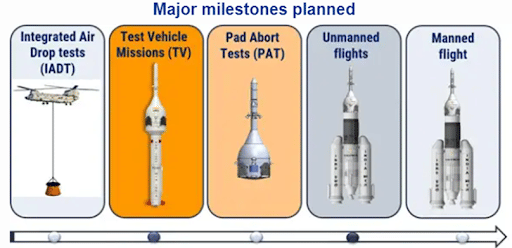
- Integrated Air Drop Test (IADT): This involved dropping a 5-ton dummy mass equivalent of the crew module from an altitude of 2.5 km, conducted by the Indian Air Force.
- Pad Abort Test (PAT): This test checks the launch abort system's capability to quickly remove the crew and spacecraft in case of a rocket failure.
- Crew Abort Test Mission: It simulates an abort condition during ascent, testing the crew escape system and module recovery through parachute deployment.
- Vyommitra: ISRO to send a humanoid robot, Vyommitra, in unmanned Gaganyaan spacecraft ahead of human spaceflight (Monitoring module parameters).
- Manned Flight: The final part of Gaganyaan where a human astronaut will be launched into space and safely returned through a soft landing in the sea.
What is Test Vehicle Abort Mission-1 (TV-D1)?
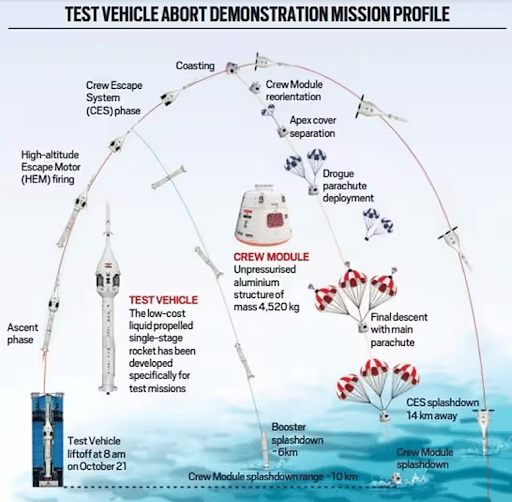
- TV-D1 was a high altitude abort test performed as part of the Gaganyaan program.
- It is the first of two abort missions to test crew safety mechanisms for the Gaganyaan mission.
- The mission comprised essential phases, including the detachment of the Crew Escape System from the Test Vehicle and the subsequent separation of the crew module.
- The TV-D1 mission was aborted at Mach number 1.2, which refers to the ratio of the velocity of an object to the velocity of sound in the surrounding medium.
- The mission's primary goal was to assess the Crew Escape System (CES) for its ability to safeguard astronauts in the event of a mission abort.
- This safety check is crucial for the upcoming Gaganyaan mission, which seeks to demonstrate the launch and safe return of three crew members from low Earth orbit, with a potential landing in either the Bay of Bengal or the Arabian Sea.
What are the forerunners to the success of the Test Vehicle Abort Mission (TV-D1)?
- Space Capsule Recovery Experiment: The first forerunner was the Space Capsule Recovery Experiment (SRE-1), which took place on January 22, 2007. The SRE satellite had been placed into orbit using a Polar Satellite Launch Vehicle (PSLV) on January 10, and it was skillfully retrieved to Earth through a sequence of controlled maneuvers and parachute deployment. This mission served as a testament to ISRO's ability to safely recover an orbiting satellite.
- Crew Module Atmospheric Re-entry Experiment: The second precursor mission was the Crew Module Atmospheric Re-entry Experiment (CARE), which was conducted on December 18, 2014. During this mission, the Launch Vehicle Mark 3 (LVM-3) inserted an uncrewed crew module into a sub-orbital altitude and executed a successful re-entry into Earth's atmosphere. The module then deployed parachutes and safely landed in the Bay of Bengal. This test served as a continued demonstration of ISRO's progress and expertise in re-entry technology.
Significance of Gaganyaan Mission for India
- Achieving Self-Reliance: The mission aligns with India's pursuit of self-reliance, in harmony with the vision of Atma Nirbhar Bharat (Self-Reliant India). It contributes to boosting India's capacity to launch satellites, a vital aspect of space technology, which supports the Make in India Initiative.
- Advancing Research and Development: Gaganyaan will play a pivotal role in advancing research and development (R&D) efforts, particularly in the space sector. This mission represents India's commitment to pushing the boundaries of scientific and technological knowledge, furthering its capabilities in space exploration.
- Human and Robotic Exploration: The mission aligns with India's broader goals of pursuing both human and robotic programs for exploring not only the solar system but also beyond. It underscores India's ambition to engage in sustained, cost-effective endeavors that involve both human and robotic exploration.
- Catering to Regional Needs: It emphasizes the need to cater to regional requirements, recognizing that a single International Space Station (ISS) may not adequately serve the global demand for space research and development.
- Strengthening International Collaborations: The Gaganyaan program fosters stronger international partnerships in space exploration. By pursuing challenging and peaceful objectives, it promotes global security and cooperation, underlining India's commitment to contributing to shared space exploration goals.
Conclusion
The Gaganyaan mission represents a significant step in India's space exploration endeavors. With clear objectives to demonstrate human spaceflight capabilities, accumulate vital experience, establish the necessary infrastructure, and inspire future generations of scientists and engineers, the mission showcases India's commitment to advancing its presence in space exploration.
(*Click this link to read prelims specific weekly current affairs articles)
FAQs
Question: What is Gaganyaan?
Answer:
Gaganyaan is India's first Human space flight mission aiming for safe transportation of astronauts to space and back. The spacecraft is being developed by the Indian Space Research Organisation (ISRO).
Question: What is ISRO?
Answer:
The Indian Space Research Organisation is the national space agency of India. It operates as the primary research and development arm of the Department of Space, which is directly overseen by the Prime Minister of India.
Question: What is TV-D1?
Answer:
The Test Vehicle is a single-stage liquid rocket developed for this abort mission. The payloads consist of the Crew Module (CM) and Crew Escape Systems (CES) with their fast-acting solid motors, along with CM fairing (CMF) and Interface Adapters.
UPSC Mains Practice Question:
|
Download the PREPP App and attempt FREE IAS Exam Mock Tests and get complete study material!

Full Test - 04: UPSC CSE Prelims CSAT (Paper-II)
Full Test - 03: UPSC CSE Prelims CSAT (Paper-II)
UPSC CSE Prelims 2026 GS Paper 1 Question Paper (24-May-2026)
UPSC CSE Prelims 2026 CSAT Paper 2 Question Paper (24-May-2026)

17 February 2025 | The Hindu Must Read Articles | Current Affairs

16 February 2026 | The Hindu Must Read Articles | Current Affairs

13 February 2026 | The Hindu Must Read Articles | Current Affairs









Comments