Have Earnings Grown Post-Pandemic?
Prepp Prelims Booster: Unemployment rates, Labor force participation rates (LFPRs), Periodic Labour Force Survey (PLFS)
Prepp Mains Booster: Indian Economy and issues relating to Planning, Mobilization of Resources, Growth, DevelopmentandEmployment
Why in the news?
- Data from the Periodic Labour Force Survey (PLFS) 2022-23 shows a strengthening of the labour market post-pandemic, with falling unemployment rates and rising labour force participation rates (LFPRs).
- A notable highlight is the significant jump in Rural women's LFPRs from 19.7% in 2018-19 to 41.5% in 2022-23.
Table of Contents
Periodic Labour Force Survey (PLFS)
Labour Force Participation Rates (LFPRs)
|
Key Takeaways from the Survey
1) Employment Patterns
- Labour Market Strengthening: There is an observable strengthening in the labour market, characterized by decreasing unemployment rates and increasing labour force participation rates (LFPRs).
- Rural Women's Participation: A significant jump was noted in LFPRs for rural women aged 15 and above, from 19.7% in 2018-19 to 41.5% in 2022-23. This indicates a major shift for a cohort previously marginalized in the labour market.
- Nature of Employment: A significant proportion of the new employment generated for women is in the realm of self-employment. Additionally, there has been an upward trend in women working as unpaid family helpers.
- Decline in Regular Wage Work: The share of women engaged in regular wage work fell from 22% to 16%, raising concerns about the quality and stability of the jobs created.
2) Earnings vs. Inflation
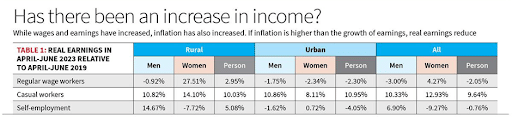
- Wage Growth: Wages and earnings have seen an increase across various segments of the workforce.
- Inflation's Erosion: The concurrent high inflation has diminished the real earnings, thus affecting the purchasing power of individuals. If inflation surpasses earnings growth, the real income and purchasing power of individuals reduce.
3) Status of Earnings
- Casual Workers' Earnings: Between 2019 and 2023, casual workers (both genders, across rural and urban areas) witnessed a net increase in their average real monthly earnings.
- Specifically, female casual workers experienced a 13% increase over the period, and male casual workers observed a 10.33% growth.
- Regular Wage Workers and Self-employed: The only other segments witnessing a growth in real earnings in 2023, compared to 2019, were women in regular wage work (with a 4.27% increase) and male self-employed workers (with a 6.9% growth).
- Rural vs. Urban Disparities: Urban male self-employed workers saw a drop in real earnings. In contrast, their rural counterparts witnessed a considerable increase in real earnings by about 14.67% in 2023 compared to 2019.
- However, rural women in regular wage employment experienced the most substantial growth in real earnings, with a remarkable 27.5% increase.
4) Impact of Inflation
- Rural Women in Self-employment: The largest decline in real earnings due to inflation was observed in this group, where their average monthly real gross earnings reduced by 7.72%.
- Moderation of Inflation: By 2023, inflation began to moderate, leading to a gradual increase in real incomes for most cohorts. Between 2022 to 2023, almost all groups (except urban women casual workers) witnessed a rise in real earnings.
- Real Earnings Growth: During 2022 to 2023, wage workers, in general, saw their real earnings grow at a rate slower than the national output, suggesting that even as the economy grew, the share of wages did not grow proportionally.

What is Inflation?
|
Comparative Analysis of Labour Market
| Parameter | Before Pandemic | After Pandemic |
|---|---|---|
| Economic Growth |
|
|
| Employment |
|
|
| Earnings |
|
|
| Sectoral Variances / Impact of Inflation |
|
|
What is a K-Shaped Recovery?
- A K-shaped recovery is an economic term used to describe a situation where different parts or sectors of the economy recover at different rates, times, or magnitudes.
- This kind of recovery is characterized by the performance of various industry sectors, with some seeing a sharp rebound and growth (similar to the upward arm of the letter 'K') while others continue to decline or stagnate (similar to the downward arm of the letter 'K').
- For instance, after the COVID-19 pandemic, sectors like technology and software services saw significant growth due to increased demand for digital services, remote work, and online shopping. Conversely, sectors like travel, tourism, and hospitality faced prolonged downturns.
- Understanding the concept of a K-shaped recovery is vital because it highlights the uneven nature of economic recoveries and the potential long-term implications of such disparities on income inequality, societal harmony, and political stability.
Way Forward
Promotion of Gender Equality
- The government and private sectors should promote programs that offer equal opportunities and fair wages for both genders.
- Support for female entrepreneurship should be prioritized, considering a significant number of rural women are moving towards self-employment.
Reviewing and Regulating Informal Employment
- With a rising number of women working as unpaid family helpers and a decrease in regular wage work for women, it's crucial to address this issue.
- Steps should be taken to formalize and recognize unpaid family work.
- Training programs can be introduced to equip these women with the skills needed for more stable and well-paying jobs.
Tackling Inflation
- Monetary and fiscal policies should be evaluated and optimized to ensure that inflation doesn't negate earnings growth.
Addressing Disparities Between Urban and Rural Earnings
- Given the differences between urban and rural sectors, policies should be tailored to address the unique challenges faced by each sector.
- The significant increase in earnings for rural women in regular wage work can serve as a case study to implement similar initiatives in other sectors.
Evaluating the True Earnings of Self-employed Individuals
- It's essential to have a clear picture of earnings for the entire population of self-employed individuals, including those who report zero incomes.
Sustained Recovery and Growth
- While there's a positive sign with the increase in real earnings for most cohorts in 2022-2023, consistent monitoring and policy adjustments are necessary to ensure this isn't a short-term surge.
Focus on Wage Growth Relative to GDP Growth
- Given that only a few cohorts experienced earnings growth faster than the GDP growth rate, there should be an emphasis on ensuring that as the country grows, its citizens, especially wage workers, also experience proportional growth in their earnings.
Engaging Stakeholders in Dialogue
- The government, businesses, trade unions, and worker associations should engage in dialogue to address the concerns highlighted from time to time.
- Their collective efforts can yield policies and initiatives that directly tackle the root causes of the issues.
Enhanced Skill Development and Training
- Given the dynamics of the post-pandemic world, it's crucial to ensure that the workforce is equipped with the skills required for the current job market.
- Government and private sector partnerships can establish training programs targeting the needs of different cohorts, especially those lagging in earnings growth.
Conclusion
Post the pandemic, while the labor market indicators like unemployment and LFPR have shown positive signs, the nature and quality of employment, particularly for women, raise concerns. Furthermore, while some segments of the workforce experienced growth in real earnings, inflation has been a dampening factor, eroding the purchasing power of many. The divergence in recovery among different cohorts in the labor market further hints at a K-shaped recovery, where the benefits of economic growth are not evenly distributed.
(*Click this link to read prelims specific weekly current affairs articles)
FAQs
Question: What is inflation?
Answer:
Inflation refers to the rate at which the general level of prices for goods and services rises, leading to a decrease in the purchasing power of money. It means that each unit of currency buys fewer goods and services than it did in prior periods. Inflation is usually measured as an annual percentage increase in the Consumer Price Index (CPI) or the Wholesale Price Index (WPI).
Question: What is a K-shaped recovery?
Answer:
A K-shaped recovery is an economic term used to describe a situation where different parts or sectors of the economy recover at different rates, times, or magnitudes. This kind of recovery is characterized by the performance of various industry sectors, with some seeing a sharp rebound and growth (similar to the upward arm of the letter 'K') while others continue to decline or stagnate (similar to the downward arm of the letter 'K').
Question: What is Labour Force Participation Rate (LFPR)?
Answer:
Labour Force Participation Rate (LFPR) is a crucial indicator in labor market studies and represents the proportion of a country's working-age population that is either employed or actively seeking employment. LFPR is defined as the ratio of the labour force to the working-age population. The labour force includes both the employed (those who have jobs) and the unemployed (those who are actively seeking jobs).
LFPR = (Labour Force / Working Age Population) ×100
UPSC Mains Practice Question:
|
MCQs
Question: Increase in absolute and per capita real GNP do not connote a higher level of economic development, if (UPSC 2018)
(a) industrial output fails to keep pace with agricultural output.
(b) agricultural output fails to keep pace with industrial output.
(c) poverty and unemployment increase.
(d) imports grow faster than exports.
Answer: (c) See the Explanation
Economic growth is characterized by an increase in real national income/national production. It entails an improvement in the quality of life and living standards, such as literacy, life expectancy, and health-care services.
Economic development occurs when a country experiences various economic changes, such as a reduction in poverty and unemployment, a reduction in income and wealth inequality, an increase in literacy rate, an improvement in health and hygiene, and so on, that improve the quality of life.
Therefore, option (c) is the correct answer.
Question: Disguised unemployment generally means (UPSC 2013)
(a) large number of people remain unemployed
(b) alternative employment is not available
(c) marginal productivity of labour is zero
(d) productivity of workers is low
Answer: (c) See the Explanation
Disguised unemployment is a phenomenon in which more individuals are employed than are required. It is largely found in India's agricultural and unorganized sectors. The labour’s marginal productivity is zero.
Therefore, option (c) is the correct answer.
Question: Which of the following cohorts saw a net increase in their average real monthly earnings between 2019 and 2023?
(a) Urban male self-employed workers
(b) Rural women in regular wage work
(c) Casual workers (both men and women)
(d) Urban women in regular wage work
Answer: (c) See the Explanation
Between 2019 and 2023, only casual workers — both men and women, across both rural and urban sectors — saw a net increase in their average real monthly earnings.
Therefore, option (c) is the correct answer.
Download the PREPP App and attempt FREE IAS Exam Mock Tests and get complete study material!

Full Test - 04: UPSC CSE Prelims CSAT (Paper-II)
Full Test - 03: UPSC CSE Prelims CSAT (Paper-II)
UPSC CSE Prelims 2026 GS Paper 1 Question Paper (24-May-2026)
UPSC CSE Prelims 2026 CSAT Paper 2 Question Paper (24-May-2026)

17 February 2025 | The Hindu Must Read Articles | Current Affairs

16 February 2026 | The Hindu Must Read Articles | Current Affairs

13 February 2026 | The Hindu Must Read Articles | Current Affairs









Comments