Tripartite Struggle - Medieval India History Notes
Tripartite Struggle took place between three great Indian dynasties – the Palas, the Pratiharas and Rashtrakutas in 8th and 9th centuries for control over the Kannauj area of northern India struggle is also known as the Kannauj Triangle Wars.
The Palas ruled India's eastern regions (Bengal region), while the Pratiharas oversaw India's western regions (Avanti-Jalaor region) and the Deccan area of India was dominated by the Rastrakutas. This war lasted for two centuries and was finally won by the Rajput Pratihara emperor Nagabhata II, who established the city as the capital of the Pratihara state, which ruled for nearly three centuries. This article will explain to you the Tripartite struggle which will be helpful in History preparation for the UPSC Civil service exam.
|
Table of Contents |

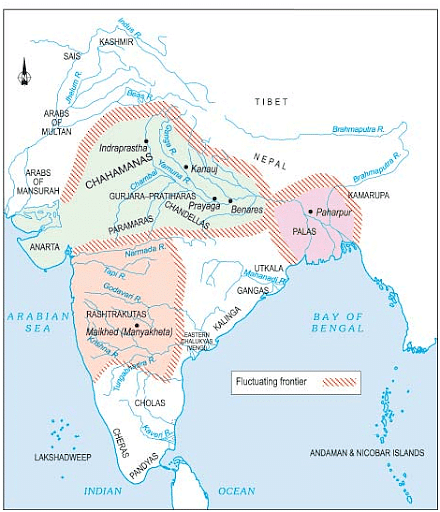
Causes of Tripartite Struggle
- During the early medieval period, Kannauj was seen as a sign of status and authority.
- Kannauj was the former capital of Harshvardhana's empire and control of it represented the political domination over northern India.
- Control of Kannauj also meant control of the Central Gangetic valley, which was rich in resources and hence strategically and commercially significant.
- Because it was connected to the silk road, this location was ideal for trade and commerce.
- Between the end of the eighth century and the first quarter of the ninth century, three kings ruled over Kannauj: Indrayudha, Vijrayudha, and Chakrayudha.
- These kings were very weak and could be easily defeated.
- The desire to plunder through warfare attracted the Rashtrakutas to Kannauj.
Tripartite Struggle - Phase I
- A tripartite struggle occurred between the Pala, Prathihara, and Rashtrakuta dynasties for control of Kanauj.
- The first phase of the tripartite struggle began around 790 AD with a clash between Dharmapala and Vatsaraja.
- The battle between Dharmapala and the Pratihara king Vatsaraja at Prayag resulted in the defeat of Dharmapala.
- After some time Vatsaraja was defeated by Rashtrakuta king Dhruva.
- Dharmapala took control of Kannauj after Vatsaraja's fall, but he was again defeated by Dhruva.
- Dhruva, on the other hand, was unable to consolidate his victory because he needed to return to the south to save his own kingdom.
- Rashtrakutas were devastated by a succession struggle after Dhruva's death in 793 CE.
- By quickly withdrawing from Northern India, the Rashtrakutas not only decimated the Palas' adversaries, the Pratiharas but also provided the Palas with a good opportunity to add to their might.
- Dharmapala took advantage of the situation and recovered Kannauj, putting Chakrayudha on the throne.
- Dharmapala, via a series of successful expeditions, established himself as the lord of virtually all of Northern India.
Tripartite Struggle - Phase II
- Pratihara ruler Nagabhatta II, the successor of Vatsaraja, invaded Kanauj and expelled its ruler Chakrayudha and established control there.
- As Chakrayudha was Dharmapala's protege, a battle between Nagabhatta II and Dharmapala was inevitable.
- Nagabhatta II defeated Dharmapala in a battle near Munger.
- After Nagabhata II took possession of Kannauj, the battle for the city intensified.
- His victory was short-lived, as he was soon overthrown by Govinda III (Rashtrakuta king), the successor of Dhruva.
- Govinda III left for the Deccan soon after this victory.
- By the end of the 9th century, the Rastrakutas' power had begun to wane alongside that of the Palas.
- The Pratiharas emerged victoriously and established themselves as the rulers of central India by the end of the tripartite struggle.
Conclusion
The tripartite conflict between the three great Indian dynasties, the Palas, the Pratiharas, and the Rashtrakutas, for control over the Kannauj area, lasted for two centuries. In the end, Pratiharas emerged victoriously and established themselves as the rulers of central India. However, tripartite struggle rendered all three dynasties feeble. This led to the country's political breakdown, which aided the Middle Eastern Islamic invaders.
FAQs
Question: What was the Tripartite Struggle in medieval India?
Answer: The Tripartite Struggle refers to the long-standing conflict between the Gurjara-Pratiharas, Palas, and Rashtrakutas over the control of the strategic city of Kannauj during the 8th–10th centuries.
Question: Why was Kannauj important in the Tripartite Struggle?
Answer: Kannauj was important because of its strategic location on major trade routes and its symbolic significance. Controlling Kannauj was seen as a mark of imperial power, making it a coveted city for the ruling dynasties.
Question: Which dynasties were involved in the Tripartite Struggle?
Answer: The three main dynasties involved in the Tripartite Struggle were the Gurjara-Pratiharas, Palas, and Rashtrakutas.
Question: Who were the key leaders of the Gurjara-Pratiharas during the Tripartite Struggle?
Answer: The key leaders of the Gurjara-Pratiharas during the struggle were Nagabhata I, Mihira Bhoja, and Mahendrapala.
Question: How did the Tripartite Struggle affect the political scenario of medieval India?
Answer: The constant warfare among the three dynasties for the control of Kannauj weakened their overall power, leading to a decline in their dominance and enabling the rise of new regional powers in India.
MCQs
- Which three dynasties were involved in the Tripartite Struggle for control of Kannauj?
A. Cholas, Palas, and Pratiharas
B. Gurjara-Pratiharas, Rashtrakutas, and Palas
C. Rajputs, Chalukyas, and Pratiharas
D. Palas, Rashtrakutas, and Chalukyas
Answer: (B) See the Explanation
The Tripartite Struggle involved the Gurjara-Pratiharas, Rashtrakutas, and Palas. These three dynasties fought for control of the highly coveted region of Kannauj from the 8th to the 10th centuries. The struggle was marked by frequent wars and shifting power dynamics between these kingdoms.
- Why was Kannauj a contested region during the Tripartite Struggle?
A. It was the birthplace of the Gurjara-Pratiharas
B. It was strategically located and controlled important trade routes
C. It was a religious center for all three dynasties
D. It was a major port city on the west coast
Answer: (B) See the Explanation
Kannauj was a coveted region because of its strategic location. It controlled important trade routes that connected northern India to the rest of the subcontinent, making it a valuable political and economic center. The prestige associated with controlling Kannauj also played a significant role in the dynasties' aspirations.
- Which dynasty emerged in eastern India and participated in the Tripartite Struggle?
A. Chalukyas
B. Palas
C. Cholas
D. Rajputs
Answer: (B) See the Explanation
The Pala dynasty, which originated in eastern India (modern-day Bengal and Bihar), was a key participant in the Tripartite Struggle. Rulers like Dharampala and Devapala sought to expand their influence into northern India and gain control over Kannauj.
- Which of the following was a key ruler of the Rashtrakutas during the Tripartite Struggle?
A. Mihira Bhoja
B. Govinda III
C. Devapala
D. Gopala
Answer: (B) See the Explanation
Govinda III of the Rashtrakuta dynasty was one of the major rulers who played an important role in the Tripartite Struggle. His military campaigns against the Pratiharas and Palas allowed the Rashtrakutas to gain temporary control over Kannauj during his reign.
- What was the ultimate outcome of the Tripartite Struggle?
A. Kannauj remained under Pala control
B. The Pratiharas emerged victorious but weakened
C. The Rashtrakutas dominated northern India
D. Kannauj was abandoned as a capital
Answer: (B) See the Explanation
Although the Pratiharas emerged as the dominant power in Kannauj by the end of the Tripartite Struggle, the continuous warfare weakened all three dynasties involved. This weakening paved the way for the rise of other regional powers in northern India.
GS Mains Questions and Model Answers
Q1: Discuss the significance of the Tripartite Struggle in shaping the political landscape of medieval northern India.
Answer: The Tripartite Struggle was a defining conflict during the early medieval period that involved the Gurjara-Pratiharas, Palas, and Rashtrakutas. The struggle was primarily for control over Kannauj, a strategic and symbolically important city due to its location on major trade routes. The constant warfare weakened all three dynasties, limiting their ability to dominate northern India for an extended period. This power vacuum eventually facilitated the rise of regional kingdoms such as the Rajputs in northern India and the Cholas in the south. Additionally, the Pratiharas, who emerged victorious, were too weakened to sustain their dominance, signaling the end of their imperial ambitions. The Tripartite Struggle thus highlights the importance of Kannauj in medieval Indian politics and how competition for power fragmented the region.
Q2: Analyze the role of Kannauj in the Tripartite Struggle and its geopolitical importance in medieval India.
Answer: Kannauj was at the heart of the Tripartite Struggle due to its geopolitical significance. Located on major trade routes, it served as a central hub for both economic and political power in northern India. Control over Kannauj was seen as a symbol of imperial legitimacy and political dominance. For the Pratiharas, Palas, and Rashtrakutas, capturing Kannauj was a strategic necessity to secure trade revenues and strengthen their influence across the subcontinent. The continuous conflict over this city not only drained the resources of the competing dynasties but also destabilized northern India, weakening the region’s ability to resist external threats. As a result, Kannauj became a focal point in the larger narrative of Indian medieval history, where control of key cities could determine the rise or fall of empires.
Q3: Discuss the impact of the tripartite struggle among the Rajputs, Cholas, and the Turks on the political landscape of medieval India. How did this struggle influence regional power dynamics and cultural developments?
Answer: The tripartite struggle in medieval India, primarily involving the Rajputs, Cholas, and Turks, had profound implications for the political landscape and cultural developments of the time.
Impact on Political Landscape:
1. Fragmentation of Power: The competition among these powers led to the fragmentation of political authority in northern and southern India. The Rajputs, with their numerous kingdoms, fought to expand their territories, while the Cholas were notable for their naval prowess and control over trade routes in the south. The Turks, particularly under leaders like Mahmud of Ghazni and later the Delhi Sultanate, aimed to establish a foothold in India, leading to constant military engagements.
2. Shifts in Allegiances: Alliances were frequently formed and broken. Rajput clans often allied with the Cholas against common enemies, such as the invading Turks. Conversely, the Turks would sometimes forge temporary alliances with Rajput states to gain leverage. This fluidity of alliances shaped the geopolitical scenario and created an atmosphere of mistrust and rivalry.
3. Rise of New Powers: The ongoing conflict allowed for the rise of new regional powers. For instance, as the Rajputs and Cholas fought against the Turks, other regional kingdoms such as the Vijayanagara Empire emerged, capitalizing on the chaos to establish their dominance in the southern and central parts of India.
Influence on Cultural Developments:
1. Cultural Synthesis: The interactions between these diverse groups led to a rich cultural synthesis. The Rajputs, known for their valor, contributed to the development of unique art forms and architectural styles, while the Cholas influenced temple architecture and sculpture. The Turks introduced Persian culture, language, and administrative practices, which gradually melded with local traditions.
2. Religious and Philosophical Exchange: The struggle facilitated a cross-pollination of ideas, leading to the evolution of various religious practices. The period saw the flourishing of Bhakti and Sufi movements, which promoted inclusivity and syncretism, often transcending the boundaries set by regional and sectarian divisions.
3. Literary Growth: The tensions and interactions between these groups also spurred literary advancements. The Rajput courts became centers of poetry and storytelling, while Chola courts patronized literature in Tamil. The Turks contributed to Persian literature, which later influenced Indian languages and literary traditions.
Previous Year Questions on the Tripartite Struggle
1. UPSC CSE Prelims 2017
Question: Which of the following was NOT a participant in the Tripartite Struggle?
A. Gurjara-Pratiharas
B. Rashtrakutas
C. Chalukyas
D. Palas
Answer: C
Explanation: The Chalukyas were not part of the Tripartite Struggle. The main participants were the Gurjara-Pratiharas, Rashtrakutas, and Palas, who fought over the control of the city of Kannauj.
2. UPSC CSE Prelims 2019
Question: The Tripartite Struggle was primarily fought for control over which of the following cities?
A. Delhi
B. Ujjain
C. Kannauj
D. Patliputra
Answer: C
Explanation: The Tripartite Struggle was a prolonged conflict between the Gurjara-Pratiharas, Palas, and Rashtrakutas over the control of Kannauj. The city held significant strategic and economic importance during the early medieval period in India.
3. UPSC CSE Mains 2018 (GS Paper 1)
Question: "The Tripartite Struggle significantly impacted the political landscape of northern India in the early medieval period." Discuss the causes, events, and consequences of the Tripartite Struggle.
Answer:
- Causes: Strategic importance of Kannauj, control of trade routes, and regional dominance.
- Key events: Military campaigns by the Gurjara-Pratiharas, Palas, and Rashtrakutas to capture and hold Kannauj.
- Consequences: Weakened all three dynasties, paved the way for the rise of Rajput kingdoms and other regional powers. The decline of these dynasties facilitated the growth of smaller, more decentralized states in northern and central India.
4. UPSC CSE Mains 2016 (GS Paper 1)
Question: Analyze the significance of the Tripartite Struggle in shaping the political dynamics of medieval India. How did the struggle impact the rise of regional powers?
Answer:
- Political significance: Struggle for Kannauj, the symbolic and strategic importance of controlling trade routes and political dominance.
- Impact on regional powers: Decline of central powers (Pratiharas, Palas, Rashtrakutas) allowed Rajputs and other smaller kingdoms to rise.
- Decentralization: Weakened dynasties enabled more localized rulers to establish control, leading to the fragmented political scenario in medieval India.
Download the PREPP App and attempt FREE IAS Exam Mock Tests and get complete study material!

Full Test - 04: UPSC CSE Prelims CSAT (Paper-II)
Full Test - 03: UPSC CSE Prelims CSAT (Paper-II)
UPSC CSE Prelims 2026 GS Paper 1 Question Paper (24-May-2026)
UPSC CSE Prelims 2026 CSAT Paper 2 Question Paper (24-May-2026)

17 February 2025 | The Hindu Must Read Articles | Current Affairs

16 February 2026 | The Hindu Must Read Articles | Current Affairs

13 February 2026 | The Hindu Must Read Articles | Current Affairs









Comments