The Contours Of India’s ‘Formal Jobs’ Crisis
Relevance: GS3 - Indian Economy and issues relating to planning, mobilization, of resources, growth, development and employment.
(Source: The Hindu, 08/03/2023)
Click here for Daily Current Affairs
Why in the news?
- The article published in The Hindu on 3rd August 2023 discussed the jobs crisis in India based on data from the EPFO which the Indian government has been using as a measure of payroll employment and formal job creation since 2017.
- The monthly data has indicated a net increase in the number of contributors which is considered to be evidence of employment creation.
- However, there are numerous reports of unemployment and job scarcity in various parts of the country.
Table of Contents

Why is this data misleading?
- The EPF Organisation’s (EPFO) annual reports reveal that the number of regular contributors to the scheme has remained relatively stagnant or even declined in recent years.
- However, EPF monthly enrolment data depicts an increase in contributors.
- Regular contributors increased from 30.9 million to 46.3 million between 2012 and 2022.
- Regular contributors are those enrolled employees whose PF contributions are made on a regular basis during the year.
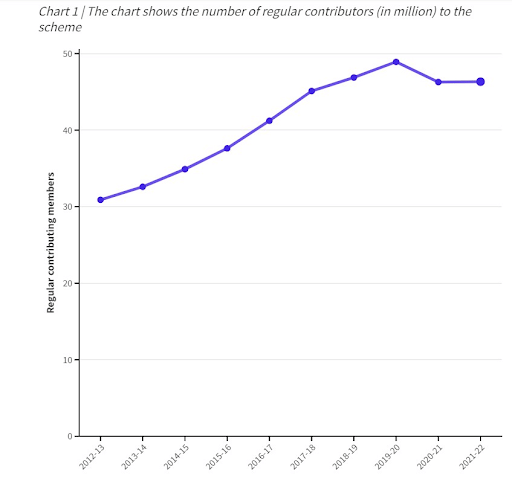
- The number of contributors increased around 2016-17, due to the Indian government encouraging firms with private PFs to join the government’s EPF and introducing other incentive schemes that paid the employer’s share of PF contributions.
- However, growth in regular contributors slowed down significantly since then due to the stabilization of the effects of such incentives and firm enrolments.
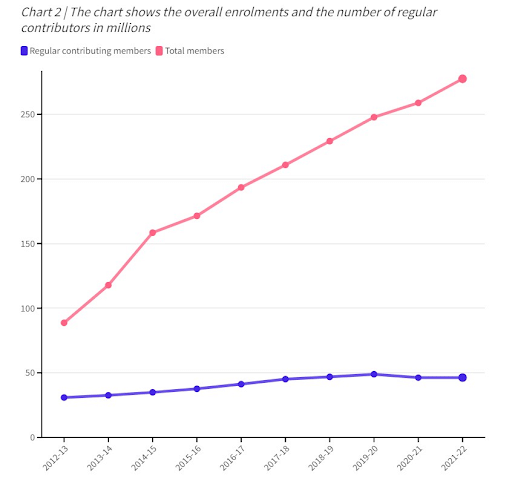
- Between 2017 and 2022, the number of regular contributors increased only from 45.11 million to 46.33 million while overall enrolments increased from 210.8 million to 277.4 million.
- During the pandemic, the number of EPF contributors declined and formal employment stagnated.
Nature of employment
- Although the total number of EPF enrolments increased by around 67 million, regular contributors increased by only 1.2 million in the same period.
- The number of people enrolled in the EPF is generally higher than regular contributors due to duplication and old membership data.
- If the EPF data is used as an indication of formal employment, only net 1.2 million formal jobs have been created in the past five years while labor participation estimates indicate that 20-25 million new participants entered the Indian labor market.
- The majority of enrolments into the EPF are from temporary or casual jobs where PF contributions are irregular.
- The Indian economy is therefore creating jobs, but they are not formal, regular, or well-paid jobs with long-term prospects.
- Formal employment in India has become increasingly standardized in terms of EPF enrolment, with limited levels of new formal job creation.
- The government's incentivization of employer PF shares means that smaller firms and employers have begun enrolling their employees into the EPF scheme to avail of its benefits and reduce their wage expenditures.
- However, many of these incentives are applicable only to employees earning ₹15,000 or less per month.
- As a result of these schemes, wage levels have stagnated around this wage level.
How has this affected the middle class?
- India, which is the most populous country in the world, requires good-quality employment to meet the needs of its increasingly educated and growing working-age population.
- Therefore, the relative absence of formal, well-paid, regular employment in the country inhibits the growth of the middle class, which was a crucial factor in China’s economic growth.
- The presence of more over-qualified youth and few jobs is a stark contrast with official claims of strong economic growth.
Initiatives
- The government has recognized the employment crisis in the country and implemented Rozgar Melas, public sector recruitment drives, and factory incentives to internationalize skills transferability and worker mobility.
Criticism
- The EPFO used to publish information on regular contributors on a monthly basis.
- However, this was stopped altogether over concerns about its accuracy.
- The government has been accused of neglecting other sources of formal employment and labor data like the employment market data of the Directorate General of Employment and Training (DGET)
- The Reserve Bank of India utilized the DGET data as the main source for formal sector employment numbers and related calculations in the country
Conclusion
- The EPF scheme has the potential to be a viable alternative to assess payroll employment but it requires significant standardization and de-duplication.
- A single data source is insufficient to understand formal employment and jobs in the country which needs a wide range of standardized, stable, and public labor statistics.
- Recent Indian governments have been criticized as ignoring other labor and employment statistical sources which has impacted its decision-making.
To know more about the changing structure of employment in India click the link.
(*Click this link to read prelims specific weekly current affairs articles)
FAQs
Question: What is the EPFO?
Answer:
The Employees' Provident Fund Organisation or EPFO is a non-constitutional body under the Union Ministry of Labour and Employment. It was launched in 1951 to promote a saving habit for retirement among employees. It is responsible for the regulation and management of provident funds in India.
Question: What is the Directorate General of Employment and Training (DGET)?
Answer:
The Directorate General of Employment and Training (DGET) is the apex organization for development and coordination at the National level for programs related to the National Employment Service. It is an attached office of the Ministry of Labor and Employment headed by the Additional Secretary (Labour & Employment) and Director General of Employment.
MCQs
Question: With reference to the Indian economy after the 1991 economic liberalization, consider the following statements: (UPSC CSE 2020)
- Worker productivity (` per worker at 2004-05 prices) increased in urban areas while it decreased in rural areas.
- The percentage share of rural areas in the workforce steadily increased.
- In rural areas, the growth in the non-farm economy increased.
- The growth rate in rural employment decreased.
Which of the statements given above is/are correct?
(a) 1 and 2 only
(b) 3 and 4 only
(c) 3 only
(d) 1, 2, and 4 only
Answer: (b) See the Explanation
- Agriculture and Allied Activities which account for over 56% of the workforce, has the lowest GVA per worker. Hence statement 1 is incorrect.
- The occupational structure in the country has changed with the percentage share of the labour-force in the agricultural sector declining and that of the services sector rising. Hence statement 2 is incorrect.
- According to the Economic Census of India, around 41.89 million rural people were employed in non-agricultural establishments which grew by 4.56 % between 1998 and 2005. Hence statement 3 is correct.
- Steady urbanization has led to the decline of the share of the rural population, in the workforce and GDP of the country. Hence statement 4 is correct.
Therefore, option (b) is the correct answer.
Download the PREPP App and attempt FREE IAS Exam Mock Tests and get complete study material!

Full Test - 04: UPSC CSE Prelims CSAT (Paper-II)
Full Test - 03: UPSC CSE Prelims CSAT (Paper-II)
UPSC CSE Prelims 2026 GS Paper 1 Question Paper (24-May-2026)
UPSC CSE Prelims 2026 CSAT Paper 2 Question Paper (24-May-2026)

17 February 2025 | The Hindu Must Read Articles | Current Affairs

16 February 2026 | The Hindu Must Read Articles | Current Affairs

13 February 2026 | The Hindu Must Read Articles | Current Affairs









Comments