Government Schools In Bihar In Danger Of Being Replaced By Cheap, Dingy Tuition Centres: Report
Relevance: GS2 - Issues relating to development of Education
(Source: The Hindu, Down to Earth, 08/05/2023)
Why in the news?
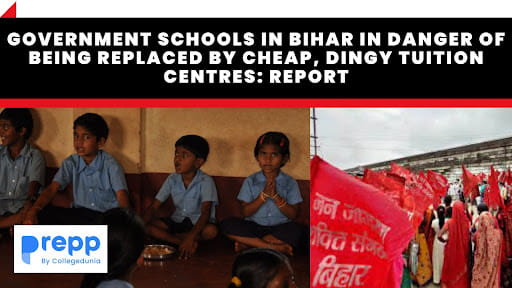
- Recently, a survey conducted by the Jan Jagran Shakti Sanghathan (JJSS) released its report which highlights a grave crisis of Government Schools in Bihar.
- The JJSS conducted a survey of 81 government primary and upper-primary schools in two districts of Bihar in early 2023.
- The survey was conducted under the guidance of notable economist Jean Dreze.
Table of Contents
Findings of the Report
- Non-Compliance with RTE Norms: It was found that schools did not meet the norms established by the Right to Education (RTE) Act.
- Low Attendance: Only 23% of enrolled students attend government primary schools in Bihar.
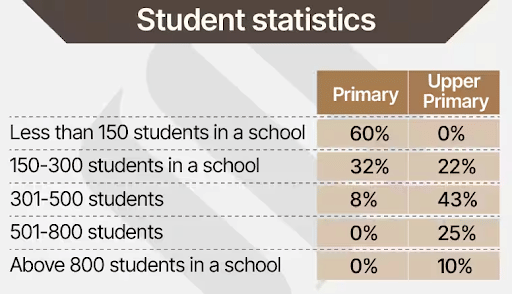
- Acute Teacher Shortage: Only 35% of primary and 5% of upper-primary schools adhering to the RTE norms for student-teacher ratio. Only 58% of appointed teachers were present during the survey.
- Reliance on Private Tuitions: The deteriorating condition of government schools has led to increased reliance on private tuitions.
- According to ASER Report 2022, the proportion of students in private tuition classes has also increased.
- Poor Infrastructure: Only 7% of primary schools in Bihar function without buildings and that only 20% schools had electricity, water and toilets.
- Failure of Direct Benefit Transfer (DBT) Scheme: Under DBT Scheme, money is given for textbooks in the students' accounts. It imposes a cruel choice on poor families to choose between buying school things and basic necessities like food.
- Impact of COVID-19 and Learning Loss: The crisis worsened the fragile education system. Many Class 1-5 students exhibited declined reading and writing skills post-school reopening, reflecting insufficient measures to tackle learning loss.
Deprivation of facilities under DBT System
- Since 2017, Bihar replaced textbook and uniform distribution in schools with cash transfers through the Direct Benefit Transfer (DBT) system.
- Many students in government schools come from impoverished backgrounds, forcing families to choose between purchasing educational materials or fulfilling basic necessities.
- Parents often face the distressing choice of investing in education or meeting immediate requirements, potentially leading to compromised learning opportunities.
- The money provided by DBT does not always reach the children or their parents. The money is conditional on 75% school attendance, and also requires an Aadhaar-linked bank account.
- As a result, numerous students' bank accounts in the surveyed blocks were rejected. This rejection disrupts the flow of funds for leaving children without necessary resources for their education.
Constitutional Provisions related to Education in India
Government Initiatives to Promote Education
|
Way Ahead
- Government schools play a vital role in providing education to a significant portion of India's population. Hence, addressing these challenges will lead to improved education quality and better prospects for students.
- Enforcing a ban on private tuitions during school hours, enhancing ways to address complaints, launching an initiative to improve school attendance, and ensuring adherence to the RTE Act can be considered.
- The increasing representation of women and socially disadvantaged groups among teachers can be an important step towards democratising schools and reducing the social distance between teachers and children.
(*Click this link to read prelims specific weekly current affairs articles)
FAQs
Question: What is Right to Education?
Answer:
In 2009, the Right to Education Act (RTE) established free and compulsory education for children as a basic right under Article 21-A.
Question: What is the primary objective of Direct Benefit Transfer (DBT)?
Answer:
The primary aim of this Direct Benefit Transfer program is to bring transparency and terminate pilferage from the distribution of funds sponsored by the Central Government of India. In DBT, benefit or subsidy is directly transferred to citizens living below the poverty line.
Question: What is the ASER?
Answer:
ASER stands for Annual Status of Education Report. This is an annual survey that aims to provide accurate estimates of children's enrollment and basic learning levels for each district and state in India.
UPSC Mains Practice Question:
|
MCQ
Question: Consider the following statements: (UPSC 2018)
- As per the Right to Education (RTE) Act, to be eligible for appointment as a teacher in a State, a person would be required to possess the minimum qualification laid down by the concerned State Council of Teacher Education.
- As per the RTE Act, for teaching primary classes, a candidate is required to pass a Teacher Eligibility Test conducted in accordance with the National Council of Teacher Education guidelines.
- In India, more than 90% of teacher education institutions are directly under the State Governments.
Which of the statements given above is/are correct?
(a) 1 and 2
(b) 2 only
(c) 1 and 3
(d) 3 only
Answer: (b) See the Explanation
- The Central Government-designated academic authority sets minimum qualifications for teachers under the RTE Act. A Teacher Eligibility Test (TET) is required for their appointment. Hence, statement 1 is incorrect.
- TET is conducted by the appropriate Government as per National Council of Teacher Education guidelines. Hence, statement 2 is correct.
- The 2012 Verma Commission on Teacher education in its report pointed out that 90% of teacher education bodies were private. Hence, statement 3 is incorrect.
Therefore, option (b) is the correct answer.
Download the PREPP App and attempt FREE IAS Exam Mock Tests and get complete study material!

Full Test - 04: UPSC CSE Prelims CSAT (Paper-II)
Full Test - 03: UPSC CSE Prelims CSAT (Paper-II)
UPSC CSE Prelims 2026 GS Paper 1 Question Paper (24-May-2026)
UPSC CSE Prelims 2026 CSAT Paper 2 Question Paper (24-May-2026)

17 February 2025 | The Hindu Must Read Articles | Current Affairs

16 February 2026 | The Hindu Must Read Articles | Current Affairs

13 February 2026 | The Hindu Must Read Articles | Current Affairs









Comments