National Emblem - Indian Polity Notes
National Emblem of India is a representational seal of the Republic of India based on the Lion Capital of Ashoka Pillar (based in Sarnath, Uttar Pradesh.) On January 26, 1950, India approved it as the State Emblem. The slogan of the Indian National Emblem is 'Satyamev Jayate' (Truth Alone Triumphs). The National Emblem of India Interchangeably, called the ‘State Emblem’ is used by the union government, numerous state governments, and other government entities.
This article explains the National Emblem which is important for UPSC IAS exam preparation.
|
Table of Contents |
National Emblem of India
- A National Emblem of a country is a seal that is used for official purposes and commands the utmost respect and allegiance.
- It is a symbol of authority and the cornerstone of a country's constitutional ideals.
- The State Emblem of India is the Republic of India's national emblem, and it is used by the union government, state governments, and other government bodies.
- It was adopted by the Government of India on January 26, 1950.
- The state emblem is based on Ashoka's Sarnath Lion Capital (Varanasi, Uttar Pradesh).
- In the original, four lions stand back to back on an abacus with a frieze bearing high relief sculptures of an elephant, a galloping horse, a bull, and a lion separated by intervening wheels above a bell-shaped lotus.
- The capital, carved from a single piece of polished sandstone, is capped with the Wheel of the Law (Dharma Chakra).
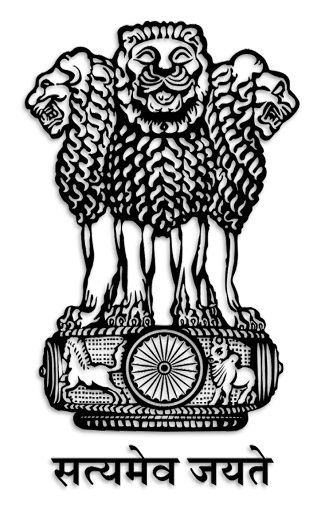
(National Emblem of India)
| Other Relevant Links | |
|---|---|
| National Flag | National Song |
| Difference Between National Anthem and National Song | Code of conduct for National Anthem |
National Emblem of India - Features
- The National emblem/State emblem of India is the official seal of the Government of India.
- In the original, four lions are mounted back to back on a circular abacus (Only three lions are visible), which is supported by a bell-shaped lotus.
- The lotus in the shape of a bell has been eliminated.
Four animals are depicted to represent the four directions:
- Galloping horse - West
- The horse depicts Kanthaka, the horse Buddha is claimed to have taken to flee his regal existence.
- Elephant - East
- The Elephant represents Queen Maya's dream in which a white elephant enters her womb.
- A Bull - South
- The Bull represents the Taurus Zodiac sign, the month in which Buddha was born.
- Lion - North
-
- The Lion represents the achievement of enlightenment.
- The animals appear to follow each other around the wheel of existence for all eternity.
- The words Satyameva Jayate from the Mundaka Upanishad, which means "Truth Alone Triumphs," are written in Devanagari script below the abacus.
- The Wheel of the Law (Dharma Chakra) crowns the Capital, and the four Lions represent Buddha spreading Dharma in all directions.
- It was created to commemorate Buddha's first discourse, known as Dharmachakrapravartna.
National Emblem of India - Legal provisions
- The State Emblem of India (Prohibition of Improper Use) Act of 2005, as well as the State Emblem of India (Regulation of Use) Rules of 2007, prohibit the improper use of the state emblem.
- The National Emblem of India, according to these laws, can only be used in accordance with the terms of the State Emblem of India (Prohibition of Improper Use) Act 2005, and any illegal use is penalised by law.
- If someone breaches the legislation, they face imprisonment for up to two years or a fine of up to Rs 5000.
Facts about National Emblem of India
- The President of India's official seal, as well as the seals of the Central and State governments, is an indisputable element of the Government of India's official letterhead.
- The National Emblem appears on all Indian money and the Republic of India's National Passport.
- The fourth lion was omitted from the two-dimensional rendition of the emblem on the initial copy of the Indian Constitution.
- Officers of the Indian Police Service (IPS) wear the state symbol on their caps.
- MPs can also use the state insignia on their letterheads and business cards.
- If someone breaks the legislation regarding the use of the National Emblem, they can face a sentence of up to two years in prison or a fine of up to INR 2000.
- Dinanath Bhargava is said to have gone to the Alipore Zoo in Kolkata to observe a lion before drawing it on paper.
- The National Emblem can be seen at the public buildings listed below:
- Rashtrapati Bhawan is the official residence of the President of India.
- Buildings of Parliament House, Supreme Court, and Central Secretariat
- Raj Niwas or Raj Bhawan
- High Courts of the State Legislature
- Buildings that house the Secretariats of States or Union Territories
- Locations of India's diplomatic missions across the world
- Heads of Missions' residences in the countries where they are accredited
- At the front doors of buildings where India's consulates are located.
Conclusion
Only three lions are visible in the State Emblem of India, which has been adopted by the Government of India; the fourth lion is hidden from view as it sits back. With a horse on the left and a bull on the right, and the outlines of other wheels on the extreme right and left, the wheel appears in relief in the center of the abacus. The lotus in the shape of a bell is missing.
| Other Relevant Links | |
|---|---|
| Indian Polity UPSC Notes | National Symbols |
| Working of Constitution | Foreign Policy |
| National Integration | Pressure Groups |
FAQs
Question. What is the State Emblem of India?
Answer: The State Emblem of India is a national symbol of India, which represents the country's sovereignty, dignity, and cultural heritage. The emblem is based on the Lion Capital of Ashoka, which was originally erected by Emperor Ashoka in Sarnath around 250 BCE. The State Emblem of India consists of a lion’s head, with four lions seated back to back, symbolizing power, courage, and confidence. The emblem also includes a wheel (the Ashoka Chakra) below the lions, which represents the wheel of law and progress.
Question. What are the elements of the State Emblem of India?
Answer: The State Emblem of India contains several key elements:
- Lion Capital: The four lions are seated back to back and symbolize strength, courage, and confidence. Only three lions are visible in the emblem, while the fourth lion is hidden from view.
- Ashoka Chakra: Below the lions is the Ashoka Chakra, a wheel with 24 spokes, which represents the wheel of law and progress. It also symbolizes the dynamism and continuity of the Indian people.
- Inscription: Below the Ashoka Chakra, there is an inscription in Devanagari script, which reads "Satyamev Jayate," meaning "Truth Alone Triumphs." This phrase is taken from the Mundaka Upanishad, an ancient Indian text.
- Base with a Horse and Bull: The emblem also depicts a bull and a horse in a circular form beneath the Ashoka Chakra. These figures are part of the original sculpture but are not part of the current state emblem.
Question. What is the significance of the State Emblem of India?
Answer: The State Emblem of India holds great significance in representing the country’s values, history, and principles:
- National Sovereignty: The Lion Capital symbolizes the strength and sovereignty of India.
- Truth and Justice: The motto "Satyamev Jayate" reflects India's commitment to truth and justice, values that are deeply embedded in its legal and cultural fabric.
- Dharma (Law): The Ashoka Chakra symbolizes law and righteousness, reflecting India’s commitment to democratic values and constitutional governance.
Question. Where is the State Emblem used?
Answer: The State Emblem of India is used in various official contexts, including:
- Government Documents: The emblem appears on official documents, coins, and currency notes, symbolizing the authority of the Indian government.
- Government Buildings: The emblem is displayed prominently in government buildings, including parliament, presidential office, and courts.
- Official Seals: The emblem is used as an official seal for government departments, ministries, and public authorities.
Question. What are the restrictions on the use of the State Emblem of India?
Answer: The State Emblem of India is a symbol of national pride and authority, and its use is strictly regulated. Some of the key restrictions include:
- Unauthorized Use: The emblem cannot be used for commercial purposes or by individuals or organizations without proper authorization from the government.
- Modification: The emblem cannot be altered or modified in any way, including the color, shape, or design, unless specifically allowed for official purposes.
- Prohibited Usage: The State Emblem cannot be used for personal or political promotion, and misuse of the emblem can lead to legal action.
MCQs
- Which ancient Indian emperor’s work is the State Emblem of India based on?
A) Emperor Ashoka
B) Emperor Akbar
C) Emperor Harsha
D) Emperor Chandragupta Maurya
Answer: (A) See the Explanation
The State Emblem of India is based on the Lion Capital of Ashoka, which was erected by Emperor Ashoka at Sarnath around 250 BCE.
- What is the motto inscribed on the State Emblem of India?
A) Ahimsa Paramo Dharma
B) Satyamev Jayate
C) Jai Hind
D) Vande Mataram
Answer: (B) See the Explanation
The motto inscribed on the State Emblem of India is "Satyamev Jayate", meaning "Truth Alone Triumphs".
- What is depicted below the four lions in the State Emblem of India?
A) The Ashoka Chakra
B) A horse and a bull
C) A lotus flower
D) The Indian flag
Answer: (A) See the Explanation
Below the four lions in the State Emblem of India is the Ashoka Chakra, a wheel with 24 spokes, representing progress and law.
- Which script is used for the inscription "Satyamev Jayate" on the State Emblem of India?
A) Sanskrit
B) Devanagari
C) Urdu
D) Hindi
Answer: (B) See the Explanation
The inscription "Satyamev Jayate" is written in Devanagari script on the State Emblem of India.
- What is the significance of the four lions in the State Emblem of India?
A) They represent the four directions
B) They symbolize the unity of India
C) They are an emblem of bravery and strength
D) They represent the four seasons
Answer: (C) See the Explanation
The four lions in the State Emblem of India symbolize bravery, strength, and confidence. They are based on the Lion Capital of Ashoka.
GS Mains Questions and Model Answers
Q1: Discuss the historical and cultural significance of the State Emblem of India.
Answer: The State Emblem of India holds profound historical and cultural significance. It is a modern adaptation of the Lion Capital of Ashoka, which was originally erected by Emperor Ashoka in Sarnath around 250 BCE. The emblem’s four lions facing different directions symbolize strength, courage, and confidence. The Ashoka Chakra, a 24-spoke wheel, represents the wheel of law and is symbolic of progress, while the motto "Satyamev Jayate" (Truth Alone Triumphs) reflects India’s commitment to justice and truth. The State Emblem represents India’s sovereignty, unity, and democratic values, and it is used in various official documents, government buildings, and seals, making it an integral part of the nation’s identity. The symbolism and the use of the emblem underscore the importance of democracy, law, and ethical governance in India’s political and cultural ethos. The emblem also connects India’s ancient history with its modern republic, ensuring the continuity of the nation’s rich cultural heritage.
Q2: Examine the role of the State Emblem in the representation of Indian sovereignty.
Answer: The State Emblem of India is an important symbol of the nation’s sovereignty, representing its status as an independent republic. The emblem, based on the Lion Capital of Ashoka, signifies strength, power, and dignity, all of which are fundamental to India’s sovereign status. The four lions represent the unity and integrity of the country, while the Ashoka Chakra embodies law and progress, key principles upon which India’s governance is based. The phrase "Satyamev Jayate" emphasizes the triumph of truth and underscores the country’s commitment to justice and equity. As a representation of India’s constitutional principles, the emblem reflects the nation’s values of democratic governance and rule of law, emphasizing its commitment to maintaining both freedom and order. The use of the emblem in government documents, buildings, and seals reinforces the authority of the Indian state and symbolizes the integrity and independence of India on the global stage.
Q3: What are the legal restrictions on the use of the State Emblem of India?
Answer: The State Emblem of India is a symbol of national pride and authority, and its use is strictly regulated by law. The Emblems and Names (Prevention of Improper Use) Act, 1950 prohibits the unauthorized use of the emblem, ensuring that it is not misused for commercial, personal, or political purposes. The emblem cannot be used by private individuals or organizations without permission from the Government of India. Additionally, the emblem cannot be altered, modified, or used in any way that may distort its design or meaning. Its use is limited to official purposes related to the Government of India, including official documents, buildings, and seals. Violations of these rules can lead to legal penalties, ensuring that the dignity and respect of the emblem are maintained. The restrictions are in place to protect the integrity of the State Emblem, maintaining its status as a symbol of the sovereignty and unity of India.
Previous Year Questions on State Emblem of India
1. UPSC CSE 2020
Question: "Discuss the symbolism of the State Emblem of India and its role in representing the nation's sovereignty."
Answer: This question required an analysis of the symbolism behind the State Emblem of India and how it represents India’s sovereignty, unity, and commitment to democratic principles.
2. UPSC CSE 2019
Question: "Examine the restrictions placed on the use of the State Emblem of India and their significance."
Answer: This question focused on the legal restrictions and regulations regarding the use of the State Emblem, as well as its importance in maintaining the dignity and respect of the emblem as a national symbol.
Download the PREPP App and attempt FREE IAS Exam Mock Tests and get complete study material!
UPSC IAS : CSAT - Mini Live Test

Live Test : UPSC CSE Prelims CSAT (Paper-II) (Oct 20 - 23)
Full Test - 04: UPSC CSE Prelims CSAT (Paper-II)
Full Test - 03: UPSC CSE Prelims CSAT (Paper-II)
UPSC CSE Prelims 2026 GS Paper 1 Question Paper (24-May-2026)
UPSC CSE Prelims 2026 CSAT Paper 2 Question Paper (24-May-2026)

17 February 2025 | The Hindu Must Read Articles | Current Affairs

16 February 2026 | The Hindu Must Read Articles | Current Affairs

13 February 2026 | The Hindu Must Read Articles | Current Affairs









Comments