Spring Tide - Geography Notes
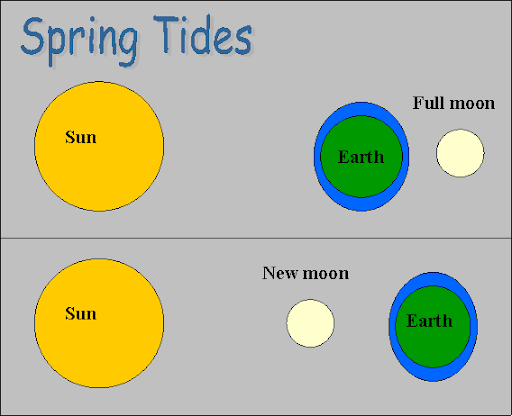
Spring tide means the tide that occurs right after every full and new moon when the sun, moon, and earth are in line. Tides are periodic motions of ocean water caused by the gravitational pull of the Moon and Sun. Spring tide, also called King Tide, is the tide's "springing forth" during new and full moons. A spring tide occurs twice a month throughout the year. The article below explains the Spring Tides followed by detailed explanations which are useful for UPSC Geography Syllabus.
|
Table of Contents |
What exactly is a Spring Tide?
- A spring occurs right after a new or full moon when there is a major difference between high and low water. In other words, a spring tide occurs when high tides are higher and low tides are lower.
- A spring tide is often referred to as a "King Tide," which describes the tide's "springing forth" during a new or full moon.
- The spring tide usually repeats three to four times a year.
- The actual spring tide is typically a few inches lower than the usual spring tides.
- Spring has nothing to do with the spring season and the word “spring” here is derived from the concept of “springing forth of tides”.
- It takes place during a lunar month.
What are Tides?
|
Importance of Tides
- Raise the Water Level: Spring Tides raise the water level near the coasts, making it easier for ships to enter the harbor.
- Aids in Fishing: Spring Tides assist in fishing. During high tides, more fish come closer to the coast.
- Greatest Biodiversity: Some of the ocean's greatest biodiversity can be found in tide pools.
- Tide pools are places that are entirely submerged during high tide but remain as pockets of seawater during low tide.
Conclusion
Thus tidal research is essential for safe navigation, enjoyment, and coastal development. Commercial and recreational fishermen alike rely on their understanding of tides and tidal currents to boost their catch rates. Fish may cluster during ebb or flood tidal currents, depending on the species and water depth in a given area.
FAQs
Question. What are spring tides?
Answer: Spring tides are tides that occur when the Sun, Moon, and Earth are aligned, leading to higher than usual high tides and lower than usual low tides. These tides happen during full moons and new moons.
Question. How do spring tides differ from neap tides?
Answer: Spring tides occur when the Sun, Moon, and Earth are in alignment (either during a new moon or full moon), which results in the highest tidal range. Neap tides, on the other hand, occur when the Sun and Moon are at right angles to each other (during the first and third quarters of the moon), resulting in the smallest tidal range.
Question. When do spring tides occur?
Answer: Spring tides occur approximately every two weeks, during the full moon and new moon phases, when the gravitational forces of the Sun and Moon combine to create stronger tidal forces.
Question. What causes spring tides?
Answer: Spring tides are caused by the combined gravitational forces of the Moon and the Sun. When these forces align, they create greater tidal bulges in the oceans, leading to higher high tides and lower low tides.
Question. How do spring tides affect coastal areas?
Answer: Spring tides can cause coastal flooding, particularly in low-lying areas, due to the higher-than-normal high tides. These tides also influence the movement of water in estuaries, bays, and harbors, and can impact shipping and fishing activities.
MCQs
- Spring tides occur during which of the following phases of the moon?
A) First and third quarters
B) Full moon and new moon
C) Waxing and waning gibbous
D) Waxing and waning crescent
Answer: (B) See the Explanation
Spring tides occur when the Sun, Moon, and Earth are aligned, which happens during the full moon and new moon phases.
- What is the main cause of spring tides?
A) The Moon’s gravitational pull alone
B) The Sun’s gravitational pull alone
C) The alignment of the Sun, Moon, and Earth
D) The rotation of the Earth
Answer: (C) See the Explanation
Spring tides occur due to the alignment of the Sun, Moon, and Earth, which enhances the gravitational forces and leads to higher high tides.
- How do spring tides affect the tidal range?
A) They reduce the tidal range
B) They increase the tidal range
C) They have no effect on the tidal range
D) They create a stagnant tidal range
Answer: (B) See the Explanation
Spring tides lead to the highest tidal ranges, with higher high tides and lower low tides.
- Which of the following is true about spring tides?
A) They occur when the Sun and Moon are at right angles to each other
B) They occur only once a year
C) They cause the greatest difference between high and low tides
D) They have no significant effect on coastal areas
Answer: (C) See the Explanation
Spring tides result in the highest tidal ranges, causing the greatest difference between high and low tides.
- Neap tides are characterized by:
A) Higher high tides and lower low tides
B) Alignment of the Sun, Moon, and Earth
C) Lower high tides and higher low tides
D) Larger tidal bulges
Answer: (C) See the Explanation
Neap tides occur when the Sun and Moon are at right angles to each other, leading to the smallest tidal range.
GS Mains Questions and Model Answers
Q1. Explain the phenomenon of spring tides and their impact on coastal environments.
Answer: Spring tides occur when the Sun, Moon, and Earth are aligned, leading to enhanced gravitational forces that produce the highest high tides and the lowest low tides. This phenomenon occurs during the new moon and full moon phases, about every two weeks. The higher tidal ranges can cause coastal flooding in low-lying areas, disrupt ecosystems, and impact human activities such as fishing, shipping, and agriculture. In estuarine areas, spring tides influence water salinity and flow, affecting the species living there. While beneficial for flushing pollutants from estuaries, spring tides can also lead to erosion and sediment deposition along the coast.
Q2. Discuss the differences between spring tides and neap tides and their significance in tide-related phenomena.
Answer: Spring tides occur when the Sun, Moon, and Earth are in alignment, creating the highest tidal ranges. These tides are characterized by a greater difference between high and low tides, which can result in coastal flooding and affect marine life. Neap tides, however, occur when the Sun and Moon are at right angles to each other, during the first and third quarters of the moon. This results in the smallest tidal range, with lower high tides and higher low tides. While spring tides have more dramatic effects on coastal areas, neap tides are less extreme and can provide more stable conditions for marine organisms.
Q3. How do spring tides influence navigation and coastal management?
Answer: Spring tides, due to their higher high tides and lower low tides, significantly impact navigation, especially in shallow coastal areas, estuaries, and harbors. During spring tides, vessels may experience challenges such as grounding in shallow waters, which can disrupt shipping schedules. Coastal management strategies must account for these tidal extremes by designing effective flood defenses, managing port operations, and ensuring that infrastructure like piers and docks can accommodate the tidal changes. Additionally, the increased tidal range during spring tides can exacerbate coastal erosion, requiring ongoing maintenance of coastal protection measures.
Previous Year Questions on Spring Tides
1. UPSC CSE 2023
Question: "Explain how the alignment of the Sun, Moon, and Earth causes spring tides and their impact on coastal areas."
Answer: Spring tides occur when the Sun, Moon, and Earth align, either during the full moon or new moon phases. This alignment causes the gravitational pull of the Sun and Moon to combine, resulting in higher than usual high tides and lower than usual low tides. These extreme tidal changes can lead to coastal flooding, erosion, and disruptions to ecosystems, especially in low-lying coastal areas.
2. UPSC CSE 2022
Question: "What is the significance of spring tides in coastal and marine ecosystems?"
Answer: Spring tides significantly affect coastal and marine ecosystems by causing extreme tidal variations. They help in flushing out pollutants and maintaining the ecological balance in estuaries. However, they also expose marine species to greater risks of coastal erosion and habitat disturbance due to the higher tidal ranges. For species living in the intertidal zone, spring tides can alter the availability of nutrients and the conditions of the habitat.
Download the PREPP App and attempt FREE IAS Exam Mock Tests and get complete study material!
Live Test : UPSC IAS : GS - Modern History - Subject Knowledge Test

Live Test : UPSC CSE Prelims CSAT (Paper-II) (Oct 20 - 23)
Full Test - 04: UPSC CSE Prelims CSAT (Paper-II)
Full Test - 03: UPSC CSE Prelims CSAT (Paper-II)
UPSC CSE Prelims 2026 CSAT Paper 2 Question Paper (24-May-2026)
UPSC CSE Prelims 2026 GS Paper 1 Question Paper (24-May-2026)

17 February 2025 | The Hindu Must Read Articles | Current Affairs

16 February 2026 | The Hindu Must Read Articles | Current Affairs

13 February 2026 | The Hindu Must Read Articles | Current Affairs









Comments