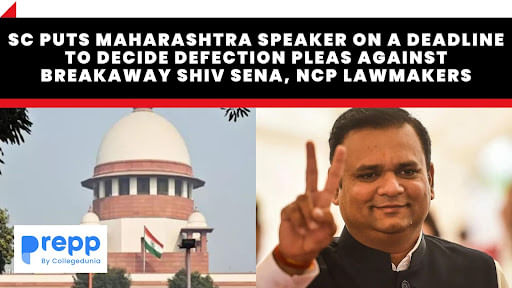
SC Puts Maharashtra Speaker On A Deadline To Decide Defection Pleas Against Breakaway Shiv Sena, NCP Lawmakers
Relevance: GS2- Parliament and State legislatures—structure, functioning, conduct of business, powers & privileges and issues arising out of these
(Source: The Hindu, 10/31/2023)
Click here for Daily Current Affairs
Why in the news?
- Recently, the Supreme Court directed the Speaker of the Maharashtra Assembly Rahul Narwekar to decide disqualification petitions filed under the Tenth Schedule of the Constitution in the Shiv Sena dispute by December 31, 2023.
- This article discusses the Office of the Speaker of the Lok Sabha and the State Legislative Assemblies and the need for the Speaker to be impartial in proceedings to ensure the desirable functioning of the House.
Table of Contents
- What has the Supreme Court ruled regarding the disqualification of members in the Maharashtra Assembly?
- Origin and Evolution of the Office of the Speaker
- Office of the Speaker
- What are the gaps in the conduct of the Speaker?
- Judicial view on the Speaker's powers to decide disqualification
- What measures can be taken to ensure the impartial and effective functioning of the Speaker?
- Conclusion
- FAQs
- MCQs
What has the Supreme Court ruled regarding the disqualification of members in the Maharashtra Assembly?
- A three-judge Bench of the Supreme Court led by Chief Justice D.Y. Chandrachud ordered the Speaker in his capacity as a tribunal under the 10th Schedule to decide the disqualification in the Maharashtra Assembly at the earliest.
- The Court further clarified that the hearings in both cases under the Tenth Schedule should not be affected by “procedural wranglings”.
- The affidavit filed by the Maharashtra Legislative Assembly Secretariat stated that the petitions could only be decided by February 29th, 2024.
- The Court observed that the Speaker had failed to decide the petitions despite the orders of the Constitution Bench in May 2023 following the incident that took place in 2022.
- Deadlines:
- The Court set a deadline for the 34 petitions against the members of Chief Minister Eknath Shinde’s camp of the Shiv Sena as December 31st, 2023.
- The deadline for the 9 petitions against the breakaway faction headed by Deputy Chief Minister Ajit Pawar in the NCP was set for January 31, 2024.
- The Court stated that the deadlines had to be set since the Speaker had failed to decide the petitions despite opportunities.
- In 2020, the Supreme Court ruled that disqualification petitions should be decided by the Speaker in a reasonable time which may be 3 months except in exceptional circumstances.
Origin and Evolution of the Office of the Speaker
- The office of the Speaker emerged in medieval Britain as a spokesperson for the House of Commons in its dealings with the King.
- Although the Speaker was viewed as an agent of the Crown up to the 17th Century, he has since the 19th Century become an impartial Chairman of the House of Commons.
- The Speaker is now seen as the custodian of the rights and privileges of the House, its committees, and its members.
Office of the Speaker
To know more about Speakers of Lok Sabha and Legislative Assemblies click the links. |
What are the gaps in the conduct of the Speaker?
- Two of the major functions performed by the Speakers are:
- Certification of a Bill as a Money Bill
- Deciding on disqualification under the Tenth Schedule for defection.
- Suspension of members: The Rules of the Lok Sabha and the respective State Legislative Assemblies allow for the suspension of members for misconduct in the House.
- However, concerns have been raised about the misuse of these provisions by Speakers and the House, particularly against the members of the Opposition.
- For example, the suspension of 12 members by the Speaker of Maharashtra in 2021, which was later overturned by the Supreme Court.
- Disqualification of members: The Speaker is the designated authority to decide on the disqualification of members under the Tenth Schedule.
- Although they are expected to perform their constitutional duty in a neutral and unbiased manner, this has not been the case with Speakers tending to favor the government.
- When the Speaker does not act in a neutral manner, this has the potential to derail the stability of elected governments.
- Example: Challenges in the Supreme Court regarding the inaction of the Maharastra Speaker in deciding disqualification petitions for more than a year.
Judicial view on the Speaker's powers to decide disqualification
|
- Referral of bills: The Speaker has the authority to refer Bills to the Parliamentary Standing Committees.
- However, it has been found that Bills that require detailed scrutiny are not referred to such committees.
- While the number of bills referred to committees in the Lok Sabha was 60% between 2004-2014, this was less than 25% in the 2014-2023 period.
- Partisan functioning of the Speakers has adversely affected the robust functioning of Parliament and other legislative bodies in the country.
- Classification as Money Bill: The Speaker is empowered to determine whether a Bill fulfills the requirements of a Money Bill with Article 110(3) stating that the decision of the Speaker of the Lok Sabha is final in questions on whether a Bill is a money bill or not.
- However, the passage of Bills with several other provisions as Money Bills has been criticized and challenged in the Supreme Court.
- Partisanship: In Britain, as a display of their impartiality, the Speaker resigns from their political party following their election and in subsequent elections, they seek votes as the Speaker seeking re-election rather than as a candidate of a particular party.
- While the Tenth Schedule allows a Speaker or Deputy Speaker to resign from their political party upon being elected, it has been never done in India.
- Handling disruptions: The Speaker is responsible for maintaining order and decorum in the House.
- However, the Speakers of the Lok Sabha and various state assemblies have been criticized for the way they handled disruptions in the House.
- Relations with the media: The Speaker is the spokesperson of the house,but has faced criticism for their interactions with the media including the lack of sufficient information provided to the media.
What measures can be taken to ensure the impartial and effective functioning of the Speaker?
- Speaker must give up political affiliations: In order to ensure that the Office of the Speaker remains neutral and unbiased, the Speaker upon being elected should resign from his/her political party for the duration of his term.
- They should also avoid participating in any political rallies or campaigns to protect the neutrality of their office.
- Tribunal to decide disqualification: The Supreme Court's suggestion of introducing a tribunal chaired by a former judge of the Supreme Court or Chief Justice of a High Court can be implemented.
- This tribunal will replace the Speaker in deciding disqualification petitions under the tenth schedule thereby ensuring impartial rulings.
- Reduce speaker's discretion: At present, the Speaker has wide discretionary powers.
- This includes the power to certify a bill as a Money bill and decide the nature of procedures and privileges in the House.
- Instead, these discretionary powers can be wielded by a committee consisting of the Speaker, Deputy Speaker, and members from both the ruling front and the opposition to guarantee a more impartial approach.
- Code of Conduct and Training: A code of conduct for the Speaker and Deputy Speaker which enforces the principles of impartiality, transparency, and accountability must be developed in consultation with all political parties.
- It can be enforced by an independent body.
- Once elected, the Speaker should be provided with training on parliamentary procedures, leadership, conflict resolution, and communication skills.
Conclusion
- The judiciary is constrained in its actions in dealing with issues related to Speakers as they are also constitutional functionaries with certain privileges.
- Therefore, it is important that the best practices of democracies like Britain be adopted by India in order to build confidence in the office of the Speaker.
- Until such laws can be enacted, Speakers should vow to display impartiality while discharging their duties in line with sound democratic practices.
(*Click this link to read prelims specific weekly current affairs articles)
FAQs
Question: What is a Money Bill?
Answer:
A Money Bill is a type of legislation that relates to the appropriation of money from the Consolidated Fund of India and is generally related to financial matters such as taxation, public expenditure, and public debt. It is defined and governed by Article 110 with Article 110(1)(a) to (g) mentioning the subjects of a Money Bill. It can only be introduced in the Lok Sabha and are certified by the Speaker.
Question: What is the Tenth Schedule?
Answer:
The Tenth Schedule or Anti-Defection Act was added to the Constitution via the 52nd Amendment Act, 1985 and sets out the provisions for disqualification of elected members on the grounds of defection to another political party. It permits a group of MP/MLAs to merge with another political party without inviting the penalty for defection.
UPSC Mains Practice Question:
|
MCQs
Question: Which one of the following statements about a Money Bill is not correct? (UPSC CSE 2000)
(a) A Money Bill can be tabled in either House of Parliament
(b) The Speaker of Lok Sabha is the final authority to decide whether a Bill is a Money Bill or not
(c) The Rajya Sabha must return a Money Bill passed by the Lok Sabha and send it for consideration within 14 days
(d) The President cannot return a Money Bill to the Lok Sabha for reconsideration
Answer: (a) See the Explanation
- A Money bill can be introduced only in the Lok Sabha and on the recommendation of the President. Hence statement 1 is incorrect.
- The Speaker of the Lok Sabha has the authority to certify a bill as a money bill before it is sent to the Rajya Sabha. Hence statement 2 is correct.
- The Rajya Sabha can only make recommendations and cannot reject or amend the bill.
- The Rajya Sabha must return the bill to the Lok Sabha within 14 days, with or without recommendations. The Lok Sabha can accept or reject any recommendations made by the Rajya Sabha. Hence statement 3 is correct.
- The President may give or withhold his assent to a Money bill but cannot return the bill for reconsideration. Hence statement 4 is correct.
Therefore, option (a) is the correct answer.
Question: Consider the following statements: (UPSC CSE 2004)
- The Speaker of Lok Sabha has the power to adjourn the House sine die but, on prorogation, it is only the President who can summon the House
- Unless sooner dissolved or there is an extension of the term, there is an automatic dissolution of the Lok Sabha by efflux of time, at the end of the period of five years, even if no formal order of dissolution is issued by the President.
- The Speaker of Lok Sabha continues in office even after the dissolution of the House and until immediately before the first meeting of the House.
Which of the statements given above are correct?
1 and 2
2 and 3
1 and 3
1, 2 and 3
Answer: (d) See the Explanation
- After the business of a session is concluded, the speaker announces adjournment sine die which adjourns the house for an indefinite period.
- After that, the president announces prorogation which is the termination of a session of the House by an order made by the President under article 85(2)(a) of the Constitution.
- It is the duty of the Indian President to summon each House of the Parliament from time to time. Hence statement 1 is correct.
- A dissolution ends the very life of the existing House, and a new House is constituted after general elections.
- Only the Lok Sabha is subject to dissolution since the Rajya Sabha is a permanent House.
- The dissolution of the Lok Sabha may take place in either of two ways:
- Automatic dissolution: On the expiry of its tenure – five years or the terms as extended during a national emergency.
- Order of President: If President is authorized by the Cabinet of Ministers, he can dissolve Lok Sabha, even before the end of the term or if the Cabinet of Ministers loses confidence and no party is able to form the government. Hence statement 2 is correct.
- After the dissolution of the Lok Sabha, Speaker continues to hold the office till immediately before the first meeting of the newly elected Lok Sabha. Hence statement 3 is correct.
Therefore, option (d) is the correct answer.
Question: Regarding the office of the Lok Sabha Speaker, consider the following statements: (UPSC 2012)
- He/She holds the office during the pleasure of the President.
- He/She need not be a member of the House at the time of his/her election but has to become a member of the House within six months from the date of his/her election.
- If he/she intends to resign, the letter of his/her resignation has to be addressed to the Deputy Speaker.
Which of the statements given above is /are correct?
(a) 1 and 2 only
(b) 3 only
(c) 1, 2 and 3
(d) None
Answer: (b) See the Explanation
- The doctrine of pleasure of the President is not applicable to the Speaker of the Lok Sabha. Hence statement 1 is incorrect.
- The Speaker is elected by the Lok-Sabha from amongst its Members so he must be a member at the time of his election. Hence statement 2 is incorrect.
- If the Lok Sabha Speaker wants to resign, the letter of his / her resignation has to be addressed to the Deputy Speaker. Hence statement 3 is correct.
Therefore, option (b) is the correct answer.
Question: Consider the following statements: (UPSC 2018)
- The Speaker of the Legislative Assembly shall vacate his/her office if he/she ceases to be a member of the Assembly.
- Whenever the Legislative Assembly is dissolved, the Speaker shall vacate his/her immediately.
Which of the statements given above is/are correct?
(a) 1 only
(b) 2 only
(c) Both 1 and 2
(d) Neither 1 nor 2
Answer: (a) See the Explanation
- As per Article 179 of the Constitution of India, the Speaker of the Legislative Assembly shall vacate his/her office if he/she ceases to be a member of the Assembly. Hence statement 1 is correct.
- As per Article 179, the Speaker does not have to vacate his/her office immediately upon dissolution of the Legislative Assembly and continues to hold office until the newly elected Assembly meets. Hence statement 2 is incorrect.
Therefore, option (a) is the correct answer.
Download the PREPP App and attempt FREE IAS Exam Mock Tests and get complete study material!

Full Test - 04: UPSC CSE Prelims CSAT (Paper-II)
Full Test - 03: UPSC CSE Prelims CSAT (Paper-II)
UPSC CSE Prelims 2026 GS Paper 1 Question Paper (24-May-2026)
UPSC CSE Prelims 2026 CSAT Paper 2 Question Paper (24-May-2026)

17 February 2025 | The Hindu Must Read Articles | Current Affairs

16 February 2026 | The Hindu Must Read Articles | Current Affairs

13 February 2026 | The Hindu Must Read Articles | Current Affairs









Comments