Mapping The Socio-Economic Changes In The Lower Cauvery Delta
Relevance: GS3 - Major crops-cropping patterns in various parts of the country, - different types of irrigation and irrigation systems storage, transport and marketing of agricultural produce and issues and related constraints, Land reforms in India.
(Source: The Hindu, 12/05/2023)
Click here for Daily Current Affairs
Why in the news?
- This article describes the results of surveys conducted in two villages, Palakurichi and Venmani, in Tamil Nadu that attempt to understand the social and economic changes in the Lower Cauvery delta.
- The surveys focused on changes in the economy and agricultural sector and their impact on other sectors like education, housing, and sanitation.
Table of Contents
Surveys in the Lower Cauvery delta
- In 2018, a project was launched by the Foundation for Agrarian Studies to study agrarian relations in the lower Cauvery delta.
- The study assessed the socio-economic changes observed in two villages in Tamil Nadu - Palakurichi and Venmani.
- Palakurichi is a village in Kilvelur taluk that has been studied by economists since the 20th century.
- Venmani village includes the hamlet of Keelavenmani, where on December 25, 1968, 44 Dalit men, women, and children were forced into a hut and set on fire.
- The two villages lie on the tail-end of the Cauvery irrigation system which means they are severely impacted by a fall in the water supply of the Cauvery River.
What are the changes observed in the region?
- The area was earlier known for being agriculturally surplus with extensive rice cultivation.
- It was also associated with harsh and cruel forms of exploitation and oppression by the state and feudal landlords against the working classes.
- However, the relations of production and the brutal direct discrimination that was rampant under the precious agrarian regime have also changed.
Changes in agricultural patterns
- The delta has declined as a major hub of rice cultivation in Tamil Nadu.
- In the green revolution era of the 1970s and 80s, the region transformed into a double-cropped region.
- However, it has now reverted to a single rice-crop region with rice yields declining from previous years.
- Reasons:
- This has been mainly due to the drop in the availability of water as a result of changes in the water-sharing agreements between Karnataka and Tamil Nadu.
- Agriculture and irrigation policy has failed to address the falling supply of Cauvery water.
- Crops that were ideal for the new water regime were not introduced.
- No major new sources of economic activity or production other than crop production were developed despite the drop in the gains of the Green Revolution.
- Similarly, micro-irrigation systems in the region were not modernized to meet the emerging challenges faced by the region.
- Recommendations: Crop regimes and agricultural policies that are suited to the intermittent drought and cyclonic activity in the region must be introduced.
- The region witnessed droughts in 2000-2002, 2008, 2012, and 2016, and floods in 2018 due to Cyclone Gaja.
Land ownership
- The survey observed that the social hierarchy of acute inequality continued to exist in the region despite the easing of oppression of agricultural workers and Dalits by feudal landlords.
- Top landlord families constitute 2% of households in Palakurichi but own 38% of the agricultural land.
- At Venmani, 1% of landlord households own 18% of all land.
- Although landlessness was still high in the region, improvements were visible as Dalit households did own land at present.
- Dalit ownership of land represented a significant change in the historic land ownership structure of the villages of the lower Cauvery delta.
Employment and wages
- Although landlords owned the most and the best land in the villages, they did not work at any of the major agricultural operations.
- These households had greater access to non-agricultural employment and modern salaried employment on account of their higher education.
- The largest class in the villages consisted of wage laborers who were engaged in multiple agricultural and non-agricultural jobs.
Cauvery river
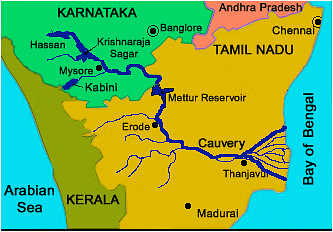
- Cauvery (Kaveri) is the largest river in Tamil Nadu and is considered one of the sacred rivers of India.
- It is also known as the Dakshina Ganga or the Ganges of the South.
- It is a perennial river which makes it significant for meeting the irrigation and hydroelectricity generation needs of the region.
- Origin: Talakaveri in the Brahmagiri hills of the Western Ghats in Karnataka.
- It stretches for 800 kilometers and drains an area of 81,155 square kilometers before draining into the Bay of Bengal.
- Sources of water:
- The Kaveri basin receives rainfall from both the South-West Monsoon and North-East Monsoon.
- Karnataka receives rainfall mostly from the South-West Monsoon while Tamil Nadu receives rainfall primarily from the North-East Monsoon.
- Tributaries:
- Left: Harangi, Hemavati, Shimsha, and Arkavati
- Right: Lakshmantirtha, Kabbani, Suvarnavati, Bhavani, Noyil, and Amaravati.
- Basin states: Tamil Nadu, Karnataka, Kerala, and the Union Territory of Puducherry.
- The majority of the basin consists of agricultural land (66.21% of the total area), while water bodies cover 4.09% of the basin.
- The basin is characterized by
- the Western Ghats,
- the Plateau of Mysore
- the Delta.
- The delta areas of the basin are the most fertile parts. Alluvial soils are found in the delta areas.
- Soil profile: The major soil types found in the Kaveri basin are black soils, red soils, laterites, alluvial soils, mixed soils, and forest soils.
- Red soils occupy the largest areas of the basin.
To learn more, click the link.
Cauvery Water Dispute
To learn more about recent developments in the dispute, click the link. |
Conclusion
- The class and anti-caste struggles in the lower Cauvery delta region have led to changes in the relations of production.
- However, the “growth without structural change” model is limited in its ability to handle challenges in economic development, employment, and the reduction of social and economic inequalities.
- Despite Tamil Nadu’s performance being better than its counterparts, the inequalities of class, caste, and gender continue to exist in newer forms because the production relations of the state have not been upheaved.
(*Click this link to read prelims specific weekly current affairs articles)
FAQs
Question: What is the Green Revolution?
Answer:
The Green Revolution was a major initiative that aimed to increase the production and quality of food crops, especially wheat and rice, in India, through the introduction of new technologies, such as HYV seeds, fertilizers, pesticides, irrigation, and mechanization. In India, it was led by M.S. Swaminathan.
Question: What is feudalism?
Answer:
Feudalism is a medieval model of government in which a ruler or lord offers mounted fighters a fief i.e. a unit of land to control in exchange for a military service.
UPSC Mains Practice Question:
|
MCQs
Question: Consider the following pairs:
Famous place River
- Pandharpur Chandrabhaga
- Tiruchirappalli Cauvery
- Hampi Malaprabha
Which of the pairs given above are correctly matched? (UPSC CSE 2019)
(a) 1 and 2 only
(b) 2 and 3 only
(c) 1 and 3 only
(d) 1, 2 and 3
Answer: (a) See the Explanation
- Pandharpur is a city located on the banks of the Chandrapur River in Maharashtra. Hence pair 1 is correct.
- Tiruchirappalli is a city on the banks of the Kaveri River in Tamil Nadu. Hence pair 2 is correct.
- Hampi is a city on the banks of the Tungabhadra River in Karnataka. Hence pair 3 is incorrect.
- The major city on the river Malaprabha is Pattadakal in Karnataka.
Therefore, option (a) is the correct answer.
Question: In which of the following regions of India are shale gas resources found?
- Cambay Basin
- Cauvery Basin
- Krishna-Godavari Basin
Select the correct answer using the code given below. (UPSC CSE 2016)
(a) 1 and 2 only
(b) 3 only
(c) 2 and 3 only
(d) 1, 2 and 3
Answer: (d) See the Explanation
- According to the Ministry of Petroleum and Natural Gas (MoPNG) there are six potential shale gas-bearing basins in the country.
- These include the Cambay, Assam-Arakan, Gondwana, Krishna-Godavari, Kaveri, and the Indo-Gangetic plain.
- Shales are fine-grained sedimentary rocks that can be rich resources of petroleum and natural gas.
Therefore, option (d) is the correct answer.
Download the PREPP App and attempt FREE IAS Exam Mock Tests and get complete study material!

Full Test - 04: UPSC CSE Prelims CSAT (Paper-II)
Full Test - 03: UPSC CSE Prelims CSAT (Paper-II)
UPSC CSE Prelims 2026 GS Paper 1 Question Paper (24-May-2026)
UPSC CSE Prelims 2026 CSAT Paper 2 Question Paper (24-May-2026)

17 February 2025 | The Hindu Must Read Articles | Current Affairs

16 February 2026 | The Hindu Must Read Articles | Current Affairs

13 February 2026 | The Hindu Must Read Articles | Current Affairs









Comments