Man-Animal Conflict - Environment Notes
Man-animal conflict refers to negative interactions between humans and wild animals that have negative consequences for both humans and their resources on the one hand, and wildlife and their habitats on the other. Man-Animal Conflict, which is caused by human-wildlife competition for natural resources, has an impact on human food security and the well-being of both humans and animals. The number of these conflicts has increased in many regions in recent decades as a result of human population growth and land use change. In this article, we will discuss Man-Animal Conflict which will be helpful for UPSC exam preparation.
|
Table of Contents |
Man-Animal Conflict
What is Man-Animal Conflict?
- The World Wide Fund for Nature (WWF) defines human-wildlife conflict as "any interaction between humans and wildlife that results in negative impacts on human social, economic, or cultural life, on wildlife population conservation, or on the environment."
- The IUCN SSC Human-Wildlife Conflict Task Force defines human-wildlife conflict as "struggles that emerge when the presence or behavior an-Animal Conflict of wildlife poses an actual or perceived, direct and recurring threat to human interests or needs, leading to disagreements between groups of people and negative impacts on people and/or wildlife."
Causes of Man-Animal Conflict
- Human-Wildlife Conflict is caused by humans coming into contact with wildlife's natural habitats. Crops, for example, are raised by herbivores and livestock by carnivores, forcing farmers who rely on both to take drastic measures to prevent wildlife loss.
- Interactions between humans and wild animals are becoming more common as the human population grows and biodiversity increases.
- The destruction of wild animals' homes is known as habitat disturbance. Humans kill or pursue wild animals in their natural habitat by digging, cutting, sealing with stones, and smoking.
- Other factors include large-scale habitat destruction caused by deforestation, overgrazing by livestock, and the expansion of human settlements and agriculture.
- Some other causes include:
- Human population growth
- Land use change
- Species habitat loss, degradation, and fragmentation
- Increasing livestock populations and competitive exclusion of wild herbivores
- Growing interest in ecotourism and increased access to nature reserves
- Abundance and distribution of wild prey
- Wildlife population growth as a result of conservation programmes
- Climate factors
- Stochastic events (e.g. fire)
Impacts of Man Animal Conflict
- Man-Animal conflict has the greatest direct impact on wildlife and the communities that live nearby.
- While human-wildlife conflict can lead to species decline and extinction, communities can suffer financial losses as well as threats to health and safety, livelihoods, food security, and property.
- The costs of living with wildlife are unevenly distributed and disproportionately fall on communities that frequently face systemic barriers, have incomes well below the poverty line, and access to few economic opportunities, while the global community benefits from healthy wildlife populations and healthy ecosystems that allow us to survive, provide food, and enable livelihoods.
- Human-wildlife conflict is a development and humanitarian issue as well as a conservation concern, affecting the income of farmers, herders, and artisanal fishers, particularly those with incomes below the poverty line.
- In addition to direct losses to communities, human-wildlife conflict has an indirect impact on people all over the world by putting pressure on the global supply chain and agricultural production, leading to food insecurity and decreased productivity among producers.
- Some other impacts include:
- Crop damage
- Predation on livestock
- Human injuries
- Human life is lost
- Property damage
- Wildlife injuries
- Animal deaths
- Habitat destruction
Preventive Strategies for Man Animal Conflict
- Artificial and natural barriers (physical and biological)
- Guarding
- Alternative high-cost livestock husbandry practices
- Relocation is the voluntary relocation of a human population
- Waste management systems that limit wildlife access to refuse
Mitigative Strategies for Man Animal Conflict
- Translocation of problematic animals: Relocating supposed "problem" animals from a conflict site to a new location was a previously used mitigation technique, but recent research has shown that this approach can have negative effects on species and is largely ineffective.
- Construction of fences or other barriers: Building barriers around cattle bomas (livestock enclosures), creating distinct wildlife corridors, and erecting beehive fences around farms to deter elephants have all proven to be successful and cost-effective strategies for mitigating human-wildlife conflict.
- Compensation: In some cases, governmental systems have been established to provide monetary compensation for losses sustained as a result of human-wildlife conflict.
- These systems hope to reduce the need for retaliatory animal killings and to financially incentivize the coexistence of humans and wildlife.
- Guard dogs that deter predators: The use of guard dogs to protect livestock from predation has been effective in reducing human-carnivore conflict all over the world.
- According to a recent review, 15.4% of study cases investigating human-carnivore conflict used livestock-guarding dogs as a management technique, with animal losses on average 60 times lower than the norm.
Initiatives Taken to Tackle the Conflict
- Gram Panchayats should be empowered: According to the WildLife (Protection) Act of 1972, the advisory envisions empowering gram panchayats to deal with problematic wild animals.
- Insurance should be provided: Using add-on coverage under the Pradhan Mantri Fasal Bima Yojna to compensate farmers for crop damage caused by HWC.
- Enhancing Fodder: Consider increasing fodder and water sources within forest areas.
- Take Proactive Measures: Prescribes local/state inter-departmental committees, the adoption of early warning systems, the construction of barriers, dedicated circle-wise Control Rooms with toll-free hotline numbers, the identification of hotspots, and so on.
- Provide Quick Relief: Payment of a portion of ex-gratia to the victim/family within 24 hours of the incident.
Recent Data of Man-Animal Conflict
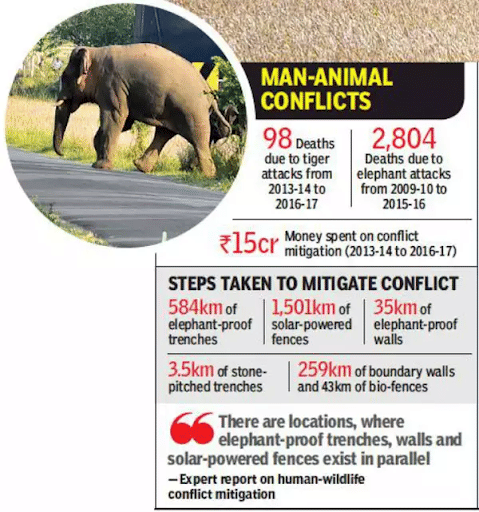
- Between 2018-19 and 2020-21, 222 elephants were electrocuted across the country.
- Furthermore, 29 tigers were killed by poaching between 2019 and 2021, while 197 tiger deaths are being investigated.
- Elephants killed 1,579 humans in three years, killing 585 in 2019-20, 461 in 2020-21, and 533 in 2021-22.
- Odisha had the most deaths (332), followed by Jharkhand (291), and West Bengal (240).
- Tigers, on the other hand, killed 125 humans in reserves between 2019 and 2021. With 61 deaths, Maharashtra accounted for nearly half of all deaths.
Conclusion
The most common method for reducing human-wildlife conflict is mitigation or finding ways to keep wildlife out of areas with high human population or agricultural density. There is a need for mass education and awareness to raise public awareness about the human-animal conflict. Once this is accomplished, mitigation will shift from short-term symptom fixes to long-term sustainable solutions to conflict prevention. The foundation of human-wildlife conflict resolution is ensuring adequate space for humans and animals to thrive. Protecting wild lands and natural habitats is critical, but so is creating buffer zones between wild and urban areas.
FAQs
Question: What is man-animal conflict?
Answer: Man-animal conflict refers to the negative interaction between humans and wildlife, often resulting in damage to crops, livestock, property, and human lives, as well as harm to wildlife populations.
Question: What are the major causes of man-animal conflict?
Answer: The major causes include habitat destruction due to deforestation, urbanization, agricultural expansion, human encroachment into wildlife habitats, scarcity of food and water for animals, and poaching.
Question: Which regions in India are most affected by man-animal conflicts?
Answer: Regions close to forests and wildlife reserves, such as parts of Assam, Uttarakhand, Karnataka, and West Bengal, are frequently affected. These areas often experience conflicts involving elephants, tigers, leopards, and other wildlife.
Question: What is the impact of man-animal conflict?
Answer: The impact includes loss of human and animal lives, destruction of crops and property, economic losses, and the retaliatory killing of animals, which endangers species already at risk.
Question: How is man-animal conflict being managed in India?
Answer: Measures include habitat restoration, building wildlife corridors, compensation schemes for affected farmers, relocation of villages from wildlife habitats, and awareness programs for local communities to reduce conflict.
MCQs
- What is the primary cause of man-animal conflict in India?
a) Increase in tourism
b) Habitat destruction and human encroachment
c) Excessive hunting by humans
d) Abundance of wildlife
Answer: (B) See the Explanation
The primary cause of man-animal conflict is habitat destruction, leading wildlife to venture into human-dominated areas in search of food and shelter, resulting in conflict.
- Which of the following is a major animal species involved in man-animal conflict in India?
a) Tigers
b) Peacocks
c) Wolves
d) Parrots
Answer: (A) See the Explanation
Tigers, along with elephants and leopards, are frequently involved in conflicts with humans, particularly in regions near forest reserves where habitats overlap with human settlements.
- Which state in India is most affected by man-elephant conflicts?
a) Kerala
b) Assam
c) Gujarat
d) Rajasthan
Answer: (B) See the Explanation
Assam is one of the states most affected by man-elephant conflicts due to the large elephant population and the proximity of human settlements to elephant habitats.
- What is a wildlife corridor?
a) A section of forest for tourism
b) A designated path to reduce human-animal conflict
c) An area where hunting is allowed
d) A protected zone only for plants
Answer: (B) See the Explanation
Wildlife corridors are protected routes that allow animals to move safely between fragmented habitats, reducing the likelihood of conflict with humans.
- Which measure is commonly used to mitigate man-animal conflict in India?
a) Banning all agriculture near forests
b) Building physical barriers like fences
c) Offering no compensation for losses
d) Encouraging deforestation
Answer: (B) See the Explanation
Building fences and trenches is a common measure to keep wildlife from entering agricultural fields and human settlements, reducing man-animal conflict.
GS Mains Questions and Model Answers
Q1: Examine the socio-economic impact of man-animal conflict in rural India.
Explanation: This question requires an analysis of the socio-economic consequences of man-animal conflict in rural India. The answer should discuss the direct economic losses suffered by farmers due to the destruction of crops and livestock, as well as the indirect impact on rural livelihoods, including reduced income and increased fear and insecurity. The answer should also consider the cost to local governments in terms of compensation schemes and preventive measures, such as building barriers. Social tensions arising from retaliatory actions against wildlife and the challenges faced by conservation efforts should be examined.
Q2: “Man-animal conflict is a growing challenge in conservation efforts in India.” Discuss.
Explanation: This question requires a discussion on how man-animal conflict poses a threat to wildlife conservation in India. The answer should focus on the challenges faced by conservationists in protecting endangered species like tigers, elephants, and leopards when they come into conflict with humans. It should also address the role of habitat destruction, the impact on biodiversity, and the difficulty in balancing human development with wildlife conservation. The answer should explore possible solutions, such as habitat restoration, wildlife corridors, and community-based conservation programs.
Q3: Analyze the role of wildlife corridors in mitigating man-animal conflict in India.
Explanation: This question asks for an analysis of how wildlife corridors help reduce man-animal conflict. The answer should explain the concept of wildlife corridors and their importance in providing safe passage for animals between fragmented habitats. The role of corridors in preventing animals from entering human settlements, thereby reducing conflict, should be discussed. The answer should also explore the challenges of creating and maintaining these corridors, including land acquisition, funding, and community involvement.
Previous Year Questions on Man-Animal Conflict
1. UPSC CSE 2019
Q1: Discuss the causes and consequences of man-animal conflict in India.
Answer: Man-animal conflict in India is primarily caused by habitat destruction due to deforestation, agricultural expansion, and human encroachment into forest areas. As wildlife habitats shrink, animals venture into human settlements in search of food, leading to conflicts. The consequences include loss of human and animal lives, destruction of crops and property, and economic losses for farmers. Additionally, retaliatory killings of animals by local communities pose a serious threat to endangered species like tigers and elephants. Managing this conflict requires a combination of habitat restoration, building wildlife corridors, and increasing community awareness.
2. UPSC CSE 2020
Q2: Explain the measures taken by the Indian government to mitigate man-animal conflict.
Answer: The Indian government has implemented several measures to mitigate man-animal conflict, including the construction of physical barriers like fences and trenches to prevent wildlife from entering human areas. Wildlife corridors have been established to facilitate the safe movement of animals between habitats. Compensation schemes are provided to farmers for crop and livestock losses due to wildlife. The relocation of human settlements from critical wildlife areas has also been encouraged. Moreover, awareness programs educate local communities on how to coexist peacefully with wildlife and prevent conflict.
Download the PREPP App and attempt FREE IAS Exam Mock Tests and get complete study material!

Full Test - 04: UPSC CSE Prelims CSAT (Paper-II)
Full Test - 03: UPSC CSE Prelims CSAT (Paper-II)
UPSC CSE Prelims 2026 GS Paper 1 Question Paper (24-May-2026)
UPSC CSE Prelims 2026 CSAT Paper 2 Question Paper (24-May-2026)

17 February 2025 | The Hindu Must Read Articles | Current Affairs

16 February 2026 | The Hindu Must Read Articles | Current Affairs

13 February 2026 | The Hindu Must Read Articles | Current Affairs









Comments