Kyoto Protocol: COP3 - Environment Notes
The Kyoto Protocol was formally adopted on 11 December 1997 but it came into effect only on 16 February 2005 after a complex ratification process. There are 192 Parties to the Kyoto Protocol as of now. COP3 refers to the third Conference of Parties (COP) to the UNFCCC session, which took place in Kyoto, Japan, in 1997 and saw the adoption of the Kyoto Protocol. This article will explain to you about Kyoto Protocol: CoP-3 which will be helpful in preparing the Environment Syllabus for the UPSC Civil Service exam.
What is Kyoto Protocol?
- By 1995, nations had come to the conclusion that the Convention's provisions for emission reductions were insufficient. They began talks to improve the world's response to climate change, and two years later the Kyoto Protocol was adopted.
- The Kyoto Protocol makes the United Nations Framework Convention on Climate Change (UNFCC) operative by requiring developed nations and economies in transition to set and meet their own individual emission targets for greenhouse gases (GHG).
- The Convention just requires such nations to develop mitigation-related policies and procedures and to report on a regular basis.
- The Kyoto Protocol adheres to the Convention's annex-based structure and is based on its rules and provisions.
- According to the principle of "common but differentiated responsibility and respective capabilities," it only binds developed nations and sets a greater burden on them because it acknowledges that they are mostly to blame for the current high levels of GHG emissions in the atmosphere.
COP 3 - Targets
- The Kyoto Protocol, in its first commitment phase, establishes legally binding carbon reduction objectives for the European Union and 37 developed nations.
- It only binds developed nations since it acknowledges that due to more than 150 years of economic activity, they are mostly to blame for the current high levels of GHG emissions in the atmosphere.
- Under its guiding principle of "common but differentiated responsibility," KP lays a higher burden on developed nations.
- Over the five-year period from 2008 to 2012, these targets come up to an average 5% reduction in emissions relative to 1990 levels.
COP 3 - Architecture of the Kyoto Protocol Regime
- The fundamental architecture of the Kyoto Protocol has been developed over two decades of experience, arduous effort, and political will.
- The heart of Kyoto Protocol is made up of the following:
- The reporting and verification processes.
- Adaptable market-based mechanisms with their own governance processes.
- A compliance system.
- These mechanisms should ideally encourage GHG abatement to begin where it is most cost-effective, such as in developing countries. It makes no difference where emissions are reduced as long as they are reduced.
- This has the added benefit of encouraging green investment in developing countries and involving the private sector in the effort to reduce and stabilise GHG emissions at a safe level.
- It also makes leapfrogging more cost-effective—that is, skipping the use of older, dirtier technology in favour of newer, cleaner infrastructure and systems with obvious long-term benefits.
Emissions Reduction Commitments
- The first was for developed country parties to make legally enforceable promises to reduce their emissions. This implied that there wasn't much room to pollute.
- Carbon dioxide is the main greenhouse gas that has become a new commodity.
- Now that an unpriced externality was understood, Kyoto Protocol started to internalize it.
Flexible Market Mechanisms
- KP's adaptable market mechanisms are based on the trading of emissions permits.
- Target-bound KP nations must cut their emissions domestically in order to achieve their obligations.
- However, they can partially achieve their goals by utilizing three "market-based mechanisms" that ideally encourage GHG abatement to begin where it is most affordable, such as in underdeveloped nations.
- Simply put, as long as emissions are decreased and removed from the atmosphere of the earth, it makes little difference where those reductions occur.
Objectives of Kyoto Mechanisms
- Its goal is to facilitate, promote, and enforce compliance with the Protocol's commitments.
- Encourage long-term development by transferring and investing in technology.
- Help Kyoto-committed countries meet their targets by reducing emissions or removing carbon from the atmosphere in other countries in a cost-effective manner.
- Encourage the private sector and developing countries to contribute to the effort to reduce emissions.
Joint Implementation (JI) of Kyoto Mechanisms
- A country with an emission reduction or limitation commitment under the Kyoto Protocol may obtain emission reduction units (ERUs) by using the "joint implementation" process.
- This can be used to satisfy its Kyoto target and will be obtained from an emission-reduction or emission-removal project in another Annex B Party, each of which is equal to one tonne of CO2.
- The flexibility and cost-effectiveness of joint implementation allow Parties to achieve a portion of their Kyoto commitments and the host Party gains from foreign investment and knowledge transfer.
- Projects beginning in 2000 may be qualified as JI projects, with ERUs awarded starting in 2008.
Clean Development Mechanism
- A nation having a Kyoto Protocol commitment to reduce or restrict emissions may conduct an emission-reduction project in developing nations thanks to the Clean Development Mechanism (CDM).
- It is the first worldwide environmental investment and credit program of its kind, offering CERs, a standardized mechanism for offsetting emissions.
- Such initiatives can generate saleable certified emission reduction (CER) credits, which are used to count toward achieving Kyoto commitments and are each equal to one tonne of CO2.

Achievements of Clean Development Mechanism
*To know more about the topic, click this link Clean Development Mechanism
Carbon Trading
- The trade of emission permits is referred to as carbon trading.
- This exchange could be a national or international transaction, depending on the context of the economy.
- There are two types of Carbon trading namely:
- Emission trading
- Offset trading
- Emissions trading, also known as "cap and trade" or "allowance trading," is a method of reducing pollution that has been successfully used to protect human health and the environment.
- Emissions trading programs consist of two major components: a pollution limit (or cap) and tradable allowances equal to the limit that allow allowance holders to emit a specific quantity (e.g., one tonne) of the pollutant.
- Carbon offset schemes enable individuals and businesses to invest in environmental projects all over the world to offset their own carbon footprints.
- The projects are typically based in developing countries and are intended to reduce future emissions.
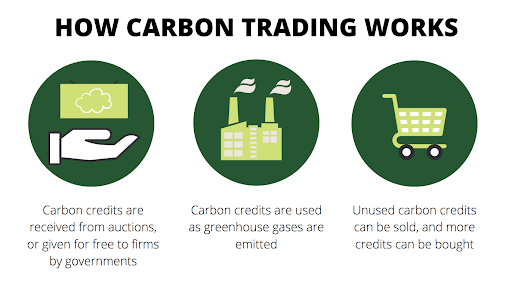
Principle of Carbon Trading
*To know more about the topic, click this link Carbon Trading
Kyoto Protocol - Challenges
- Although the Kyoto Protocol was a historic diplomatic achievement, its success was far from guaranteed.
- Indeed, reports issued within the first two years of the treaty's implementation indicated that the majority of participants would fail to meet their emission targets.
- Even if the targets were met, some critics argue that the overall benefit to the environment would be minimal because China, the world's leading emitter of greenhouse gases, and the United States, the world's second largest emitter, were not bound by the protocol.
- China because of its status as a developing country and the United States because it had not ratified the protocol.
- Other critics claimed that the protocol's emission reductions were too modest to make a discernible difference in global temperatures over the next several decades, even if fully implemented with US participation.
- Meanwhile, some developing countries argued that better adapting to climate variability and change was just as important as lowering greenhouse gas emissions.
Non-Compliance of Kyoto and Penalties
- The Protocol has penalties for non-compliance, much like most things in life.
- A nation loses the ability to receive credit for joint implementation projects if it does not adhere to the measurement and reporting standards.
- A country must make up the shortfall plus an additional 30% during the following period if it exceeds its emissions cap and doesn't try to make up the difference via one of the available procedures.
- The nation might also be prohibited from taking part in the "cap and trade" program.
Doha Amendment
- On December 8, 2012, the Doha Amendment to the Kyoto Protocol was adopted in Doha, Qatar, for a second commitment period beginning in 2013 and lasting until 2020.
- As of 28 October 2020, 147 Parties had deposited their instrument of acceptance, meeting the threshold of 144 instruments of acceptance required for the Doha Amendment to enter into force.
- The amendment went into effect on December 31, 2020.
- The amendments were as follows:
- New commitments for Annex I Kyoto Protocol Parties who agreed to take on commitments in a second commitment period from January 1, 2013 to December 31, 2020;
- Parties will report on a revised list of GHGs during the second commitment period; and
- Amendments to several Kyoto Protocol articles that specifically referenced issues from the first commitment period and needed to be updated for the second commitment period.
- The amendment was distributed to all Kyoto Protocol Parties on December 21, 2012, by the Secretary-General of the United Nations, acting in his capacity as Depositary, in accordance with Articles 20 and 21 of the Protocol.
- During the first commitment period, 37 industrialised countries and economies in transition, as well as the European Community, pledged to reduce GHG emissions by 5% on average compared to 1990 levels.
- Parties committed to reducing GHG emissions by at least 18% below 1990 levels in the eight-year period from 2013 to 2020 during the second commitment period; however, the composition of Parties differs from the first.
India at Kyoto Protocol
- India was exempted from legally binding greenhouse gas emission commitments.
- India highlighted the distinction between developed and developing countries in terms of the burden of responsibility for climate action.
- India successfully defended its obligation to promote socioeconomic development while simultaneously pressuring Annex I developed countries to take greater responsibility for reducing greenhouse gas emissions.
Conclusion
The Kyoto Protocol's future is uncertain. However, the Kyoto Protocol can be seen as a crucial first step toward a truly global system of emission reductions that will stabilize GHG emissions and can serve as the framework for a future global climate change agreement.
FAQs
Question: What was the Kyoto Protocol and its main objective?
Answer: The Kyoto Protocol, adopted in December 1997 during COP3 in Kyoto, Japan, is an international treaty aimed at combating climate change. Its primary objective is to reduce greenhouse gas emissions globally, thereby limiting global warming. The protocol set binding targets for industrialized nations and economies in transition, mandating them to reduce their collective greenhouse gas emissions by an average of 5.2% from 1990 levels during the commitment period of 2008 to 2012. The treaty emphasizes the importance of developed countries taking the lead in emissions reduction due to their historical contributions to global emissions.
Question: How does the Kyoto Protocol differ from other environmental agreements?
Answer: The Kyoto Protocol is distinctive due to its legally binding targets for greenhouse gas emissions reductions, which set it apart from previous agreements. Unlike the United Nations Framework Convention on Climate Change (UNFCCC), which primarily encourages voluntary measures, the Kyoto Protocol imposes specific emission reduction targets on developed countries. Additionally, it introduces market-based mechanisms such as emissions trading, the Clean Development Mechanism (CDM), and Joint Implementation (JI) to help countries meet their targets cost-effectively, promoting sustainable development while addressing climate change.
Question: What are the major mechanisms introduced by the Kyoto Protocol?
Answer: The Kyoto Protocol introduced several key mechanisms to facilitate the reduction of greenhouse gas emissions. These include:
1. **Emissions Trading:** This market-based approach allows countries with excess emission allowances to sell them to countries that are struggling to meet their targets, thereby promoting cost-effective reductions.
2. **Clean Development Mechanism (CDM):** This mechanism allows developed countries to invest in emission reduction projects in developing countries, earning credits that can offset their own emissions.
3. **Joint Implementation (JI):** Under JI, developed countries can collaborate on projects in other developed nations to achieve emission reductions and share the benefits.
Question: Why was the Kyoto Protocol considered controversial?
Answer: The Kyoto Protocol faced controversy for several reasons. One major point of contention was that it imposed binding targets solely on developed countries, exempting developing nations from mandatory reductions, which some argued undermined global efforts to combat climate change. Additionally, the U.S. and other nations expressed concerns over potential economic impacts, leading to significant criticism and reluctance to ratify. Furthermore, the lack of enforcement mechanisms raised questions about compliance, as nations could withdraw or fail to meet their targets without facing serious consequences.
Question: What were the outcomes of the Kyoto Protocol after its implementation?
Answer: The Kyoto Protocol achieved mixed outcomes. While it successfully raised awareness about climate change and encouraged some emissions reductions, the overall global emissions continued to rise. Some countries met their targets, while others, including major emitters like the U.S. and Canada, withdrew from the agreement. The protocol set the stage for future climate negotiations, including the Paris Agreement in 2015, which expanded participation to all countries and emphasized nationally determined contributions (NDCs), moving towards a more inclusive and flexible approach to climate action.
MCQs
1. What was the primary aim of the Kyoto Protocol?
A) To promote renewable energy
B) To reduce greenhouse gas emissions
C) To enhance biodiversity
D) To support sustainable agriculture
Answer: (B) See the Explanation
Explanation: The Kyoto Protocol's main objective was to reduce greenhouse gas emissions globally, with developed nations committing to specific reduction targets to mitigate climate change impacts.
2. Which mechanism allows developed countries to invest in emission reduction projects in developing countries?
A) Joint Implementation
B) Emissions Trading
C) Clean Development Mechanism
D) Carbon Credit Exchange
Answer: (C) See the Explanation
Explanation: The Clean Development Mechanism (CDM) allows developed countries to invest in emission reduction projects in developing countries, earning credits that can be used to meet their own targets.
3. Which country did not ratify the Kyoto Protocol, leading to significant controversy?
A) Japan
B) Canada
C) United States
D) Russia
Answer: (C) See the Explanation
Explanation: The United States did not ratify the Kyoto Protocol, citing economic concerns and the exclusion of developing nations from binding targets, which fueled controversy and debates around global climate agreements.
4. What is a significant feature of the Kyoto Protocol compared to previous environmental agreements?
A) Voluntary participation
B) Binding emission reduction targets
C) Focus on biodiversity
D) No enforcement mechanisms
Answer: (B) See the Explanation
Explanation: A significant feature of the Kyoto Protocol is that it established binding emission reduction targets for developed countries, differentiating it from earlier agreements that lacked such requirements.
5. Which agreement followed the Kyoto Protocol, addressing broader participation in climate action?
A) Montreal Protocol
B) Paris Agreement
C) Ramsar Convention
D) Agenda 21
Answer: (B) See the Explanation
Explanation: The Paris Agreement, established in 2015, followed the Kyoto Protocol and aimed for broader participation by including commitments from all countries to address climate change through nationally determined contributions (NDCs).
GS Mains Questions and Model Answers
Q1: Discuss the key mechanisms of the Kyoto Protocol and their role in facilitating emissions reduction.
Answer: The Kyoto Protocol introduced several mechanisms designed to facilitate emissions reductions among participating countries. Primarily, it established **Emissions Trading**, allowing countries that exceed their emissions targets to sell excess allowances to those unable to meet theirs. This market-driven approach aimed to create economic incentives for reducing emissions cost-effectively. Another significant mechanism was the **Clean Development Mechanism (CDM)**, which enabled developed nations to invest in sustainable development projects in developing countries, earning carbon credits in return. This encouraged financial flows into developing nations while simultaneously helping developed countries meet their targets. Additionally, **Joint Implementation (JI)** allowed countries to collaborate on projects within their borders to achieve emission reductions collectively. These mechanisms were pivotal in promoting a flexible and cooperative approach to climate change mitigation, emphasizing cost-effectiveness and global participation.
Q2: Evaluate the effectiveness of the Kyoto Protocol in achieving its goals and the challenges it faced.
Answer: The Kyoto Protocol was instrumental in raising global awareness about climate change and establishing a framework for international cooperation on emissions reductions. However, its effectiveness was mixed. While some countries successfully met their targets, overall global emissions continued to rise, indicating a lack of comprehensive impact. Major challenges included the absence of binding commitments for developing countries, which led to criticisms regarding fairness and equity. The withdrawal of significant emitters like the United States further undermined the protocol’s effectiveness. Additionally, the lack of strong enforcement mechanisms allowed non-compliance without significant consequences. Despite these challenges, the Kyoto Protocol laid the groundwork for future climate agreements, including the Paris Agreement, emphasizing the need for global cooperation and a more inclusive approach to climate action.
Q3: Analyze the implications of the Kyoto Protocol on global climate negotiations following its implementation.
Answer: The Kyoto Protocol had profound implications for subsequent global climate negotiations. It established a precedent for legally binding emission reduction targets, influencing the framework of future agreements. However, its shortcomings highlighted the need for a more inclusive and flexible approach. This realization culminated in the Paris Agreement, which sought to engage all countries, regardless of development status, in climate action through **nationally determined contributions (NDCs)**. The Kyoto experience underscored the importance of equitable responsibility-sharing and the necessity of supporting developing countries in their climate initiatives. The protocol's mixed outcomes prompted a reevaluation of climate strategies, focusing on integration, technology transfer, and sustainable development to enhance resilience against climate change. The ongoing dialogues and frameworks that emerged post-Kyoto have been essential in shaping the global response to climate change today.
Previous Year Questions on Kyoto Protocol
1. UPSC CSE Prelims 2020:
Question: Which of the following statements regarding the Kyoto Protocol is/are correct?
A) It aimed to reduce greenhouse gas emissions worldwide.
B) It established a framework for emissions trading.
C) Developing countries were required to meet binding targets.
D) It was adopted in 2000.
Answer: (A) and (B)
Explanation: The Kyoto Protocol aimed to reduce greenhouse gas emissions globally and established a framework for emissions trading, but it did not impose binding targets on developing countries. It was adopted in 1997, not 2000.
2. UPSC CSE Mains 2018 (GS Paper 3):
Question: "Assess the significance of the Kyoto Protocol in global environmental governance." Discuss its impact on international climate change negotiations.
Answer: The Kyoto Protocol marked a crucial milestone in global environmental governance by establishing the first legally binding commitments for greenhouse gas emissions reductions. It fostered international cooperation and emphasized the principle of common but differentiated responsibilities, recognizing the varying capabilities and responsibilities of countries in combating climate change. Its implementation led to heightened awareness and engagement in climate negotiations, setting the stage for future agreements. Although it faced challenges such as non-compliance and exclusion of developing nations from binding targets, the lessons learned from the protocol informed subsequent frameworks like the Paris Agreement, which aimed for broader participation and flexibility in addressing climate change. The Kyoto Protocol’s legacy continues to influence the discourse on climate action and global governance.
Download the PREPP App and attempt FREE IAS Exam Mock Tests and get complete study material!

Full Test - 04: UPSC CSE Prelims CSAT (Paper-II)
Full Test - 03: UPSC CSE Prelims CSAT (Paper-II)
UPSC CSE Prelims 2026 GS Paper 1 Question Paper (24-May-2026)
UPSC CSE Prelims 2026 CSAT Paper 2 Question Paper (24-May-2026)

17 February 2025 | The Hindu Must Read Articles | Current Affairs

16 February 2026 | The Hindu Must Read Articles | Current Affairs

13 February 2026 | The Hindu Must Read Articles | Current Affairs









Comments