Inverted Pyramid of Biomass - Environment Notes
An inverted pyramid of biomass is the graphical representation of biomass contained in a unit area at multiple trophic levels with less number of producers at the base of the pyramid when compared to consumers at the higher trophic levels. In many aquatic habitats, the biomass pyramid may take on an inverted shape. This article will explain to you the Inverted Pyramid of Biomass which will be helpful in preparing the Environment syllabus for the UPSC Civil service exam.
|
Table of Contents |
Inverted Pyramid of Biomass - Concept
- Pyramids with a narrow base and a broad top are known as inverted pyramids.
- It means that compared to higher trophic levels like herbivores or carnivores, the number of biomass at the first trophic level, or producer level, is low.
- Inverted pyramids are what they're called.
- In many aquatic ecosystems, the biomass pyramid may take on an inverted shape.
- The biomass pyramid has a small base with consumer biomass actually exceeding production biomass at any one time, and the pyramid takes on an inverted form.

Inverted Pyramid of Biomass
|
|
|
|---|---|
| Pyramid of Numbers | Ecological Pyramids |
| Pyramid of Biomass | Pyramid of Energy |
Example
Biomass Pyramid of a Marine Ecosystem
- The aquatic ecosystem's biomass pyramid is inverted.
- The biomass of primary producers is substantially lower than that of zooplanktons, which is lower than that of small and large fish, which have the highest biomass.
- You might be wondering how this is possible, and how the ecosystem can function with so few phytoplanktons.
- Because phytoplanktons have a higher reproducibility and shorter lifespan, even though their quantity is lower at any given moment, they regularly replenish to meet the increased demand of zooplankton and larger fish.
- A consumer can easily survive on a small amount of food if the food generates faster than its consumption.
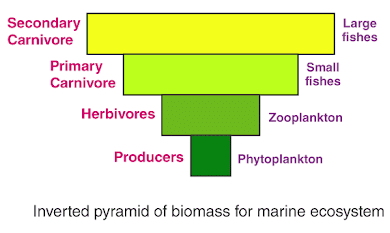
Inverted Pyramid of Biomass of a Marine Ecosystem
What is the Pyramid of Biomass?
|
Limitations
- One of the most significant drawbacks of a biomass pyramid is that each trophic level appears to have more energy than it actually has.
- The consumption of another animal by humans is a good example of this.
- The bone mass of the animal is determined. The mass of the bones, on the other hand, is not utilized at the following level of the biomass pyramid.
- The mass that is not really transported to the next trophic level is counted in a biomass pyramid.
- Nonetheless, a biomass pyramid remains one of the most effective techniques to assess if an ecosystem is out of balance.
Conclusion
The inverted pyramid of biomass is an excellent approach to visualize the structure of an ecosystem. At different trophic levels, these are used to assess the quantity of energy turned into living tissue.
FAQs
Q1: What is an inverted pyramid of biomass?
Answer: An inverted pyramid of biomass represents a situation in an ecosystem where the biomass of producers (e.g., plants or phytoplankton) is less than the biomass of consumers. This type of pyramid is commonly observed in aquatic ecosystems, where producers have high turnover rates.
Q2: In which ecosystems is an inverted pyramid of biomass most commonly observed?
Answer: An inverted pyramid of biomass is most commonly observed in aquatic ecosystems, such as lakes, oceans, and rivers, where phytoplankton (producers) have a lower biomass than the consumers (such as fish and zooplankton).
Q3: How is an inverted pyramid of biomass different from an upright pyramid of biomass?
Answer: In an upright pyramid of biomass, the biomass of producers is greater than that of consumers at higher trophic levels, whereas in an inverted pyramid of biomass, the biomass of producers is lower than the biomass of consumers.
Q4: What causes the formation of an inverted pyramid of biomass in aquatic ecosystems?
Answer: The formation of an inverted pyramid of biomass in aquatic ecosystems is caused by the high turnover rate of phytoplankton (producers), which reproduce and grow rapidly but are consumed quickly by herbivores, resulting in lower biomass compared to the consumers.
Q5: Can an inverted pyramid of biomass occur in terrestrial ecosystems?
Answer: An inverted pyramid of biomass is rare in terrestrial ecosystems, where biomass usually decreases with increasing trophic levels. It is more typical in aquatic ecosystems due to the nature of phytoplankton growth and consumption.
MCQs
- In which of the following ecosystems is an inverted pyramid of biomass most likely to occur?
a) Tropical rainforest
b) Ocean ecosystem
c) Desert ecosystem
d) Grassland ecosystem
Answer: (B) See the Explanation
- What is the primary reason for the formation of an inverted pyramid of biomass in aquatic ecosystems?
a) High reproductive rate of producers
b) Low availability of sunlight
c) Rapid consumption of producers by consumers
d) High nutrient levels in water
Answer: (C) See the Explanation
- Which of the following trophic levels typically has the lowest biomass in an inverted pyramid of biomass?
a) Primary consumers
b) Secondary consumers
c) Producers
d) Tertiary consumers
Answer: (C) See the Explanation
- An inverted pyramid of biomass is most likely to occur in ecosystems where:
a) Producers have a short lifespan and high turnover rate
b) Consumers are more efficient at converting energy
c) Nutrients are scarce
d) Decomposers dominate the ecosystem
Answer: (A) See the Explanation
- Which of the following best describes an inverted pyramid of biomass?
a) Energy is lost as it moves up the trophic levels
b) Biomass increases at each successive trophic level
c) Biomass of consumers exceeds that of producers
d) The number of organisms increases at higher trophic levels
Answer: (C) See the Explanation
GS Mains Questions and Model Answers
Q1. Explain the concept of the inverted pyramid of biomass and discuss its significance in aquatic ecosystems.
Answer: The inverted pyramid of biomass is a graphical representation of an ecosystem where the biomass of producers is lower than that of consumers. This phenomenon is primarily observed in aquatic ecosystems, where phytoplankton, the primary producers, have a high turnover rate—they grow and reproduce rapidly but are consumed at an equally fast rate by primary consumers such as zooplankton.
This type of pyramid indicates that, despite having a smaller biomass, producers can sustain a larger biomass of consumers due to their rapid reproduction. In ecosystems like oceans and lakes, the phytoplankton regenerate quickly enough to support higher trophic levels, making the inverted pyramid a typical feature of these ecosystems. The inverted pyramid is significant as it highlights the efficiency of energy transfer and the adaptability of producers in such ecosystems.
Q2. Compare and contrast the inverted pyramid of biomass with the pyramid of energy.
Answer: The inverted pyramid of biomass and the pyramid of energy are both models used to represent the flow of energy and biomass through trophic levels in an ecosystem, but they differ in several key ways.
In an inverted pyramid of biomass, the biomass of producers is lower than that of consumers, which occurs mainly in aquatic ecosystems due to the high turnover rate of producers like phytoplankton. However, in a pyramid of energy, the flow of energy is always unidirectional and decreases as it moves up the trophic levels, meaning there cannot be an inverted pyramid of energy.
The pyramid of energy represents the total energy available at each trophic level, and unlike the biomass pyramid, it does not become inverted. This is because energy is lost as heat through metabolic processes at each level, and only a fraction of energy is passed on to the next trophic level. Therefore, while the pyramid of energy is always upright, the pyramid of biomass can be inverted, particularly in aquatic ecosystems.
Q3. Discuss the ecological implications of an inverted pyramid of biomass in aquatic ecosystems.
Answer: The presence of an inverted pyramid of biomass in aquatic ecosystems has several ecological implications. One of the most important is the indication that producers like phytoplankton have high productivity and can regenerate rapidly to sustain a larger biomass of consumers, such as zooplankton and fish.
This dynamic is crucial for the functioning of marine food webs, where the rapid turnover of phytoplankton ensures a continuous supply of food for higher trophic levels. However, the reliance on such rapid regeneration makes these ecosystems vulnerable to changes in environmental conditions, such as pollution or climate change, which can disrupt phytoplankton populations and, consequently, the entire food web.
Moreover, an inverted pyramid of biomass highlights the efficiency of energy transfer in aquatic ecosystems, where a small biomass of producers can support a larger biomass of consumers. This efficiency is critical for maintaining biodiversity and the stability of aquatic ecosystems.
Previous Year Questions on Inverted pyramid of Biomass
1. UPSC CSE Mains 2018
Question. Explain why an inverted pyramid of biomass is common in aquatic ecosystems, with examples.
Answer: An inverted pyramid of biomass is common in aquatic ecosystems because the primary producers in these ecosystems, mainly phytoplankton, have a high turnover rate. Phytoplankton reproduce rapidly but are also consumed quickly by primary consumers such as zooplankton. As a result, their biomass at any given time is low compared to the biomass of consumers.
For example, in the marine ecosystem, phytoplankton are the base of the food web, but their total biomass is often lower than that of the zooplankton and fish that feed on them. This is because phytoplankton are highly efficient at converting solar energy into biomass and can regenerate rapidly. Despite having lower biomass, they provide a sufficient food supply for higher trophic levels, making an inverted pyramid of biomass a common feature of aquatic ecosystems.
2. UPSC CSE Mains 2019
Question. What factors contribute to the formation of an inverted pyramid of biomass in aquatic ecosystems? Discuss with examples.
Answer: Several factors contribute to the formation of an inverted pyramid of biomass in aquatic ecosystems. The primary factor is the high turnover rate of producers like phytoplankton, which reproduce rapidly but are also consumed quickly by primary consumers like zooplankton. This results in a situation where the biomass of producers is lower than the biomass of consumers at any given time, even though the producers are highly productive.
For example, in ocean ecosystems, the total biomass of small fish and zooplankton often exceeds that of phytoplankton, despite phytoplankton being the primary producers. This occurs because phytoplankton can quickly replenish their population, ensuring that the food web remains supported even with low standing biomass. Another contributing factor is the efficient energy transfer in aquatic ecosystems, where a smaller biomass of producers can support a larger biomass of consumers due to the continuous regeneration of the producer population.
Download the PREPP App and attempt FREE IAS Exam Mock Tests and get complete study material!

Full Test - 04: UPSC CSE Prelims CSAT (Paper-II)
Full Test - 03: UPSC CSE Prelims CSAT (Paper-II)
UPSC CSE Prelims 2026 GS Paper 1 Question Paper (24-May-2026)
UPSC CSE Prelims 2026 CSAT Paper 2 Question Paper (24-May-2026)

17 February 2025 | The Hindu Must Read Articles | Current Affairs

16 February 2026 | The Hindu Must Read Articles | Current Affairs

13 February 2026 | The Hindu Must Read Articles | Current Affairs









Comments