India's National War Memorial - Art and Culture Notes
The National War Memorial in India is a national monument built to honor and remember Indian military soldiers who fought in independent India's armed conflicts. The names of armed forces personnel killed in conflicts with Pakistan and China, as well as the 1961 Goa War, Operation Pawan, and other operations such as Operation Rakshak, are inscribed in gold letters on the memorial walls.
|
Table of Contents |
The Government of India built this monument on 40 acres of land near India Gate in New Delhi, around the existing chhatri (canopy). The memorial wall is flush with the ground and blends in with the surrounding aesthetics. It was finished in January 2019 and unveiled on February 25th, 2019. This article will explain India's National War Memorial which will be helpful in Indian Art and Culture preparation for the UPSC Civil service exam.
National War Memorial
- The National War Memorial in India is a national monument created to honor and remember Indian military personnel who served in armed conflicts throughout the country's independence.
- The names of armed forces servicemen who died in military conflicts with Pakistan and China, as well as the 1961 War in Goa, Operation Pawan, and other operations such as Operation Rakshak, are inscribed in golden script on the monument walls.
- The Government of India constructed this monument on 40 acres of ground at India Gate, New Delhi, around the existing chhatri (canopy).
- The memorial wall is flat with the ground and complements the beauty of the surrounding area.
- It was finished in January 2019 and unveiled on 25 February 2019 at a ceremony at the monument where the Prime Minister of India, in the presence of the Chief of Defence Staff (CDS) of India and the three Chiefs of Staffs of the Indian Armed Forces, lit the eternal flame of the Amar Jawan Jyoti (Flames of Eternal Soldiers) at the Amar Chakra beneath the main obelisk of the monument.
- In early April 2017, the results of a global design competition were released.
- The proposal of WeBe Design Lab, a Chennai-based architectural firm, was judged the winner, and the business was chosen to conceptualize the architectural design and coordinate the project's construction.
- WeBe Design Lab's lead architect, Yogesh Chandrahasan, was motivated by the idea of building a monument to honor and celebrate sacrifices rather than a place to grieve them.
- The National War Memorial and Museum was recognized as a Special Project, and the responsibility of "timely completion" was assigned to a Special Projects Division under the Ministry of Defence's Chief Administrative Officer and the Military Engineer Services.
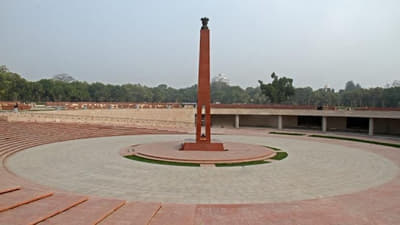
National War Memorial - Features
- The Memorial is made out of four concentric circles and a central tower with an 'everlasting flame' depicting the immortal soldier burning at its base (amar jawan).
- The concentric circles are arranged in the shape of a Chakravyuh, an ancient Indian battle formation.
- Amar Chakra: The Eternal Flame (Amar Jawan Jyoti) that burns continually beneath the main tower at the monument's center gives the memorial its name. The flame represents the immortality of fallen warriors' spirits and the nation's pledge to never forget their sacrifices.
- Veerta Chakra (Circle of Bravery), shows the bravery of Indian soldiers in the form of a covered gallery with six bronze paintings representing courageous fighting acts of the Indian Armed Forces.
- Battle of Gangasagar, Longewala, Tithwal, Rizangla, Operation Meghdoot, and Operation Trident are among the conflicts included here.
- Tyag Chakra (Sacrifice Circle): The honor walls are circular concentric walls that represent the ancient military configuration 'Chakravyuh.'
- The walls are covered with granite tablets, with one dedicated to each soldier who has given the ultimate sacrifice on the battlefield, with his name inscribed in golden letters along with his rank information.
- The outermost circle of the Rakshak Chakra (Circle of Protection) provides comfort to the residents of the country regarding their safety against any danger, with each tree symbolizing the troops who safeguard the Nation's territorial integrity around the clock.
- The busts of all 21 winners of the Param Vir Chakra, India's highest military honor, are housed at the Param Yodha Sthal.
Amar Jawan Jyothi
- Amar Jawan Jyoti is an Indian memorial that was conceived and built following the 1971 Indo-Pakistani War and dedicated on January 26, 1972.
- It served as India's national war monument until February 2019, when the new National War Memorial was erected and lit, complete with its own flame.
- The ancient flame was united with the newer ones at the National War Memorial on January 21, 2022.
- The Amar Jawan Jyoti is presently housed in the National War Memorial's inner ring, the Amar Chakra (Circle of Immortality).
- The Memorial has four concentric rings, each depicting a Chakravyuh, as well as a central obelisk with a flame burning at its base.

National War Museum
- In the nearby Princess Park area, a National War Museum will be built, with an underground tube connecting it to the memorial.
- The Princess Park, located north of India Gate, is a 14-acre area of barrack-style housing established during World War II.
- It has been used as family housing for mid-level armed services officials stationed at the Service Headquarters in New Delhi since 1947.
Conclusion
The National War Memorial honors troops who died protecting the country throughout the 1962 India-China war, 1947, 1965, and 1971 Indo-Pak wars, Indian Peace Keeping Force operations in Sri Lanka, and the 1999 Kargil battle. The National War Memorial will have a new 'eternal flame,' while the present everlasting flame at the Amar Jawan Jyoti, which was constructed in 1972 to commemorate troops who died in the 1971 India-Pakistan war, will remain lit.
FAQs
Question: What is the significance of India's National War Memorial?
Answer: The National War Memorial honors the sacrifices of Indian soldiers who have died in combat. It serves as a symbol of respect and gratitude for their contribution to India's defense and freedom.
Question: When was India's National War Memorial inaugurated?
Answer: It was inaugurated on 25th February 2019 by Prime Minister Narendra Modi, in the presence of the armed forces' leadership and other dignitaries.
Question: What are the key features of the National War Memorial?
Answer: The memorial has four concentric circles – the Amar Chakra (Martyrs' Memorial), Veerta Chakra (Valour Circle), Tyag Chakra (Sacrifice Circle), and Rakshak Chakra (Defenders' Circle) – each symbolizing different aspects of soldiering.
Question: Where is India's National War Memorial located?
Answer: The National War Memorial is located in the heart of New Delhi, near the India Gate, symbolizing the nation's respect for its martyrs.
Question: What is the role of the National War Memorial in Indian culture?
Answer: The National War Memorial plays a critical role in preserving India's military history, encouraging patriotism, and educating future generations about the sacrifices made by soldiers.
MCQs
1. What is the central feature of the National War Memorial in India?
A) The Amar Chakra
B) The Rakshak Chakra
C) The Tyag Chakra
D) The Veerta Chakra
Answer: (A) See the Explanation
The central feature of the National War Memorial is the Amar Chakra, which is dedicated to the martyrs who sacrificed their lives for India. It stands as the core symbol of remembrance.
2. What is the purpose of the National War Memorial?
A) To honor the freedom fighters of India
B) To honor the soldiers who died in war
C) To serve as a museum for military artifacts
D) To celebrate India's victory in wars
Answer: (B) See the Explanation
The primary purpose of the National War Memorial is to honor the soldiers who sacrificed their lives in various wars, ensuring their contributions are remembered by future generations.
3. Where is India's National War Memorial located?
A) Near Parliament House
B) Near India Gate, New Delhi
C) In Mumbai
D) In Kolkata
Answer: (B) See the Explanation
The National War Memorial is strategically located near India Gate in New Delhi, symbolizing the connection between India's history of conflict and its national capital.
4. What does the Tyag Chakra represent at the National War Memorial?
A) The sacrifice of soldiers
B) The bravery of soldiers
C) The valor of soldiers
D) The protection of the nation
Answer: (A) See the Explanation
The Tyag Chakra represents the supreme sacrifice made by soldiers who gave their lives for the defense of the nation, paying tribute to their selfless dedication.
5. Which of the following is not part of the National War Memorial?
A) Veerta Chakra
B) Rakshak Chakra
C) Jawan Chakra
D) Amar Chakra
Answer: (C) See the Explanation
The Jawan Chakra is not part of the National War Memorial. The memorial includes the Amar Chakra, Veerta Chakra, Tyag Chakra, and Rakshak Chakra.
GS Mains Questions and Model Answers
Q1: Discuss the historical significance of the National War Memorial and its role in preserving the memory of India's military heroes.
Answer: The National War Memorial, established to honor Indian soldiers who have died in wars since independence, serves as a vital symbol of national pride and respect. Its historical significance lies in its representation of India's military history and the acknowledgment of the sacrifices made. The memorial ensures that future generations are aware of the contributions made by soldiers, fostering a sense of patriotism and reverence towards the armed forces.
Q2: How does the design of the National War Memorial reflect India's military history and cultural ethos?
Answer: The design of the National War Memorial is symbolic of India's military history and cultural ethos. The concentric circles represent different facets of the armed forces – valor, sacrifice, and protection. The Amar Chakra at the center signifies the eternal remembrance of fallen soldiers. The incorporation of traditional Indian motifs, like the lotus, along with modern design elements, symbolizes the union of India's ancient and contemporary military traditions, creating a fitting tribute to the soldiers.
Q3: What challenges did India face in constructing the National War Memorial, and how were they overcome?
Answer: The construction of the National War Memorial faced challenges such as land acquisition, securing appropriate funding, and the complexity of designing a memorial that would represent all branches of the armed forces. The project overcame these challenges by engaging expert architects, the military, and the public to ensure that the design met national expectations. Moreover, careful planning was undertaken to ensure that the memorial blended well with its surroundings, particularly India Gate.
Previous Year Questions on India's national War Memorial
1. UPSC CSE 2020
Question: Discuss the significance of memorials and museums in preserving the cultural heritage of a nation. How does the National War Memorial contribute to this cause?
Answer: Memorials and museums play a critical role in preserving the cultural heritage of a nation, serving as a repository of history, struggles, and achievements. They act as a bridge between the past and the present, educating future generations. The National War Memorial contributes to this cause by preserving the memory of India's military history and honoring the sacrifices of soldiers, thus promoting a culture of remembrance and patriotism.
2. UPSC CSE 2019
Question: Explain the importance of commemorating national heroes in the context of India’s art and culture. What role does the National War Memorial play in this regard?
Answer: Commemorating national heroes is important in maintaining national identity and pride. It allows citizens to acknowledge and appreciate the sacrifices made for the country’s freedom and security. In the context of India's art and culture, the National War Memorial serves as a visual and symbolic tribute to the country's military history, instilling patriotism and respect for the armed forces, while promoting the preservation of national heritage.
Download the PREPP App and attempt FREE IAS Exam Mock Tests and get complete study material!
UPSC IAS : CSAT - Mini Live Test

Live Test : UPSC CSE Prelims CSAT (Paper-II) (Oct 20 - 23)
Full Test - 04: UPSC CSE Prelims CSAT (Paper-II)
Full Test - 03: UPSC CSE Prelims CSAT (Paper-II)
UPSC CSE Prelims 2026 GS Paper 1 Question Paper (24-May-2026)
UPSC CSE Prelims 2026 CSAT Paper 2 Question Paper (24-May-2026)

17 February 2025 | The Hindu Must Read Articles | Current Affairs

16 February 2026 | The Hindu Must Read Articles | Current Affairs

13 February 2026 | The Hindu Must Read Articles | Current Affairs









Comments