Indian State of Forest Report (ISFR) - Environment Notes
The Indian State of Forest Report (ISFR) is a biennial survey of India's forests and tree resources. In 1987, the first India State of Forest Report was released. The Union Ministry of Environment, Forests and Climate Change (MoEFCC) is the one which releases this report. The latest version of India's State of Forest Report was released in the year 2021. It also gives detailed information for particular states, zones, and the entire country. This article will explain to you about the Indian State of Forest Report which will be helpful in preparing the Environment syllabus for the UPSC Civil service exam.
|
Table of Contents |
India State of Forest Report 2021
- The Indian State of Forest Report 2021 is the 17th biennial evaluation of India's forests (MoEFCC).
- The ISFR 2021 provides the most up-to-date information on the country's 'Forest cover' and 'Tree cover'.
- It also presents the estimates of growing stock, the extent of trees outside forests, mangrove cover, bamboo resources, and forest carbon stock assessments.
- The chapter on forest carbon assessment also includes India's progress toward meeting its Nationally Determined Contribution commitments.
India State of Forest Report 2021
| Other Relevant Links | |
|---|---|
| Tundra | Grassland Ecosystem |
| Forest Ecosystem | Desert Ecosystem |
| Deforestation | Desertification |
India State of Forest Report 2021 - New Features
- A special chapter on "Forest Cover Assessment in Tiger Reserves and Tiger Corridor Areas of the Country and Decadal Change in Forest Cover" has been added to the standard chapters this time.
- This report also includes the results of two special studies: Above Ground Biomass Estimation Using Synthetic Aperture Radar Data (carried out in partnership with ISRO) and Climate Hot Spots in Forest Areas Studies.
- A separate chapter is dedicated to new initiatives undertaken by the Forest Survey of India (FSI) team in the recent two years.
- The Indian State of Forest Report 2021 has also assessed forest cover in tiger reserves, tiger corridors, and the Gir forest, which is home to the Asiatic lion, for the first time.
India State of Forest Report 2021 - Major Findings
Increase in Total Forest and Tree Cover
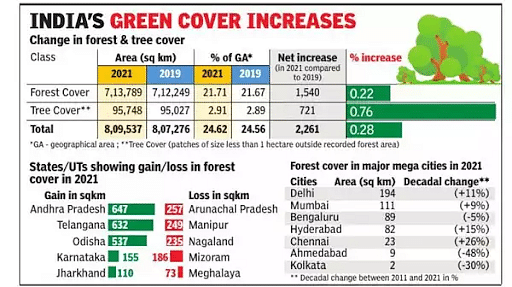
- The total forest and tree cover of the country has increased by 2,261 sq km since the last assessment in 2019 (ISFR-2019).
- The increase in forest cover is 1,540 square kilometres, and the increase in tree cover is 721 square kilometres.
- The country's entire forest and tree cover is 80.9 million hectares, or 24.62% of its overall geographical area.
Increase in Forest Cover (Top States)
- The open forest has seen an increase in forest cover, followed by dense forests.
- According to ISFR-2021, Andhra Pradesh (647 sq km), Telangana (632 sq km), and Odisha (632 sq km) are the top three states with increased forest cover (537 sq km).
Area-wise Forest Cover
- According to ISFR 2021, Madhya Pradesh has the country's largest forest cover, followed by Arunachal Pradesh, Chhattisgarh, Odisha, and Maharashtra.
Percentage-wise Forest Cover
- The top five states in terms of forest cover as the percentage of total geographical area.
- Mizoram (84.53 %)
- Arunachal Pradesh (79.33 %)
- Meghalaya (76.00 %)
- Manipur (74.34 %)
- Nagaland (73.90 % )
States/ UTs with more than one-third area under Forest Cover
- According to the ISFR 2021 findings, 17 states/UTs have forest cover covering more than 33% of their land area.
- More than 75%: Lakshadweep, Mizoram, Andaman & Nicobar Islands, Arunachal Pradesh, and Meghalaya.
- Approximately 33% to 75%: Forest cover ranges from 33 percent to 75 percent in 12 states/UTs, including Manipur, Nagaland, Tripura, Goa, Kerala, Sikkim, Uttarakhand, Chhattisgarh, Dadra & Nagar Haveli and Daman & Diu, Assam, and Odisha.
Increase in Mangrove Cover
- According to the India State of Forest Report (ISFR) 2021, mangrove cover has increased by 17 square kilometres since the previous assessment in 2019.
- The country's total mangrove cover is 4,992 square kilometres.
- Odisha (8 sq km), Maharashtra (4 sq km), and Karnataka are the top three states wit increasing mangrove cover (3 sq km).
Total Carbon Stock
- According to the India State of Forest Report (ISFR) 2021, the country's carbon stock has increased by 79.4 million tonnes since the previous assessment in 2019.
- Carbon store increases by 39.7 million tonnes every year.
- The country's forest carbon stock is projected to be 7,204 million tonnes.
Bamboo Forests
- According to ISFR 2021, bamboo forests have increased from 13,882 million culms (stems) in 2019 to 53,336 million culms (stems) in 2021.
Forest Fires in India
- According to the conclusions of the India State of Forest Report (ISFR) 2021, forest fires threaten 35.46 percent of the country's forest cover.
- 2.81 % are extremely vulnerable, 7.85 percent are very highly vulnerable, and 11.51 percent are highly vulnerable.
Climate Change Hotspots in Indian Forests
- According to ISFR 2021, climate change and rising temperatures would have a negative influence on 45-64 percent of Indian forests by 2030.
- Forests would be highly sensitive climate hotspots in all Indian states (excluding Assam, Meghalaya, Tripura, and Nagaland).
- Climate change and rising temperatures are most likely to harm the UT of Ladakh (forest cover 0.1-0.2 percent).
Forest Cover in Tiger Reserve Areas
- IFSR 2021 added a new chapter on forest cover assessment in India's Tiger Reserves, Corridors, and Lion Conservation Areas.
- In the recent decade, forest cover has decreased by 22.62 square kilometres across the 52 tiger reserves (sq km).
- Twenty of the 52 tiger reserves have exhibited signs of growth.
- Buxa (West Bengal), 238.80 sq km is one of the top three Tiger Reserves with rising forest cover.
- Anamalai (Tamil Nadu) is 120.78 square kilometres, while Indravati (Chhattisgarh) is 64.48 square kilometres.
- The 32 remaining reserves are shrinking, ranging in size from 0.06 square kilometres in Orang, Assam, to 118.97 square kilometres in Kawal, Telangana.
India State of Forest Report - Significance
- The Indian State of Forest Report is widely utilised as a primary information source among the central government, state governments, state forest department forestry professionals, academics, foreign organisations, and other stakeholders.
- The Indian State of Forest Report is also used for developing forest policies, planning, and management, as well as investments that affect the country's forestry sector.
- This report serves as a valuable resource for students and academics interested in natural resource management.
- The Indian State of Forest Report supplies a substantial amount of data that satisfies India's reporting duties to international organisations, different conventions and pledges, including:
- Food and Agriculture Organization (FAO)
- UN Framework Convention on Climate Change (UNFCCC)
- Convention on Biological Diversity (CBD)
Governments Initiatives
National Mission for a Green India
- It is one of the National Action Plan on Climate Change's eight missions (NAPCC).
- It was established in February 2014.
- The main goal is to protect our country's biological resources and associated livelihoods from the dangers of climate change.
- It also aims to recognise the critical role of forestry in ecological sustainability, biodiversity conservation, food, water, and livelihood security.
National Afforestation Programme (NAP)
- The National Afforestation Programme’s objective is to promote the afforestation of degraded forest lands.
- It was established in the year 2000.
- The Ministry of Environment, Forest and Climate Change (MoEFCC) is in charge of implementing it.
Compensatory Afforestation Fund Management and Planning Authority (CAMPA)
- The Compensatory Afforestation Fund Management and Planning Authority was established in 2016.
- 90% of the funds go to the states while the remaining 10% goes to the Centre.
- The funds can be used for catchment area treatment, assisted natural generation, forest management, wildlife protection and management, village relocation from protected areas, human-wildlife conflict management, training and awareness generation, supply of wood-saving devices, and other related activities.
National Action Programme to Combat Desertification
- It was established in 2001 in order to address the growing problem of desertification and to take necessary action.
- The Ministry of Environment, Forestry, and Climate Change is in charge of implementing it.
- The Forest Fire Prevention and Management Scheme (FFPM) is the only federally financed programme dedicated to helping states deal with forest fires.
Conclusion
The goal of this collaborative work as a report was also to map climatic hotspots over India's forest cover using computer model-based temperature and rainfall data projections for future time periods as well. The level of accuracy reached in this report is really high. The classification accuracy of forest cover has been determined to be 92.99 per cent which is really a significant figure.
|
|
|
|---|---|
| Environment Notes | Functions of an Ecosystem |
| Indian Forest Types | Terrestrial Ecosystems |
FAQs
Question: What is the primary objective of the Indian State of Forest Report (ISFR)?
Answer: The primary objective of the ISFR is to provide a comprehensive assessment of India’s forest and tree cover, helping policymakers track progress in forest conservation and sustainable forest management.
Question: How often is the Indian State of Forest Report published?
Answer: The ISFR is published biennially (every two years) by the Forest Survey of India (FSI) to monitor changes in forest and tree cover in the country.
Question: What role does ISFR play in climate change mitigation?
Answer: The ISFR plays a crucial role in climate change mitigation by assessing the amount of carbon stock in India’s forests, which helps in estimating the contribution of forests to carbon sequestration.
Question: Which Indian state has the highest forest cover according to the latest ISFR?
Answer: According to the latest ISFR, the state with the highest forest cover is Madhya Pradesh, followed by Arunachal Pradesh and Chhattisgarh.
Question: What are the different forest density categories used in the ISFR?
Answer: The ISFR categorizes forest cover into three main density classes: very dense forest (above 70% canopy density), moderately dense forest (40-70% canopy density), and open forest (10-40% canopy density).
MCQs
- What is the main purpose of the Indian State of Forest Report (ISFR)?
A. To assess the agricultural productivity of India
B. To provide a comprehensive assessment of India’s forest and tree cover
C. To track urban development projects
D. To evaluate the energy sector in India
Answer: (B) See the Explanation
The ISFR provides a comprehensive assessment of India’s forest and tree cover, helping in the evaluation of forest management and conservation efforts.
- Which category of forest has the highest canopy density, as per the ISFR classification?
A. Open forest
B. Moderately dense forest
C. Very dense forest
D. Scrub forest
Answer: (C) See the Explanation
Very dense forest is the category with the highest canopy density, defined as having more than 70% canopy cover.
- What does the ISFR report contribute to in the context of global environmental concerns?
A. Carbon emissions
B. Fossil fuel consumption
C. Carbon sequestration
D. Plastic waste management
Answer: (C) See the Explanation
The ISFR contributes to understanding carbon sequestration, which is crucial for climate change mitigation by estimating the amount of carbon stock stored in forests.
- Which Indian state has the highest forest cover, as per the latest ISFR?
A. Karnataka
B. Madhya Pradesh
C. Kerala
D. Tamil Nadu
Answer: (B) See the Explanation
According to the latest ISFR, Madhya Pradesh has the highest forest cover among Indian states, followed by Arunachal Pradesh and Chhattisgarh.
- How often is the Indian State of Forest Report (ISFR) published?
A. Every year
B. Every five years
C. Biennially
D. Every decade
Answer: (C) See the Explanation
The ISFR is published biennially (every two years) by the Forest Survey of India.
GS Mains Questions and Model Answers
Q1: Discuss the significance of the Indian State of Forest Report (ISFR) in the context of environmental conservation and sustainable development.
Answer: The Indian State of Forest Report (ISFR) plays a crucial role in environmental conservation by providing data on India’s forest and tree cover. The report helps in tracking the progress of afforestation and conservation programs, highlighting changes in forest area, forest density, and biodiversity. It also estimates carbon stock in forests, contributing to climate change mitigation efforts. The ISFR supports sustainable development by offering insights into forest resource management, helping policymakers create informed strategies to balance development with environmental protection.
Q2: Analyze the role of India’s forests in climate change mitigation, as highlighted by the ISFR.
Answer: India’s forests play a vital role in climate change mitigation by acting as carbon sinks. The ISFR highlights the contribution of forests in carbon sequestration, wherein trees absorb carbon dioxide from the atmosphere and store it as biomass. The report provides data on carbon stock in India’s forests, helping assess their impact on global carbon cycles. Efforts to increase forest cover and reduce deforestation are essential to enhancing carbon sequestration, thus reducing India’s carbon footprint. The ISFR’s focus on sustainable forest management is critical for long-term environmental stability and climate resilience.
Q3: Evaluate the challenges faced by India in achieving its forest conservation goals, as highlighted in the Indian State of Forest Report (ISFR).
Answer: Despite progress in forest conservation, India faces several challenges, as highlighted in the ISFR. These challenges include deforestation, driven by urbanization, agriculture, and infrastructure development. Forest degradation, illegal logging, and the over-exploitation of forest resources further threaten the sustainability of India’s forests. Climate change and forest fires also pose significant risks, affecting forest health and biodiversity. To overcome these challenges, India needs to strengthen its afforestation programs, improve forest governance, and adopt community-based conservation models. The ISFR provides critical data to track these efforts and identify areas that require focused interventions.
Previous Year Questions on Indian State of Forest Report
1. UPSC CSE Prelims 2020
Question: Which state has the highest forest cover in India as per the Indian State of Forest Report (ISFR)?
A. Kerala
B. Assam
C. Madhya Pradesh
D. Maharashtra
Answer: C
Explanation: According to the latest Indian State of Forest Report (ISFR), Madhya Pradesh has the highest forest cover in India.
2. UPSC CSE Mains 2018 (GS Paper 3)
Question: "Forests play a crucial role in carbon sequestration." In light of the ISFR data, discuss the importance of forests in India’s climate change mitigation strategy.
Answer: Forests play a crucial role in carbon sequestration, acting as natural carbon sinks by absorbing significant amounts of carbon dioxide from the atmosphere. According to the India State of Forest Report (ISFR), the total carbon stock in India's forests is approximately 7,204 million tonnes, which contributes substantially to mitigating climate change. Forests not only absorb carbon but also store it in the biomass, including trees, soil, and forest products. This helps reduce the overall concentration of greenhouse gases, a key factor in global warming.
In India’s climate change mitigation strategy, forests are vital in curbing carbon emissions. Afforestation and reforestation efforts, combined with sustainable forest management, can enhance this carbon absorption capacity, making forests a critical component in achieving India’s climate goals. By improving forest health and expanding forest cover, India can increase its carbon sequestration potential. Therefore, it is essential to adopt sustainable forest practices and protect existing forests to ensure their long-term contribution to climate change mitigation.
Download the PREPP App and attempt FREE IAS Exam Mock Tests and get complete study material!

Full Test - 04: UPSC CSE Prelims CSAT (Paper-II)
Full Test - 03: UPSC CSE Prelims CSAT (Paper-II)
UPSC CSE Prelims 2026 GS Paper 1 Question Paper (24-May-2026)
UPSC CSE Prelims 2026 CSAT Paper 2 Question Paper (24-May-2026)

17 February 2025 | The Hindu Must Read Articles | Current Affairs

16 February 2026 | The Hindu Must Read Articles | Current Affairs

13 February 2026 | The Hindu Must Read Articles | Current Affairs









Comments