Goals of Monetary Policy - Indian Economy Notes
It is stated in the Preamble of the Reserve Bank of India Act 1934 that, the primary goal of the monetary policy is to maintain price stability while keeping in mind the objective of growth. “Goals of Monetary Policy” is one of the important concepts in the UPSC/IAS 2023 Economy syllabus which is discussed in this article in detail.
|
Table of Contents |
What is Monetary Policy?
- Monetary policy refers to a collection of activities that a country's central bank can take to control the entire money supply and achieve long-term economic growth.
- Monetary policy can be broadly categorised into - Expansionary or contractionary monetary policy.
- Interest rates can be raised or lowered, cash can be directly lent to banks, and bank reserve requirements can be changed.
*To know more about the topic, click this link Monetary Policy
| Other Relevant Links | |
|---|---|
| Monetary Policy Committee (MPC) | Monetary Policy Tools |
| Money Supply | Types of Monetary Policy |
| Reserve Bank of India | Monetary Policy Transmission |
Goals of Monetary Policy
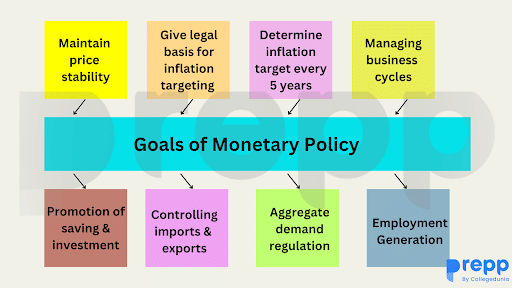
- The primary goal of monetary policy is to maintain price stability while still pursuing the goal of economic growth. Price stability is a critical prerequisite for long-term growth.
- The Reserve Bank of India (RBI) Act, 1934 was revised in May 2016 to give a legal basis for the flexible inflation targeting framework's implementation.
- The amended RBI Act also mandates that the government of India, in collaboration with the Reserve Bank, determine the inflation target once every five years.
- As a result, the Central Government published a notice in the Official Gazette setting a target of 4% Consumer Price Index (CPI) inflation for the period August 5, 2016 to March 31, 2021, with a 6% upper tolerance limit and a 2% lower tolerance limit.
- The Central Government retained the inflation target and tolerance band for the following 5-year period – April 1, 2021 to March 31, 2026 – on March 31, 2021.
- The following issues have been identified by the central government as contributing to the inability to meet the inflation target:
- For any three consecutive quarters, average inflation exceeds the inflation target's upper tolerance level; or
- For any three consecutive quarters, average inflation falls below the lower tolerance level.
- Prior to the May 2016 change to the RBI Act, the flexible inflation targeting framework was controlled by a February 20, 2015 Monetary Policy Framework Agreement between the Government and the Reserve Bank of India.
Other Goals of Monetary Policy
- Promotion of saving and investment: A higher rate of interest means more opportunities for investment and savings, ensuring a healthy cash flow in the economy.
- Managing business cycles: A business cycle has two primary stages: boom and depression. By regulating credit to manage the availability of money, monetary policy is the most effective weapon for controlling the boom and bust of business cycles.
- Controlling imports and exports: Monetary policy assists export-oriented units in substituting imports and increasing exports by assisting them in obtaining a loan at a lower interest rate. As a result, the state of the balance of payments improves.
- Aggregate demand regulation: When credit is expanded and interest rates are lowered, more people are able to get loans for the purchase of goods and services.
- Employment Generation: Small and medium companies (SMEs) can readily obtain a loan for business expansion because to the monetary policy's ability to cut interest rates. This could result in more job chances.
- Helping infrastructure development: The monetary policy allows for concessional funding for infrastructure development within the country.
Tools to achieve the goals of Monetary Policy
- The Reserve Bank of India in its Bi-monthly Monetary Policy Review meeting changes the monetary policy tools according to the prevailing inflation and economic situation.
- For instance, due to the COVID-19 situation present in the country in March 2020, the RBI took an accommodative stance and reduced Repo Rate by 75 basis points from 5.15% to 4.40%.
- It also reduced reverse repo rate from 4.9% to 4.00% and Marginal Standing Facility rate from 5.40% to 4.65% to boost consumption.
- Some important tools are:
*Click on the relevant links to read more about it.
Conclusion
The Reserve Bank of India has successfully maintained its primary goal of inflation targeting in the first five years of the statutory agreement with the government by altering the instruments of monetary policy accordingly.
| Other Relevant Links | |
|---|---|
| Indian Economics Notes | Monetary Policy |
| Banking Sector in India | Inflation |
FAQs
Question: What is the primary objective of India's monetary policy?
Answer: The primary objective of India's monetary policy is to maintain price stability and to ensure adequate flow of credit to productive sectors of the economy. The Reserve Bank of India (RBI) aims to control inflation, stabilize the rupee, and promote economic growth. In recent years, the focus has shifted to inflation targeting, with a target range set by the government in consultation with the RBI.
Question: What are the key goals of monetary policy in India?
Answer: The key goals of India's monetary policy include: 1. Controlling inflation 2. Ensuring financial stability 3. Promoting economic growth 4. Managing exchange rates 5. Reducing the fiscal deficit These goals are achieved by regulating money supply, adjusting interest rates, and managing foreign exchange reserves.
Question: How does the RBI control inflation in India?
Answer: The Reserve Bank of India controls inflation through monetary policy tools such as the repo rate, reverse repo rate, cash reserve ratio (CRR), and open market operations (OMO). By adjusting the repo rate, the RBI can influence short-term interest rates, which in turn affects consumer and business spending, thus controlling inflationary pressures.
Question: What is the role of RBI in achieving financial stability?
Answer: The RBI plays a key role in ensuring financial stability by managing the liquidity in the banking system, regulating commercial banks, and implementing prudential norms. The RBI also oversees the payment and settlement systems, ensuring that financial institutions remain solvent and stable, and that the banking system is robust enough to handle financial crises.
Question: How does monetary policy affect economic growth in India?
Answer: Monetary policy impacts economic growth by influencing interest rates and the availability of credit. Lower interest rates encourage borrowing and investment, which can stimulate demand and economic growth. On the other hand, higher interest rates can help control inflation but might slow down growth. The RBI balances these factors to achieve steady growth while keeping inflation under control.
MCQs
1. What is the main goal of India's monetary policy?
A) Price stability
B) Employment generation
C) Debt reduction
D) Industrial growth
Answer: (A) See the Explanation
Explanation: The primary goal of India's monetary policy is to maintain price stability while supporting economic growth. This is largely achieved by managing inflation levels through various policy tools like interest rates and money supply regulation.
2. How does the RBI influence inflation through monetary policy?
A) By controlling fiscal policies
B) By adjusting interest rates
C) By controlling government expenditure
D) By issuing bonds
Answer: (B) See the Explanation
Explanation: The RBI influences inflation primarily by adjusting interest rates. Lower interest rates encourage borrowing and spending, which can boost demand and potentially increase inflation, while higher rates reduce borrowing and control inflationary pressures.
3. Which of the following is a tool used by the RBI to regulate the money supply in the economy?
A) Repo rate
B) GDP growth rate
C) Government subsidies
D) Import duties
Answer: (A) See the Explanation
Explanation: The repo rate is one of the key tools used by the RBI to regulate money supply. It is the rate at which the RBI lends money to commercial banks, influencing the interest rates in the broader economy.
4. What is the role of the Reserve Bank of India in controlling financial stability?
A) Regulation of banks
B) Adjusting tax policies
C) Setting income tax rates
D) Encouraging government spending
Answer: (A) See the Explanation
Explanation: The RBI ensures financial stability by regulating banks, setting prudential norms, and overseeing the payment and settlement systems. It ensures that financial institutions operate safely and are resilient to economic shocks.
5. Which of the following goals is directly related to managing the fiscal deficit in India?
A) Maintaining economic growth
B) Stabilizing exchange rates
C) Controlling inflation
D) Reducing the fiscal deficit
Answer: (D) See the Explanation
Explanation: The RBI works indirectly to reduce the fiscal deficit by managing the supply of money and influencing interest rates, which can affect government borrowing costs and overall fiscal management.
GS Mains Questions and Model Answers
Q1: Analyze the importance of monetary policy in managing inflation and promoting economic stability in India. How does it affect various sectors of the economy?
Answer: Monetary policy is crucial for managing inflation and ensuring economic stability in India. By controlling money supply and adjusting interest rates, the Reserve Bank of India (RBI) influences inflationary pressures, promoting price stability. Higher interest rates reduce inflation by curbing demand, while lower rates stimulate economic growth. The policy impacts various sectors such as agriculture, industry, and services, by affecting borrowing costs and investment levels. A balanced monetary policy helps maintain growth while keeping inflation within acceptable limits, supporting overall economic development.
Q2: Discuss the challenges faced by the RBI in achieving the goals of monetary policy in India. What measures can be taken to overcome these challenges?
Answer: The RBI faces several challenges in achieving the goals of monetary policy, including the complex interplay between inflation control and economic growth, managing volatile capital flows, and aligning monetary policy with fiscal policy. Additionally, the RBI must address structural issues such as financial inclusion and inefficient credit flow to critical sectors. To overcome these challenges, the RBI can focus on improving monetary policy transmission, coordinating better with the government on fiscal measures, and ensuring a more inclusive financial system that facilitates access to credit for underserved areas.
Q3: Evaluate the role of the RBI in achieving India's sustainable development goals through its monetary policy. How does it support climate change mitigation and adaptation?
Answer: The RBI plays a significant role in India's sustainable development goals by ensuring that monetary policy supports long-term economic stability and sustainable growth. Through initiatives like promoting green financing, the RBI encourages investments in renewable energy and sustainable projects. It also supports climate change mitigation by providing favorable monetary conditions for environmentally sustainable businesses. By integrating environmental concerns into its policy framework, the RBI fosters economic growth that aligns with both climate goals and development needs.
Previous Year Questions on Monetary Policy
1. UPSC CSE Prelims 2020:
Question: Which of the following is a primary objective of India's monetary policy?
A) Promoting exports
B) Reducing inflation
C) Managing government spending
D) Ensuring a stable exchange rate
Answer: (B)
Explanation: The primary objective of India's monetary policy is to control inflation and ensure price stability, alongside promoting economic growth.
2. UPSC CSE Mains 2019 (GS Paper 3):
Question: "Critically examine the effectiveness of India’s monetary policy in curbing inflation and stimulating economic growth." What are the key challenges?
Answer: India's monetary policy has been effective in curbing inflation through tools like interest rate adjustments and money supply regulation. However, challenges such as balancing inflation control with economic growth, managing external shocks, and ensuring equitable credit distribution persist. The RBI needs to address these by improving transmission mechanisms and aligning fiscal and monetary policies for better outcomes.
Download the PREPP App and attempt FREE IAS Exam Mock Tests and get complete study material!

Full Test - 04: UPSC CSE Prelims CSAT (Paper-II)
Full Test - 03: UPSC CSE Prelims CSAT (Paper-II)
UPSC CSE Prelims 2026 GS Paper 1 Question Paper (24-May-2026)
UPSC CSE Prelims 2026 CSAT Paper 2 Question Paper (24-May-2026)

17 February 2025 | The Hindu Must Read Articles | Current Affairs

16 February 2026 | The Hindu Must Read Articles | Current Affairs

13 February 2026 | The Hindu Must Read Articles | Current Affairs









Comments