Difference Between Left-Wing and Right-Wing - Indian Polity Notes
Left-Wing and Right-Wing Politics are opposing ideologies with different outlooks and applications. The differences between Left-Wing and Right-wing are very deep-rooted. Left-Wing ideology is considered to be reformative or revolutionary. On the other hand, the Right-Wing ideology is believed to be conservative and establishment. Their views differ in both the social and economic aspects. This article explains the Differences between Left-Wing and Right-wing are important for UPSC IAS exam preparation.
|
Table of Contents |
Left Wing and Right Wing - Concept
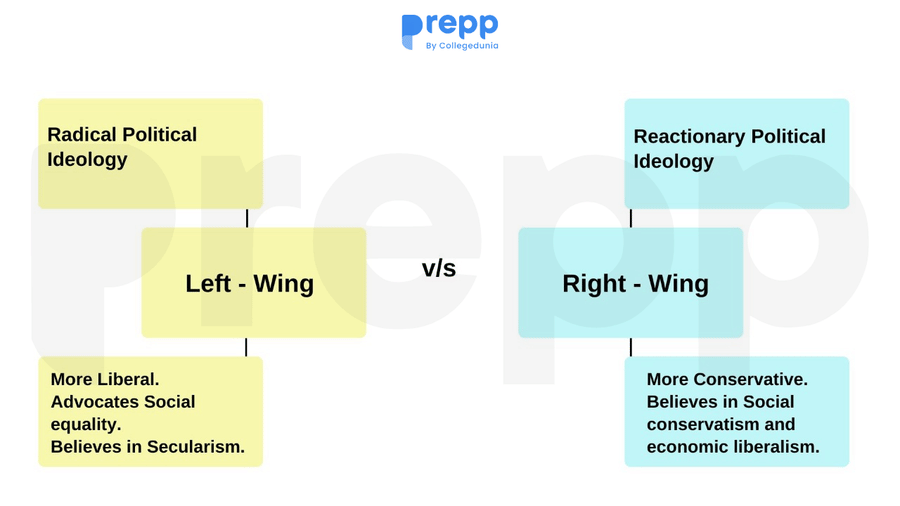
- Left-wing beliefs are liberal in the sense that they believe the government should have a stronger role in society.
- The emphasis on equality, fraternity, progress, and change are the characteristics of left-wing politics.
- Conservative politics are more prominent on the Right - wing. Those who believe in the current system. Conservatives, Nationalists, and Republicans are all adherents of the right.
- They believe in social conservatism and economic liberalism.
- Both The word 'left' and 'right' were originally employed in the French Revolution of the 18th century.
| Other Relevant Links | |
|---|---|
| Left Wing | Right Wing |
| Multi-Party System | Political Parties and Pressure Groups |
Differences between Left Wing and Right Wing
|
Left-Wing |
Right-Wing |
|---|---|
|
The parties who wish to overhaul the current system. They are mostly Liberals, Socialists, Democrats, and Communists. |
Those who believe in the current system. The right-core wing's beliefs are social conservatism and economic liberalism, and they are Conservatives, Nationalists, and Republicans. |
|
Radical Political Ideology |
Reactionary Political Ideology |
|
In terms of method and outlook, left-wing politics are more liberal. |
Right-wing politics are more conservative than left-wing politics. |
|
During the French Revolution, anti-monarchy revolutionaries sat on the left side of the hall, giving rise to the name "left-wing." |
The phrase 'Right-wing' originated during the French Revolution when supporters of the monarchy sat on the right side of the National Assembly's right hall. |
|
Reduced income inequality, higher tax rates for the wealthy, and more government spending on social programmes and infrastructure are all examples of left-wing economic policy. |
Its economic objectives include minimal taxes and reduced government supervision of enterprises. |
|
The emphasis on equality, fraternity, development, and reform characterises left-wing politics. |
The notions of authority, hierarchy, tradition, and nationalism characterise right-wing politics. |
|
Those on the left-wing believe that having the government play a larger role in society will benefit everyone. |
Right-wing beliefs think that the best outcome for society is achieved when individual rights and civil liberties are prioritised, with the government's role limited. |
|
Social equality, popular sovereignty, and national self-determination are the foundations of left-wing nationalism. It is intimately associated with national liberation movements. |
Right-wing nationalism is influenced by Romantic nationalism, which claims that the state's legitimacy is derived from the culture it rules, including language, race, and customs "born" inside that culture. |
|
Traditional left-wing politics has been hostile to religious institutions, believing that the state and religion must be kept separate as the state must be secular. |
Right-wing politics has always found followers among those who feel religion should have a larger role in society. |
|
Left-wing populist views do not contain horizontal exclusion and will instead focus on egalitarian values. |
In right-wing political circles, populism is a recurring theme. Populism is a political philosophy that appeals to regular citizens who believe their rights are being ignored. |
Conclusion
In general, political parties in India are difficult to categorise as left or right because they adhere to some left-wing and some right-wing viewpoints. They are free to adjust their policies without regard for whether they are left- or right-wing. As a result, it is preferable to assess political parties based on their programmes and viewpoints. Neither Left-wing nor Right-wing ideology in its purest form is best for a country in terms of its development. Rather the mix of both is known as the centrist ideology which would help a country’s growth and development.
FAQs
Question: What are the core ideologies of left-wing politics in India?
Answer: Left-wing politics in India primarily focuses on social equality, welfare, and the redistribution of wealth. The core ideologies emphasize government intervention in the economy to ensure equitable resource distribution, support for marginalized communities, and a commitment to secularism. Prominent left-wing parties advocate for policies aimed at reducing economic disparities, promoting labor rights, and enhancing social justice through welfare programs. This ideology also encompasses environmental sustainability and progressive social policies, positioning it as a champion for the underprivileged in Indian society.
Question: How do right-wing ideologies manifest in Indian politics?
Answer: Right-wing ideologies in India are characterized by an emphasis on nationalism, tradition, and economic liberalism. Right-wing parties often advocate for a limited role of government in economic affairs, promoting free-market policies and private enterprise. Additionally, they emphasize cultural identity, often intertwining religion with nationalism, which can influence social policies. This perspective supports the idea of a strong state to maintain law and order and often promotes traditional values, viewing them as essential for societal stability and progress.
Question: What is the historical context of left-wing and right-wing politics in India?
Answer: The historical context of left-wing and right-wing politics in India can be traced back to the independence movement. The Indian National Congress initially had a broad ideological base, including leftists who advocated for socialism. Post-independence, the left gained prominence with the formation of the Communist Party of India, focusing on workers' rights and land reforms. In contrast, right-wing politics emerged with organizations like the Rashtriya Swayamsevak Sangh (RSS), advocating for Hindu nationalism and cultural revival. Over the decades, these ideologies have evolved, shaping contemporary political dynamics, especially with the rise of the Bharatiya Janata Party (BJP) as a major political force representing right-wing views.
Question: What are the key differences between left-wing and right-wing parties in India?
Answer: The key differences between left-wing and right-wing parties in India are based on their ideological approaches to governance and society. Left-wing parties advocate for social justice, wealth redistribution, and government intervention in the economy, prioritizing welfare programs for marginalized groups. In contrast, right-wing parties emphasize nationalism, cultural identity, and free-market economics, often favoring privatization and minimal government interference. Additionally, left-wing parties generally support secularism and inclusivity, while right-wing parties may promote a more religiously oriented nationalism, leading to divergent perspectives on social policies and governance.
Question: How do left-wing and right-wing parties influence policy-making in India?
Answer: Left-wing and right-wing parties significantly influence policy-making in India through their respective ideologies and electoral power. Left-wing parties often push for progressive reforms, such as labor rights, environmental protection, and social welfare initiatives, shaping policies aimed at reducing inequality. On the other hand, right-wing parties influence policies by advocating for economic liberalization, national security, and cultural values, which can lead to changes in taxation, trade, and education systems. The political competition between these ideologies drives legislative debates and policy formulation, reflecting the diverse perspectives of Indian society.
MCQs
1. Which ideology is primarily associated with left-wing politics in India?
A) Nationalism
B) Economic liberalism
C) Social equality
D) Traditionalism
Answer: (C) See the Explanation
Explanation: Left-wing politics in India is primarily associated with the ideology of social equality, focusing on wealth redistribution, welfare programs, and government intervention to support marginalized communities.
2. Which party is often considered a representative of right-wing ideology in India?
A) Indian National Congress
B) Communist Party of India
C) Aam Aadmi Party
D) Bharatiya Janata Party
Answer: (D) See the Explanation
Explanation: The Bharatiya Janata Party (BJP) is often considered a representative of right-wing ideology in India, emphasizing nationalism, cultural identity, and economic liberalism.
3. What is a primary focus of right-wing political parties in India?
A) Government intervention in the economy
B) Secularism
C) Free-market policies
D) Environmental sustainability
Answer: (C) See the Explanation
Explanation: Right-wing political parties in India primarily focus on free-market policies, advocating for limited government intervention in economic affairs and promoting private enterprise.
4. Which of the following best describes left-wing politics?
A) Emphasis on tradition
B) Advocacy for social justice
C) Focus on national security
D) Promotion of individualism
Answer: (B) See the Explanation
Explanation: Left-wing politics is best described by advocacy for social justice, prioritizing equality and welfare for marginalized groups through various social programs and reforms.
5. What was a significant historical factor in the development of left and right ideologies in India?
A) Colonial rule
B) Globalization
C) Post-independence economic policies
D) Regional conflicts
Answer: (A) See the Explanation
Explanation: Colonial rule significantly influenced the development of left and right ideologies in India, as it fostered movements for both social justice (leading to leftist ideologies) and nationalism (leading to rightist ideologies).
GS Mains Questions and Model Answers
Q1: Evaluate the ideological differences between left-wing and right-wing politics in India, and discuss their implications for governance.
Answer: The ideological differences between left-wing and right-wing politics in India are stark, influencing their respective approaches to governance. Left-wing parties advocate for social justice, economic equality, and extensive welfare programs aimed at uplifting marginalized communities. They emphasize government intervention in the economy to address disparities and promote inclusivity. In contrast, right-wing parties prioritize nationalism, cultural identity, and free-market principles, advocating for minimal government interference and greater reliance on private enterprise. These differences have significant implications for governance, as leftist policies often focus on redistributive measures and social welfare, while rightist policies emphasize economic growth and traditional values. The interplay of these ideologies shapes policy decisions, electoral strategies, and the overall political landscape, reflecting the diverse aspirations and concerns of Indian society.
Q2: Analyze the impact of left-wing movements on social policies in India.
Answer: Left-wing movements have had a profound impact on social policies in India, advocating for issues such as land reforms, labor rights, and social justice. Historically, these movements have sought to address the needs of marginalized communities, including lower castes, women, and laborers, pushing for legislation that ensures equitable access to resources and opportunities. For instance, land reforms initiated by leftist leaders aimed to redistribute land from feudal lords to landless farmers, significantly altering the agrarian landscape. Furthermore, left-wing parties have championed policies that promote gender equality and worker protections, such as the Minimum Wages Act and the Maternity Benefit Act. The ongoing influence of left-wing ideologies continues to shape contemporary social policies, emphasizing the need for a more inclusive society and equitable development.
Q3: Discuss the role of right-wing political parties in shaping India's economic policies post-liberalization.
Answer: Right-wing political parties, particularly the Bharatiya Janata Party (BJP), have played a crucial role in shaping India's economic policies since the liberalization of the economy in the 1990s. Their emphasis on free-market principles has led to a shift towards privatization and deregulation, encouraging foreign investment and promoting entrepreneurship. The right-wing's focus on infrastructure development and economic growth has resulted in significant initiatives such as the Make in India campaign, aimed at boosting manufacturing and job creation. Additionally, right-wing parties advocate for minimal government interference in the economy, positioning themselves as champions of individual enterprise. However, this approach has also raised concerns regarding inequality and social welfare, as economic growth has not uniformly benefited all sections of society. The tension between growth-oriented policies and the need for inclusive development remains a central theme in India's post-liberalization economic landscape.
Previous Year Questions on Left-Wing and Right-Wing
1. UPSC CSE Prelims 2021:
Question: Which of the following is a characteristic of left-wing politics?
A) Emphasis on free markets
B) Advocacy for social welfare
C) Focus on nationalism
D) Support for traditional values
Answer: (B)
Explanation: Left-wing politics is characterized by advocacy for social welfare, focusing on policies aimed at reducing inequality and supporting marginalized communities through government intervention.
2. UPSC CSE Mains 2019 (GS Paper 1):
Question: "Critically analyze the evolution of right-wing ideologies in India and their impact on social policies." Discuss the implications for governance.
Answer: The evolution of right-wing ideologies in India has been marked by a focus on nationalism and economic liberalism, particularly with the rise of the Bharatiya Janata Party (BJP). This ideological shift has influenced social policies, often prioritizing cultural identity and traditional values over progressive reforms. The right's emphasis on a strong state and economic growth has led to significant policy changes, including increased privatization and a reduction in government welfare programs. However, this has also sparked debates about social justice and equality, highlighting the need for a balanced approach to governance that addresses both economic growth and social equity.
Download the PREPP App and attempt FREE IAS Exam Mock Tests and get complete study material!

Full Test - 04: UPSC CSE Prelims CSAT (Paper-II)
Full Test - 03: UPSC CSE Prelims CSAT (Paper-II)
UPSC CSE Prelims 2026 GS Paper 1 Question Paper (24-May-2026)
UPSC CSE Prelims 2026 CSAT Paper 2 Question Paper (24-May-2026)

17 February 2025 | The Hindu Must Read Articles | Current Affairs

16 February 2026 | The Hindu Must Read Articles | Current Affairs

13 February 2026 | The Hindu Must Read Articles | Current Affairs









Comments