Political Systems (Democratic and Non-Democratic) - Indian Polity Notes
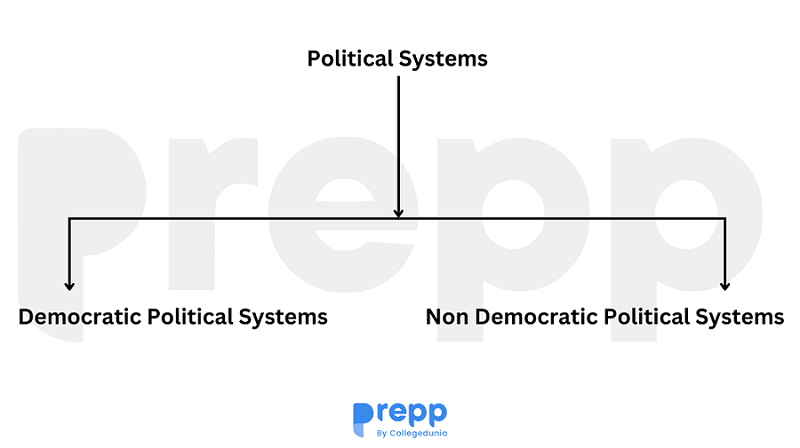
Political system refers to the set of institutions, laws, and practices that determine how a country or society is governed and how political power is distributed. There are various types of political systems, each with its own characteristics and principles. Democratic and non-democratic political systems represent two broad categories that describe how political power is exercised and how governments are structured. Understanding different types of political systems is important for UPSC Examination.
| To Read update on this topic: |
|
Table of Contents |
Democratic Government - Concept
- Democracy is a type of government in which individuals directly exercise power or via elected representatives who form a governing body.
- In principle a democratic government practises democracy as a fundamental form of governance.
- In such a political system people rule the government either directly or via representatives elected by them.
- Democracy permits individuals to participate equally in the formulation, development, and construction of laws, either directly or through elected officials.
- It refers to the social, economic, and cultural conditions that allow for the free and equitable exercise of political self determination.
- It is also frequently associated with neoliberalism ie. market-oriented reforms policies.
|
“Man's capacity for justice makes democracy possible, but man's inclination to injustice makes democracy necessary.”
|

Basic Features Of Democratic Government
- Rule by the People:In a democratic political system, ultimate authority and decision-making power rest with the people. Citizens typically have the right to participate in the political process through voting.
- Representation: Democracies often employ a representative system, where citizens elect representatives to make decisions on their behalf. This is known as representative democracy.
- Protection of Individual Rights: Democracies emphasize the protection of individual rights and freedoms. Constitutions or legal frameworks often guarantee citizens certain fundamental rights.
- Rule of Law: Democracies operate under the rule of law, where laws apply equally to all individuals, including government officials. No one is above the law.
- Pluralism and Diversity: Democratic societies tend to value diversity of opinions and perspectives. Multiple political parties and a vibrant civil society are common features.
- Free and Fair Elections: Democratic elections are expected to be free and fair, allowing citizens to choose their leaders without coercion or manipulation.
- Peaceful Transfer of Power: In a stable democracy, power transitions occur peacefully, often through regular elections.
Democratic Government - Types
Direct democracy and representative democracy are the two primary types
Direct democracy
- Direct democracy is a form of governance in which citizens can directly engage in decision-making.
- Electoral tools such as referendums, recall, and citizens' initiatives are referred to as direct democracy tools, despite the fact that they are mostly utilised in a representational democracy.
- Example: Switzerland
Representative democracy
- In the current world, representative democracy is the most frequent type of democracy.
- In this system, ordinary people elect politicians to represent them. If the leader or head of a state is also elected democratically, the state is known as a democratic republic.
- Example: United Kingdom
Democratic Government – Significance
The democratic form of government is significant for several reasons
- Popular Sovereignty: In a democracy, the ultimate source of political authority is the people. Citizens have the power to elect their representatives and participate in decision-making processes. It ensures that the government is accountable to the people.
- Individual Rights and Freedoms: Democracies prioritize the protection of individual rights and freedoms. Constitutions and legal frameworks often enshrine fundamental rights, ensuring that citizens are protected from arbitrary government actions.
- Rule of Law: Democratic societies operate under the rule of law, where laws are applied equally to all individuals, including government officials. This helps prevent abuses of power and ensures a fair and just legal system.
- Political Pluralism: Democracy encourages political pluralism, allowing for the existence of multiple political parties and diverse opinions. This diversity fosters a robust political debate and representation of various perspectives within society.
- Peaceful Conflict Resolution: Democracies provide mechanisms for resolving conflicts and differences through peaceful means. Elections, debates, and negotiations are employed to address disagreements, reducing the likelihood of violent conflict.
- Accountability and Transparency: Democratic governments are accountable to the people. Regular elections allow citizens to hold leaders accountable for their actions and policies. Additionally, transparency in government operations promotes public trust.
- Inclusive Decision-Making: Democracy ensures that decisions are made with the input of a broad spectrum of the population.
- Economic Stability: Democracies, through stable governance and adherence to the rule of law, often contribute to economic stability. Predictable political environments are conducive to investment and economic growth.
- Human Development: Democracies often correlate with higher levels of human development. They tend to invest in education, healthcare, and social welfare, contributing to the overall well-being of their citizens.
Non-democratic Government
- A non-democratic government is one that does not adhere to democratic principles.
- Non-democratic governments can be monarchies, oligarchies, aristocracies, anarchies, feudalism, theocracies, or any other type of government.
- The decision-making process of non-democratic dictators is extremely swift. In strategic thought and even action implementation.
- The majority of this occurs because non-democratic rulers do not have to deal with assembly processes or public opinion.
- Discrimination and inequality are the basic features of non-democratic governments. People in such a society usually;
- Lack the right to choose the rulers of their choice
- Lack the right to replace the rulers who do not perform in their interest
- Lack the protection to their life and property – i.e. Human rights violation
- Lack the right to equality before law and equal protection of law
- Active participation in civic and political life is often hindered by obstacles created by the privileged groups.
Non-democratic government – Types
- Monarchy is where the actual power is exercised by a person who is not elected by people and cannot be replaced by them. In premodern times all the kings, Queens, and their nobles were the monarch.
- Oligarchy Here power is exercised by a small group of people who are, in practice, not accountable to people.
- Aristocracy In such a state power is exercised by some privileged groups of society.
- Theocracy is a state which is run by religious authority. Ex: Taliban in Afghanistan.
Difference between Democratic and Non - Democratic Governments
| Democratic government | Non - Democratic government |
|---|---|
|
|
|
|
|
|
|
|
|
|
|
|
Conclusion
While democratic governance has its advantages, it is important to note that no system is perfect, and challenges can arise within democracies. Issues such as voter apathy, political polarization, and the risk of "tyranny of the majority" are considerations that democratic societies grapple with. Nonetheless, the democratic form of government remains a widely embraced model for promoting individual freedoms, equality, and governance that is responsive to the needs and aspirations of the people.
|
|
|
|---|---|
| Indian Polity UPSC Notes | Types of government |
| Presidential form of government | Monarchy |
| Constitution of India-Overview | Historical Background of Indian Constitution |
FAQs
Q1. What is a democratic government?
Answer: A democratic government is one in which the power to govern is vested in the people, either directly or through elected representatives.
Q2. What are the characteristics of a non-democratic government?
Answer: Non-democratic governments often have centralized control, limited political freedoms, and a lack of fair electoral processes.
Q3. How does a parliamentary democracy function?
Answer: A parliamentary democracy is governed by representatives elected by the public, where the executive derives its democratic legitimacy from the legislature.
Q4. What are the differences between direct and representative democracy?
Answer: In direct democracy, citizens vote on laws directly, while in representative democracy, they elect representatives to make decisions on their behalf.
Q5. Can a country be both democratic and authoritarian?
Answer: Yes, some countries exhibit hybrid regimes where democratic structures exist but are undermined by authoritarian practices.
MCQs
- Which of the following is a feature of a democratic government?
A) Concentration of power in one individual
B) Regular free and fair elections
C) Suppression of dissent
D) Control of media by the government
Answer: (B) See the Explanation
A fundamental characteristic of a democratic government is that it conducts regular free and fair elections, ensuring that the government reflects the will of the people.
- What type of government is characterized by a single-party rule?
A) Democratic
B) Theocratic
C) Authoritarian
D) Federal
Answer: (C) See the Explanation
Authoritarian governments often feature single-party rule, where one political party controls the state, limiting political pluralism.
- Which of the following is a disadvantage of direct democracy?
A) Voter apathy
B) Higher participation rates
C) Enhanced civic engagement
D) More informed decision-making
Answer: (A) See the Explanation
Direct democracy can lead to voter apathy as citizens may feel overwhelmed by the frequency and complexity of decisions they need to make.
- In which type of government is the head of state different from the head of government?
A) Presidential system
B) Parliamentary system
C) Monarchy
D) Oligarchy
Answer: (B) See the Explanation
In a parliamentary system, the head of state (often a monarch or president) is distinct from the head of government (the prime minister).
- Which of the following best describes a theocratic government?
A) Rule by the elected representatives of the people
B) Rule by religious leaders
C) Rule by military leaders
D) Rule by a single political party
Answer: (B) See the Explanation
In a theocratic government, religious leaders control the government, and laws are often based on religious principles.
GS Mains Questions and Model Answers
Q1. Discuss the significance of democratic governance in modern society.
Answer: Democratic governance is crucial in modern society as it ensures the participation of citizens in decision-making processes. It promotes accountability and transparency in government operations, allowing citizens to influence policies that affect their lives. By providing mechanisms for peaceful transition of power, democracy prevents the concentration of power and abuse, fostering a more equitable society. Furthermore, democratic governance supports human rights, civil liberties, and the rule of law, creating an environment where diversity is respected and protected. As global challenges arise, democratic institutions facilitate collective action and responsive governance, essential for sustainable development.
Q2. Evaluate the impact of non-democratic regimes on economic development.
Answer: Non-democratic regimes often hinder economic development due to a lack of accountability and transparency. Such governments may prioritize political loyalty over competence, leading to inefficient resource allocation and corruption. The absence of public participation in decision-making can stifle innovation and limit opportunities for entrepreneurship. Furthermore, these regimes may suppress dissent, leading to social unrest and instability, which deter foreign investment. In contrast, democracies generally promote policies that encourage economic growth through open markets and protection of property rights. Ultimately, while some non-democratic regimes may achieve short-term economic gains, their long-term sustainability is often compromised.
Q3. Analyze the challenges faced by hybrid regimes in maintaining stability.
Answer: Hybrid regimes, which blend democratic and authoritarian elements, face unique challenges in maintaining stability. The lack of genuine democratic processes can lead to public disillusionment, protests, and calls for reform, threatening the regime's legitimacy. Additionally, these regimes may struggle to balance repression with the need for public support, often resorting to authoritarian measures that can escalate tensions. The presence of opposition groups and a civil society seeking greater democratic freedoms further complicates governance. Furthermore, external pressures from international organizations advocating for democracy may influence domestic politics, pushing hybrid regimes to adopt reforms they are not genuinely committed to. This instability can result in an unpredictable political environment, jeopardizing both governance and economic growth.
Previous Year Questions on Political Systems
1. UPSC CSE 2020
Question: Discuss the challenges to democracy in India.
Answer: The challenges to democracy in India are multifaceted, ranging from political corruption and criminalization of politics to social inequality and communal tensions. Political corruption undermines public trust in democratic institutions, as rampant bribery and nepotism distort governance and public service delivery. The criminalization of politics, where individuals with serious criminal charges stand for elections, poses a significant threat to the integrity of democracy, as it raises questions about the motives and accountability of elected representatives. Social inequality further complicates the democratic fabric, as marginalized groups often face systemic discrimination, limiting their participation in political processes. Communal tensions can lead to violence and undermine social cohesion, destabilizing democratic structures. Addressing these challenges requires a comprehensive approach, focusing on electoral reforms, strengthening the rule of law, and promoting inclusive policies that empower all citizens.
2. UPSC CSE 2019
Question: Examine the role of the Election Commission in ensuring free and fair elections in India.
Answer: The Election Commission of India (ECI) plays a pivotal role in upholding the democratic ethos by ensuring free and fair elections. It is an autonomous constitutional authority tasked with overseeing the electoral process in the country. The ECI's responsibilities include preparing and updating electoral rolls, conducting elections to the Lok Sabha, Rajya Sabha, and State Legislative Assemblies, and ensuring compliance with electoral laws. The ECI also monitors campaign financing, enforces the Model Code of Conduct, and addresses grievances related to electoral malpractice. By instituting measures such as Voter Verifiable Paper Audit Trails (VVPAT) and electronic voting machines (EVMs), the ECI enhances transparency and voter confidence in the electoral process. Moreover, its independence from the executive and legislative branches allows it to function without undue influence, crucial for maintaining the integrity of the electoral system. The ECI's efforts in promoting voter education and participation further contribute to strengthening the democratic framework in India.
*email: contactus@prepp.in
Download the PREPP App and attempt FREE IAS Exam Mock Tests and get complete study material!
UPSC IAS : CSAT - Mini Live Test

Live Test : UPSC CSE Prelims CSAT (Paper-II) (Oct 20 - 23)
Full Test - 04: UPSC CSE Prelims CSAT (Paper-II)
Full Test - 03: UPSC CSE Prelims CSAT (Paper-II)
UPSC CSE Prelims 2026 GS Paper 1 Question Paper (24-May-2026)
UPSC CSE Prelims 2026 CSAT Paper 2 Question Paper (24-May-2026)

17 February 2025 | The Hindu Must Read Articles | Current Affairs

16 February 2026 | The Hindu Must Read Articles | Current Affairs

13 February 2026 | The Hindu Must Read Articles | Current Affairs









Comments