Difference Between Parliamentary and Presidential Form of Government - Indian Polity Notes
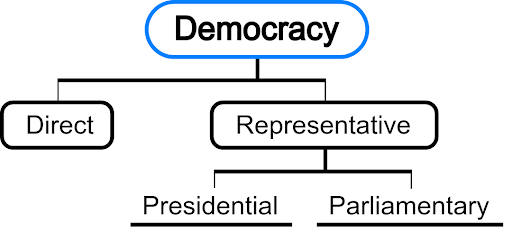
A representative democracy is separated into two parts: Parliamentary democracy and Presidential democracy. A presidential system, also known as a single executive system, is a type of government in which the president leads an executive branch that is separate from the legislative branch, whereas a parliamentary system, also known as parliamentary democracy, is a type of democratic administration in which the executive gains political legitimacy by commanding the support of the legislative, usually a parliament, to whom it is accountable. In this article, we will discuss the Difference Between Parliamentary and Presidential Form of Government which is important for UPSC Examinations.
|
Table of Contents |

Presidential Form of Government?
- A presidential system is a form of government in which the President serves as the Chief Executive and is chosen by the people directly.
- As a result, the executive branch of government is distinct from the legislative branch.
- It is a type of government in which the three branches (legislature, executive, and judiciary) operate independently and are unable to dismiss or dissolve one another.
- While the legislative creates the laws, the President is responsible for enforcing them, and the courts are in charge of carrying out judicial tasks.
- This kind of government is stable. Because the president's tenure is set and not subject to parliamentary majority support, he does not need to be concerned about losing the government.
- There is no chance of the government falling suddenly. The president is not under any political pressure to make choices.
- Because the government's duration is fixed, political parties do not seek to destabilise it.
Parliamentary Form of Government
- A Parliamentary form of democracy is also known as the Cabinet form of government or the ‘Responsible Government’.
- It is a form of government in which residents elect members to the legislative legislature.
- This Parliament is in charge of making state-wide decisions and legislation.
- It is also directly accountable to the general public.
- The constitution-makers in India chose a parliamentary form of government primarily because the system in England had a large effect on them.
- Another point the founding fathers realised was that the parliamentary model would only function to accommodate our population's various and different factions.
- Due to the lack of a true separation of powers, the legislature cannot always hold the executive accountable. This is especially true if the administration has a large majority in the House of Representatives.
Difference between the Parliamentary and Presidential forms of the Government
|
Basis |
Parliamentary Form of Government |
Presidential Form of Government |
|
Meaning |
It is a type of governance in which the legislative and the executive branch are intimately correlated. It is a form of government in which citizens elect representatives to the legislative body. |
It is a form of governance in which the executive, judiciary, and legislature all act independently of one another. The President serves as the chief executive and is directly chosen by the people. |
|
Executive |
Dual executive as leader of the state and leader of the government are different. The executive is divided into two components under parliamentary government: the Head of State (President) and the Head of Government (Prime Minister). |
a single executive as the head of the state and the head of the government is the same. The President is the head of the Presidential form of government. |
|
Ministers |
Belong to the ruling party and are Members of Parliament. Generally, no outsider is allowed to become a minister. |
Can be chosen from outside the legislature, and are usually industry experts. |
|
Accountability |
Executive accountable to Legislature. The parliamentary system of government is one in which the legislative and executive bodies work in tandem, but the judiciary branch operates independently. |
Executive not accountable to Legislature. With contrast, in a presidential form of government, the three branches of government operate independently of one another. |
|
Dissolution of the lower house |
The Prime Minister is able to dissolve the lower house. |
The President cannot dissolve the lower house. |
|
Tenure |
Prime Minister’s tenure depends upon majority support in the Parliament. Thus, it is not fixed. |
Fixed tenure for President. |
|
Separation of Powers |
No clear-cut separation of power. |
The principle of Separation of powers is strictly followed. |
|
Party Discipline |
Stronger party discipline |
Party discipline is comparatively less |
|
Autocracy |
Less autocratic |
More autocratic. |
|
Examples |
India and The United Kingdom |
Costa Rica and the United States |
Conclusion
Every country in the world has its own constitution, which governs how policies are developed, how government organisations and institutions operate, and how decisions are made. The governmental structure of a country differs depending on whether it has a presidential or parliamentary system. Some countries have utilised a mix of these strategies. These systems are distinguished by the separation of powers, accountability, executives, and other criteria. Both of these methods have advantages and disadvantages. A country chooses the system that best meets its requirements. In a diverse country like India, the parliamentary system provides excellent representative governance.
| Other Relevant Links | |
|---|---|
| Indian Polity UPSC Notes | Types of government |
| Parliamentary form of government | Presidential form of government |
FAQs
Question: What is the main difference between a parliamentary and presidential form of government?
Answer: The main difference lies in the relationship between the executive and the legislature. In a parliamentary system, the executive is part of the legislature, whereas in a presidential system, the executive is separate and independent.
Question: How is the head of government chosen in a parliamentary system?
Answer: In a parliamentary system, the head of government, usually the Prime Minister, is selected from the majority party in the legislature.
Question: What type of government does India have?
Answer: India follows a parliamentary system of government, modeled after the British parliamentary structure.
Question: What is the accountability mechanism in a presidential form of government?
Answer: In a presidential system, the President is not directly accountable to the legislature but can be removed from office through the process of impeachment.
Question: Can the Prime Minister in a parliamentary system be removed?
Answer: Yes, the Prime Minister in a parliamentary system can be removed by the legislature through a vote of no confidence.
MCQs
1. Which system of government has a fusion of powers between the executive and legislative branches?A) Presidential
B) Parliamentary
C) Semi-presidential
D) Federal
Answer: (B) See the Explanation
In a parliamentary system, the executive (Prime Minister and the Cabinet) is drawn from the legislature, creating a fusion of powers between the two branches.
A) Vote of no confidence
B) Impeachment
C) Recall
D) Dissolution
Answer: (B) See the Explanation
In a presidential system, the President can be removed from office through impeachment, which is initiated by the legislature in case of gross misconduct or violation of the constitution.
A) Presidential system
B) Parliamentary system
C) Federal system
D) Unitary system
Answer: (B) See the Explanation
In a parliamentary system, the executive (Prime Minister and Cabinet) remains in office only as long as they retain the confidence of the majority in the legislature.
A) India
B) United Kingdom
C) United States
D) Australia
Answer: (C) See the Explanation
The United States follows a presidential system where the President is both the head of state and government, and is elected independently of the legislature.
A) Impeachment
B) Dissolution
C) Vote of no confidence
D) Recall
Answer: (C) See the Explanation
In a parliamentary system, the Prime Minister can be removed from office through a vote of no confidence by the legislature.
GS Mains Questions and Model Answers
Q1: Compare the parliamentary and presidential forms of government with reference to the separation of powers and accountability mechanisms.
Answer: The parliamentary system has a fusion of powers between the executive and legislative branches, as the executive is part of the legislature. The Prime Minister and Cabinet are accountable to the legislature and can be removed through a vote of no confidence. On the other hand, the presidential system has a strict separation of powers. The President is independent of the legislature and is not directly accountable to it. Instead, the President can only be removed through impeachment. This system creates a more rigid structure of checks and balances but limits the legislature’s power over the executive.
Q2: Discuss the advantages and disadvantages of the parliamentary system of government with examples from India.
Answer: The parliamentary system has several advantages, such as the close relationship between the executive and legislative branches, which facilitates smooth law-making. In India, this system allows the government to pass legislation more efficiently when it has a majority in the legislature. However, one disadvantage is the potential for instability if no single party has a clear majority, leading to frequent elections or coalition politics. Another drawback is that the executive (Prime Minister) is often under political pressure from the legislature, which may affect decision-making. Despite these challenges, the parliamentary system in India has ensured a balance of power and representation.
Q3: Evaluate the effectiveness of the presidential system of government in ensuring political stability and accountability.
Answer: The presidential system provides political stability due to the fixed tenure of the President, ensuring that the executive remains in power for a set period regardless of legislative changes. This reduces the likelihood of frequent elections or government collapses. Additionally, the clear separation of powers allows for a system of checks and balances between the executive, legislature, and judiciary. However, accountability is limited, as the President is not directly answerable to the legislature and can only be removed through impeachment, which is a lengthy process. While this system provides stability, it can also lead to gridlock if the President and legislature are controlled by different political parties.
Previous Year Questions on Parliamentary and Presidential Systems
1. UPSC CSE Mains 2017 (GS Paper 2)
Question: Compare the parliamentary system of government in India with the presidential system of government in the USA.
Answer: The parliamentary system in India is characterized by a fusion of powers, where the executive (Prime Minister and Cabinet) is part of the legislature and is accountable to it. The Prime Minister is chosen from the majority party in the legislature and can be removed through a vote of no confidence. In contrast, the presidential system in the USA has a clear separation of powers between the executive and legislative branches. The President is independently elected by the people and serves a fixed term. While the parliamentary system allows for more responsive governance, the presidential system ensures greater stability through the fixed tenure of the executive.
2. UPSC CSE Mains 2019 (GS Paper 2)
Question: Discuss the merits and demerits of the fixed tenure of the executive in a presidential form of government.
Answer: The fixed tenure of the executive in a presidential form of government provides political stability, as the executive remains in office for a set period, reducing the risk of frequent elections or government collapses. This allows for more consistent policy implementation. However, a significant drawback is the potential for gridlock between the executive and the legislature, especially if they are controlled by different parties, leading to delays in decision-making. Additionally, the lack of direct accountability to the legislature limits the flexibility of the government in responding to changing political dynamics, as seen in the USA.
Download the PREPP App and attempt FREE IAS Exam Mock Tests and get complete study material!

Full Test - 04: UPSC CSE Prelims CSAT (Paper-II)
Full Test - 03: UPSC CSE Prelims CSAT (Paper-II)
UPSC CSE Prelims 2026 GS Paper 1 Question Paper (24-May-2026)
UPSC CSE Prelims 2026 CSAT Paper 2 Question Paper (24-May-2026)

17 February 2025 | The Hindu Must Read Articles | Current Affairs

16 February 2026 | The Hindu Must Read Articles | Current Affairs

13 February 2026 | The Hindu Must Read Articles | Current Affairs









Comments