Darjeeling and Sikkim Himalayas - Geography Notes
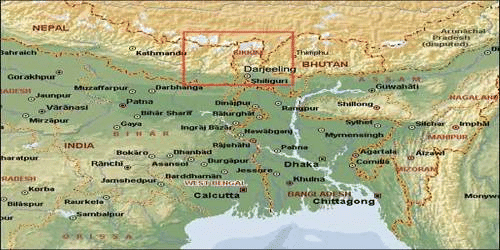
The Sikkim-Darjeeling Himalaya encompasses a stretch of tectonically active Eastern Himalaya. It is made up of three primary tectonic units: the Higher Himalaya, Lower Himalaya, and Siwaliks, which are separated by thrusts yet linked by the Tista River's enormous fluvial system. This article will explain to you about Darjeeling and Sikkim Himalayas which will be helpful in Geography preparation for the UPSC Civil service exam.
|
Table of Contents |
Darjeeling and Sikkim Himalayas
Darjeeling and Sikkim Himalayas
- They are bordered on the west by the Nepal Himalayas and on the east by the Bhutan Himalayas.
- It is a small part of the Himalayas, yet it is quite important.
- It is home to high mountain peaks like Kanchenjunga (Kanchengiri) and deep valleys and is known for fast-flowing rivers like Tista.
- The Lepcha tribes live in the higher elevations of this region, while Nepalis, Bengalis, and Central Indian tribals live in the lower elevations, mainly in the Darjeeling Himalayas.
- Tea plantations were introduced to this region by the British, who took advantage of the physical characteristics, which included a moderate slope, dense soil cover with high organic content, evenly distributed rainfall throughout the year, and mild winters.
- These portions of the Himalayas are quite small in comparison to the rest of the Himalayas.
- These, along with the Arunachal Himalayas, are notable for their lack of Shiwalik formations when compared to other areas of the Himalayas.
- The 'duar formations,' which have also been utilised for the creation of tea gardens, take the place of the Shiwaliks here.
Geology
- The Darjeeling-Sikkim Himalaya is located in a zone where the Indian and Eurasian plates' convergence vectors are almost perpendicular to the Himalayan deformation front.
- High-grade gneissic rocks are exposed around the periphery of the Teesta half window in the Darjeeling – Sikkim Himalaya.
- The Lingtse gneiss forms a tectonic zone in the northeastern part around Rumtek and Dikchu (Sikkim).
Climate
- In the south, the climate is subtropical, while in the north, the climate is tundra.
- The majority of the inhabited areas have a temperate climate, with summer temperatures rarely exceeding 28 °C (82 °F).
- For the most part, the average annual temperature in the region is around 18 °C (64 °F).
- The snow line varies between 6,100 and 4,900 metres.
- Four months of the year, the tundra-like region in the north is snowbound.
- The temperature drops below 0 °C almost every night.
- Heavy rains increase the risk of landslides during the monsoon season.
- During the winter and monsoon seasons, fog blankets many areas, making travel dangerous.
Human Life
- Bhotiyas are people of Tibetan ancestry who live in this area.
- The Doms and Khasas are said to have resided there.
- The Khasas were a West Central nomadic tribe who entered the Indo-Gangetic plain from the northwest and spread from Kashmir to Assam, according to historians.
- The descendants of the Khasas are now known as Kanets in the neighbouring state of Himachal Pradesh.
- Darjeeling's Namgyal Institute of Tibetology houses one of the world's largest collections of Tibetan art, including iconography and religious art.
Flora and fauna
- The region has a diverse range of plants, ranging from tropical to temperate, alpine, and tundra species, due to its altitudinal gradation.
- Orchids, figs, laurel, bananas, sal trees, and bamboo are among the plants that grow here.
- Alpine vegetation can be found between 3,500 and 5,000 metres above sea level.
- Snow leopards, musk deer, red pandas, Himalayan marmots, Himalayan serows, Himalayan gorals, muntjacs, common langurs, Asian black bears, clouded leopards, marbled cats, leopard cats, dholes, Tibetan wolves, hog badgers, binturongs, and Himalayan jungle cats are among the fauna.
- Yaks are one of the more common animals found in the alpine zone, and they are primarily raised for milk, meat, and as a beast of burden.
Significance
- The Sikkim and Darjeeling Himalayas are especially recognised for their stunning splendour and diverse flora and fauna, particularly orchids.
- Darjeeling is known for its tea industry and spectacular views of Kanchenjunga, the world's third highest mountain.
- This region also has the Darjeeling Himalayan Train, a narrow-gauge mountain railway that is listed on the UNESCO World Heritage List.
- The Duar Formations are flood plains in the Himalayan foothills that have aided in the establishment of tea gardens in the area.
Conclusion
The Himalayas in general have retained a profound significance for the peoples of South Asia for thousands of years, as evidenced by their literature, mythology, and religions. The enormous glaciated heights have captivated pilgrim mountaineers from India since ancient times, earning them the Sanskrit name Himalaya. In modern times, the Himalayas have attracted mountaineers all around the world as both an attraction and a challenge.
FAQs
Question: What are the Darjeeling and Sikkim Himalayas known for?
Answer: The Darjeeling and Sikkim Himalayas are known for their biodiversity, tea plantations, scenic landscapes, and snow-capped mountains, including Mt. Kanchenjunga, the third-highest peak in the world.
Question: What is the significance of Mt. Kanchenjunga in this region?
Answer: Mt. Kanchenjunga, located in the Sikkim Himalayas, is revered both culturally and ecologically. It is the third-highest peak globally and serves as a vital landmark and source of biodiversity.
Question: Which rivers originate in the Sikkim and Darjeeling Himalayas?
Answer: Major rivers, including the Teesta and Rangeet, originate from the Sikkim and Darjeeling Himalayas. These rivers are essential for local agriculture and hydropower.
Question: How does the climate vary across the Darjeeling and Sikkim Himalayas?
Answer: The climate ranges from subtropical in lower regions to alpine in higher altitudes, with heavy rainfall, especially during the monsoon season, and significant snowfall at higher elevations.
Question: What are the primary economic activities in this region?
Answer: Key economic activities include tea cultivation in Darjeeling, tourism, agriculture, and hydropower generation. The region is famous for its high-quality Darjeeling tea.
MCQs
1. Which mountain peak is located in the Sikkim Himalayas?
A) Nanda Devi
B) Kanchenjunga
C) Everest
D) Dhaulagiri
Answer: (B) See the Explanation
Explanation: Mt. Kanchenjunga, the third-highest peak in the world, is located in the Sikkim Himalayas, bordering Nepal and India.
2. Which river is a major water source in the Darjeeling-Sikkim Himalayas?
A) Ganga
B) Teesta
C) Brahmaputra
D) Yamuna
Answer: (B) See the Explanation
Explanation: The Teesta River, originating in the Sikkim Himalayas, is a significant river flowing through Sikkim and North Bengal, supporting agriculture and hydropower.
3. The Darjeeling Himalayas are most famous for:
A) Silk production
B) Timber export
C) Tea cultivation
D) Iron ore mining
Answer: (C) See the Explanation
Explanation: Darjeeling is renowned worldwide for its tea plantations, producing high-quality Darjeeling tea.
4. What type of climate does the higher region of Sikkim experience?
A) Arid
B) Tropical
C) Alpine
D) Semi-arid
Answer: (C) See the Explanation
Explanation: The higher altitudes of Sikkim experience an alpine climate with cold temperatures and significant snowfall.
5. Which of the following contributes significantly to the local economy in Darjeeling?
A) Coal mining
B) Tea plantations
C) Cotton farming
D) Spice trade
Answer: (B) See the Explanation
Explanation: The tea industry in Darjeeling is a major contributor to the local economy and is internationally known for its quality tea.
GS Mains Questions and Model Answers
Q1: Describe the geographical features of the Darjeeling and Sikkim Himalayas. How do these features influence the climate and biodiversity in the region?
Answer: The Darjeeling and Sikkim Himalayas are characterized by steep mountains, deep valleys, and dense forests, with elevations ranging from subtropical foothills to alpine heights. The diverse topography influences climate variation, from humid subtropical in lower altitudes to alpine in higher regions. This range fosters rich biodiversity, including unique flora and fauna, such as rhododendrons and red pandas, contributing to the region's ecological significance. Seasonal monsoon rains and snow further shape the region's distinct environment and support agriculture and hydropower.
Q2: Evaluate the economic importance of the Darjeeling and Sikkim Himalayas, focusing on tourism and agriculture. What are the challenges associated with these economic activities?
Answer: Tourism and tea cultivation are vital for the region’s economy. Darjeeling’s tea is globally renowned, while tourism thrives due to scenic landscapes and cultural heritage. However, challenges include landslides, deforestation, and infrastructure stress from high tourist footfall. Climate change poses risks to tea yields and biodiversity. Sustainable practices and eco-tourism development are essential to balance economic growth with environmental preservation.
Q3: Analyze the role of rivers originating in the Sikkim and Darjeeling Himalayas. How do they support the socio-economic development of the region?
Answer: Rivers like the Teesta and Rangeet are lifelines for the region, supporting agriculture, drinking water, and hydropower projects. They irrigate tea plantations and paddy fields, aiding food security and income generation. Hydropower projects on the Teesta provide energy for Sikkim and beyond. However, river ecosystems face threats from pollution, dam construction, and climate change, necessitating sustainable river management to preserve ecological and economic benefits.
Previous Year Questions on Darjeeling and Sikkim Himalayas
1. UPSC CSE Prelims 2021:
Question: Which river primarily supports agriculture and hydropower projects in Sikkim?
A) Ganga
B) Teesta
C) Brahmaputra
D) Yamuna
Answer: (B)
Explanation: The Teesta River is crucial for Sikkim, supporting agriculture and several hydropower projects that aid the region’s economy.
2. UPSC CSE Mains 2020 (GS Paper 1):
Question: "Discuss the ecological significance of the Darjeeling and Sikkim Himalayas. How does their biodiversity contribute to the region’s environmental stability?"
Answer: The Darjeeling and Sikkim Himalayas host diverse ecosystems with rare flora and fauna, such as rhododendrons, red pandas, and orchids, which support regional biodiversity. These ecosystems stabilize soil, regulate climate, and sustain water resources, crucial for both local communities and broader environmental health.
Download the PREPP App and attempt FREE IAS Exam Mock Tests and get complete study material!

Full Test - 04: UPSC CSE Prelims CSAT (Paper-II)
Full Test - 03: UPSC CSE Prelims CSAT (Paper-II)
UPSC CSE Prelims 2026 GS Paper 1 Question Paper (24-May-2026)
UPSC CSE Prelims 2026 CSAT Paper 2 Question Paper (24-May-2026)

17 February 2025 | The Hindu Must Read Articles | Current Affairs

16 February 2026 | The Hindu Must Read Articles | Current Affairs

13 February 2026 | The Hindu Must Read Articles | Current Affairs









Comments