Cutting-Edge Quantum-Technology Backed Green Hydrogen Production
Relevance: GS3 - Energy GS2 - Government policies and interventions for the development of various sectors
(Source: PIB, 11/04/2023)
Click here for Daily Current Affairs
Why in the news?
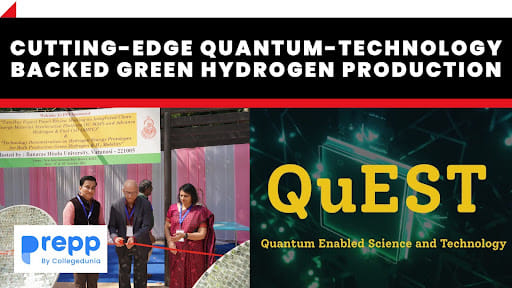
- Recently, the Green Keplerate Team from Banaras Hindu University developed a new High Throughput Quantum Backed Green Hydrogen Production Technology.
- This will promote the production of green hydrogen in bulk and help India achieve its objectives under the National Green Hydrogen Mission.
Table of Contents
What is the new Green Hydrogen production technology?
- It introduces a next-generation quantum-powered photo-catalyst with a charge transfer system coupled with high proton availability and mobility and delivered quantum catalytic applications for energy generation.
- The state-of-the-art photochemical reactor showcases the uses of Green Hydrogen as an eco-friendly energy alternative.
- It has been funded by the Department of Science and Technology (DST).
Features
- It is equipped with built-in illumination assembly and external concave reflective panels which enable it to maximize the capture of solar energy.
- It also consists of a continuous electron-coupled proton supply system which is propelled with an electron injector mechanism utilizing industrial metal-waste.
- The peak rate of Green Hydrogen production achieved at lab scale, following rigorous optimization, was around 1 liter/min per 10 g of Quantum Photocatalysts.
How is the new technology significant?
- Cost-effectiveness: The new technology produces hydrogen of very high purity.
- This eliminates the need for additional purification which makes the hydrogen fuel produced more cost-efficient.
- Wide scope: It offers the potential for wide-ranging applications in various sectors such as energy production, transportation, agriculture, etc.
- The team also demonstrated the storage-free direct hydrogen internal combustion engine technologies.
What is Quantum Technology?
- Quantum Technology is based on the principles of Quantum mechanics which describes nature at the scale of atoms and elementary particles.
- It is based on phenomena exhibited by microscopic particles that are distinct from the behavior of normal macroscopic objects i.e. Classical physics.
- Applications:
- Quantum technology helps scientists understand the physical world and has pioneered innovations such as lasers and semiconductor transistors.
- It can help develop more reliable navigation and timing systems, secure communications, accurate healthcare imaging, and powerful computing.
India’s initiatives
- QuEST: In 2018, the Department of Science & Technology launched the Quantum-Enabled Science & Technology (QuEST) programme to accelerate research in quantum technology with a commitment of ₹80 crores in a three-year period.
- NM-QTA: The National Mission for Quantum Technologies and Applications was announced in the 2020 Budget to strengthen the country’s quantum industry.
- It consists of a total outlay of ₹8000 crores over a five-year period In the 2020 Budget speech.
- Quantum Communication Lab: The C-DOT Quantum Communication Lab was inaugurated in 2020 and a Quantum Key Distribution (QKD) solution that was indigenously developed was also released.
- NM-ICPS: The National Mission on Interdisciplinary Cyber-Physical Systems (NM-ICPS) was launched in 2018 to address technology and human-resource development in Cyber-Physical Systems (CPS) and associated technologies.
- It aims to establish 15 Technology Innovation Hubs (TIH), six Application Innovation Hubs (AIH), and four Technology Translation Research Parks (TTRP).
- Implementing agency: Department of Science & Technology for a period of five years.
- National Quantum Mission: It is an initiative of the Union government that aims to drive India’s advancement in quantum technology through a project-driven multi-disciplinary approach.
- It aims to accelerate research, capacity building, and collaboration across institutions and academia.
- It aims to build a strong research and development ecosystem and a skilled workforce while commercializing quantum services.
National Green Hydrogen Mission
- The National Green Hydrogen Mission was launched with the aim of incentivizing the production of green hydrogen in India to make the country a net exporter of the fuel.
- Target: Develop production capacity of at least 5MMT (Million Metric Tonnes) per annum.
- It also sets an additional target of 125 GW of renewable energy to help decarbonize the Indian industrial, mobility, and energy sectors.
- According to the Union government, create $8 trillion of investment and 6 lakh jobs by 2030.
- Nodal ministry: Union Ministry of New and Renewable Energy
- Umbrella missions: There are two umbrella missions under the programme:
- Strategic Interventions for Green Hydrogen Transition Programme (SIGHTS): It will fund the domestic manufacture of electrolyzers and the development of green hydrogen.
- Support pilot projects in emerging end-use and production pathways.
- Other components:
- Strategic Hydrogen Innovation Partnership(SHIP): It will facilitate a public-private partnership framework for Research and Development under the Mission.
- A robust Standards and Regulations framework will be also developed.
- A coordinated skill development programme will also be undertaken.
- Implementation: Identification of states and regions capable of producing or utilizing hydrogen on a large scale will be done by the Union Ministry of New and Renewable Energy.
- These identified sites will be developed as Hydrogen hubs by the Ministry.
- The Ministry has budgeted ₹17,490 Crore for the SIGHTS programme, ₹1466 Crore for pilot projects and hydrogen hubs, ₹400 Crore for research and development, and ₹388 Crore for other parts of the mission.
Significance
- It will make green hydrogen production commercially viable by reducing costs from ₹350-400/kg at present to around ₹100/kg.
- It will help reduce the dependence on fuel imports by ensuring savings of ₹1 lakh in fossil fuel imports, and help develop local production capacities and new technologies like fuel-efficient cells.
- It will contribute to employment generation by creating 6 lakh jobs.
- The economy can be immunized from supply chain challenges.
- Decarbonization will result in savings of around 50 MMT of CO2 emissions per annum by 2030 which is in line with India’s NDCs under the Paris Agreement to reduce the emission intensity of its GDP by 45% from 2005 levels in 2030.
To learn more, click the link.
Green Hydrogen
|
(*Click this link to read prelims specific weekly current affairs articles)
FAQs
Question: What is photocatalysis?
Answer:
Photocatalysis is the acceleration of a photoreaction in the presence of a photocatalyst, which is a material that changes the rate of a chemical reaction on exposure to light. Chlorophyll in plants is a natural photocatalyst.
Question: What are the different types of hydrogen?
Answer:
Hydrogen is mainly classified into three categories on the basis of the method of extraction.
- Grey Hydrogen: It is produced via coal or lignite gasification (black or brown), or via a process called steam methane reformation (SMR) of natural gas or methane (grey).
- Blue Hydrogen: It is produced via natural gas or coal gasification combined with carbon capture storage (CCS) or carbon capture use (CCU) technologies.
- Green Hydrogen: It is produced using electrolysis of water with electricity generated by renewable energy.
UPSC Mains Practice Question:
|
MCQs
Question: With reference to green hydrogen, consider the following statements: It can be used directly as a fuel for internal combustion.
- It can be blended with natural gas and used as fuel for heat or power generation.
- It can be used in the hydrogen fuel cell to run vehicles.
How many of the above statements are correct? (UPSC CSE 2023)
(a) Only one
(b) Only two
(c) All three
(d) None
Answer: (c) See the Explanation
- Green hydrogen can be used directly as a fuel for internal combustion by a hydrogen engine (HCE). The HCE is a modified gasoline-powered engine that doesn't emit any carbon-based pollution and has a higher octane rating. Hence, statement 1 is correct.
- Hydrogen produced through clean pathways can be injected into natural gas pipelines, and the resulting blends can be used to generate heat and power with lower emissions than using natural gas alone. Hence, statement 2 is correct.
- Fuel cells can use the chemical energy of green hydrogen to produce electricity cleanly and efficiently. Hence statement 3 is correct.
Therefore, option (c) is the correct answer.
Question: Consider the following heavy industries:
- Fertilizer plants
- Oil refineries
- Steel Plants
Green hydrogen is expected to play a significant role in decarbonizing how many of the above industries? (UPSC CSE 2023)
(a) Only one
(b) Only two
(c) All three
(d) None
Answer: (c) See the Explanation
- Green hydrogen can be used as a clean energy source to reduce carbon emissions in fertilizer plants.
- Green hydrogen can be used to generate electricity or directly as a feedstock in the ammonia production process. Hence statement 1 is correct.
- Green hydrogen can be utilized in oil refineries to replace or supplement fossil fuels thereby reducing their carbon footprint.
- It can be used in refining processes, such as hydrocracking and hydrotreating, to remove impurities and improve the quality of fuels. Hence statement 2 is correct.
- Green hydrogen can be used as a replacement for coal or coke as a reducing agent in the steelmaking process, which produces “green” or low-carbon steel.
- It can also be used for heat generation and electricity production in the steel industry, which leads to further reduction of carbon emissions. Hence statement 3 is correct.
Therefore, option (c) is the correct answer.
Download the PREPP App and attempt FREE IAS Exam Mock Tests and get complete study material!

Full Test - 04: UPSC CSE Prelims CSAT (Paper-II)
Full Test - 03: UPSC CSE Prelims CSAT (Paper-II)
UPSC CSE Prelims 2026 GS Paper 1 Question Paper (24-May-2026)
UPSC CSE Prelims 2026 CSAT Paper 2 Question Paper (24-May-2026)

17 February 2025 | The Hindu Must Read Articles | Current Affairs

16 February 2026 | The Hindu Must Read Articles | Current Affairs

13 February 2026 | The Hindu Must Read Articles | Current Affairs









Comments