CPI vs WPI - Indian Economy Notes
The Consumer Price Index (CPI) and the Wholesale Price Index (WPI) are used as a measure of inflation at the retail level and manufacturing level respectively. The CPI vs WPI debate is an age-old one in choosing the right metric for indicating inflation in an economy and used for inflation targeting by the Reserve Bank of India (RBI). In 2014, during the tenure of Raghuram Rajan as the Governor of RBI, CPI was chosen as an inflation indicator and policy making. In this article, we will see the differences between CPI and WPI which makes them unique and indicate inflation at various levels.
|
Table of Contents |
What is the Consumer Price Index (CPI)?
- The Consumer Price Index (CPI) is a statistic used to assess changes in the average price level of goods and services purchased by households over time.
- It is a widely used economic statistic that helps assess inflation and the cost of living.
- The CPI basket comprises 448 items in rural and 460 items in urban.
- There were four Consumer Price Indices in the economy, each covering a different socioeconomic group.
- Consumer Price Index for Industrial Workers (CPI-IW),
- Consumer Price Index for Agricultural Laborers (CPI-AL),
- Consumer Price Index for Rural Laborers (CPI-RL),
- Consumer Price Index for Urban Non-Manual Employees (CPI-UNME).
- CPI is now using a new series based on the base year 2012=100 for all of India as well as States/UTs separately for rural, urban, and combined. Consumer Price Indices are published by the Central Statistics Office (CSO), Ministry of Statistics and Program Implementation (MOSPI).
|
|
|
|---|---|
| Consumer Price Index (CPI) | Wholesale Price Index (WPI) |
| Producer Price Index | House Price Index |
What is the Wholesale Price Index (WPI)?
- In India, this is the most widely used method for calculating the inflation rate. The Wholesale Price Index is the index used to calculate wholesale inflation (WPI).
- This rate of inflation is commonly referred to as headline inflation. The Office of Economic Advisor, Ministry of Commerce and Industry publishes the WPI. The base year is aligned with CPI as 2012=100.
- Prior to 2014, the RBI used WPI to make the majority of its policy decisions. However, the WPI-based inflation calculation was not false proof. WPI displays the total price of a commodity basket of 697 items.
- The RBI shifted to CPI for policy decisions beginning in 2014.
Difference between CPI and WPI
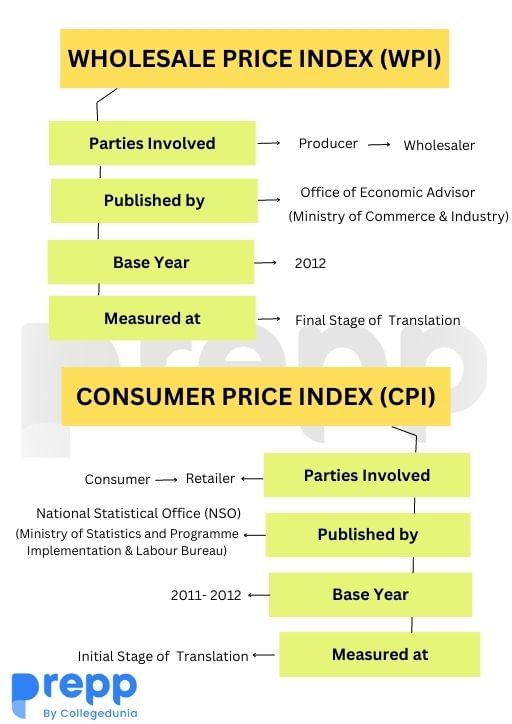
| Parameter | CPI | WPI |
|---|---|---|
| Meaning | It reflects the average change in prices paid by consumers at the retail level. | It reflects changes in average wholesale prices for goods sold in bulk. |
| Published by | National Statistical Office (NSO), Ministry of Statistics and Programme Implementation & Labour Bureau | Office of Economic Advisor (Ministry of Commerce & Industry) |
| Base Year | 2012 | 2011-2012 |
| Frequency of Publishing | Monthly (14th of every month) | Primary articles, fuel, and power on a Weekly basis (Generally Thursdays) Overall index on monthly basis. |
| Source | The CPI's item weights are based on average household expenditures gathered from consumer expenditure surveys. | The WPI's item weights are based on production values. |
| Measured at | Final stage of transaction | First stage of transaction |
| Price paid by | Consumers | Wholesale dealers and manufacturers. |
| Number of items | 448 items in rural and 460 items in urban | 697 (including Primary, fuel & power and manufactured products) |
| Weightage of food items | The food group has a weight of 39.06%. | The food group (Food articles and manufactured food products) account for 24.4% of the total weight. |
| Status of services | Services are included in the CPI (like housing, education, medical care etc) | Services are not included in the WPI. |
| Commodities included | Education, communication, transportation, recreation, clothing, foods and beverages, housing and medical care etc. | Minerals, machinery, basic metals, and other manufacturing inputs and intermediary items etc |
Note
Earlier the CPI was published by the Central Statistics Office (CSO) which is merged and now called as National Statistical Office (NSO), Ministry of Statistics and Programme Implementation
Conclusion
The CPI and the WPI are calculated based on a basket composed of different articles. Since inflation targeting is more relevant at the consumer level as it helps in policy making. The RBI can adjust its monetary policy to keep inflation within the agreeable permissible limits to meet its obligations under the Flexible Inflation Targeting Framework (FITF) signed with the government.
|
|
|
|---|---|
| Indian Economics Notes | Inflation |
| What is Inflation | Cause of Inflation |
| Impact of Inflation | Inflation targeting |
| Measures to control Inflation | Measuring Inflation |
FAQs
Question: What is the CPI used for?
Answer: CPI measures inflation at the consumer level, reflecting changes in the prices of goods and services purchased by households.
Question: How does WPI differ from CPI?
Answer: WPI measures inflation at the wholesale level, focusing on bulk goods prices, while CPI reflects retail prices for consumers.
Question: Why does the RBI use CPI for inflation targeting?
Answer: CPI reflects the cost of living and provides a more accurate picture of inflation affecting the general public, making it more relevant for monetary policy.
Question: What are the base years for CPI and WPI?
Answer: The base year for both CPI and WPI is 2012=100.
Question: Do CPI and WPI include services?
Answer: CPI includes services like housing and education, while WPI focuses only on goods.
MCQs
1. Which index includes services like housing and education?
A) CPI
B) WPI
C) Both CPI and WPI
D) None
Answer: (A) See the Explanation
CPI includes services, whereas WPI focuses only on goods.
2. Which has the highest weightage in the WPI?
A) Fuel and Power
B) Primary Goods
C) Manufactured Products
D) Food Articles
Answer: (C) See the Explanation
Manufactured Products have the highest weightage in the WPI.
3. Why is CPI preferred for inflation targeting by the RBI?
A) It reflects wholesale prices
B) It focuses on consumer price changes
C) It includes bulk goods
D) It tracks only manufactured products
Answer: (B) See the Explanation
CPI tracks consumer price changes, making it more relevant for inflation targeting.
4. Which of the following is published by the Ministry of Commerce and Industry?
A) CPI
B) WPI
C) Both
D) None
Answer: (B) See the Explanation
WPI is published by the Office of Economic Advisor, Ministry of Commerce and Industry.
5. Which index has a higher weightage for food items?
A) CPI
B) WPI
C) Both have equal weightage
D) None
Answer: (A) See the Explanation
The CPI has a higher weightage for food items (39.06%).
GS Mains Questions and Model Answers
Q1: Discuss the significance of CPI over WPI in India’s inflation measurement.
Answer: The Consumer Price Index (CPI) is more significant for measuring inflation in India as it reflects changes in the cost of living, focusing on retail prices of goods and services. Since it includes services, which account for a large part of household expenditure, CPI offers a more comprehensive picture of inflation than the Wholesale Price Index (WPI), which focuses on goods sold in bulk. CPI’s emphasis on consumer-level inflation is crucial for monetary policy and inflation targeting.
Q2: Examine the role of CPI and WPI in policy formulation by the Reserve Bank of India.
Answer: The CPI plays a crucial role in the RBI’s monetary policy, especially after 2014, when it was adopted for inflation targeting. CPI reflects changes in retail prices and cost of living, making it more relevant for understanding inflation’s impact on consumers. In contrast, WPI, focused on wholesale prices, is less sensitive to consumer demand and includes only goods. Thus, the RBI uses CPI to adjust its repo rates and manage inflation expectations.
Q3: Analyze the limitations of using WPI for inflation measurement.
Answer: The Wholesale Price Index (WPI) has limitations in inflation measurement as it excludes services, which form a significant part of the economy. It focuses on goods at the wholesale level, making it less reflective of consumer inflation. WPI also fails to capture the price fluctuations of products purchased directly by consumers, making it a less accurate measure for inflation targeting. This led the RBI to shift its focus to CPI, which is more comprehensive in reflecting retail inflation.
Previous Year Questions on CPI and WPI
1. UPSC CSE Prelims 2019
Question: Which index is used by the Reserve Bank of India for inflation targeting?
A) Wholesale Price Index
B) Consumer Price Index
C) Both
D) None
Answer: B
Explanation: Since 2014, the Consumer Price Index (CPI) is used by the RBI for inflation targeting.
2. UPSC CSE Mains 2020 (GS Paper 3)
Question: Discuss the shift from WPI to CPI for inflation measurement in India and its implications for monetary policy.
Answer: The shift from WPI to CPI for inflation measurement reflects the RBI’s focus on consumer-level inflation rather than wholesale prices. CPI, which includes services and goods purchased by consumers, offers a better understanding of the cost of living. This shift allows the RBI to fine-tune its monetary policy to target retail inflation, making policy interventions more effective in controlling inflation, especially under the Flexible Inflation Targeting Framework adopted in 2016.
Download the PREPP App and attempt FREE IAS Exam Mock Tests and get complete study material!

Full Test - 04: UPSC CSE Prelims CSAT (Paper-II)
Full Test - 03: UPSC CSE Prelims CSAT (Paper-II)
UPSC CSE Prelims 2026 GS Paper 1 Question Paper (24-May-2026)
UPSC CSE Prelims 2026 CSAT Paper 2 Question Paper (24-May-2026)

17 February 2025 | The Hindu Must Read Articles | Current Affairs

16 February 2026 | The Hindu Must Read Articles | Current Affairs

13 February 2026 | The Hindu Must Read Articles | Current Affairs









Comments