The Impact of Inflation is it reduces the purchasing power of households due to an increase in prices. The impact of inflation is felt across different sectors of the economy which are favorable to some and unfavorable to others. Due to this price uncertainty, may discourage investment and savings for the future. The impact of inflation is an important topic for the UPSC IAS Exam General Studies Paper 3. In this article, let us see the meaning of inflation, Positive and Negative impacts of inflation on different sectors of the economy.
Inflation
![Impact of Inflation]()
Impact of Inflation
What is Inflation?
- Inflation measures the change in prices of a basket of goods and services over the course of a year.
- It occurs as a result of a mismatch between the supply and demand for money, changes in production and distribution costs, or an increase in product taxes.
- Inflation is measured by the Consumer Price Index (CPI) in India.
Positive Impacts
Positive Impacts
Increased Profits for Producers
- In most cases, inflation benefits the producers of goods. They make more money because they can sell their products at higher prices.
Increased Investment Returns
- During periods of inflation, investors and entrepreneurs are given additional incentives to invest in productive activities. As a result, they benefit from higher returns.
Increase in production output
- When producers receive the appropriate investment, they produce more goods and services. As a result, inflation causes an increase in product/service production.
Increased Employment and Earnings
- As output rises, so does the demand for the various production factors, including labor. As a result, employment and income rise in response to inflation.
Shareholders income increases
- If a company's profits increase as a result of inflation, it can pay out dividends to its shareholders. As a result, during inflationary periods, shareholders' dividend income may increase.
Borrowers' Advantages
- Inflation reduces the purchasing power of money. As a result, if the borrower pays an interest rate that is lower than the inflation rate, he benefits from the process. This is due to the fact that the real value of the money returned by the borrower is less than the value of the money borrowed.
Governments tax revenue improves
- As the cost of goods and services rises, people must pay more indirect taxes, known as ad valorem (on value)
- Direct taxes rise as people move into higher tax brackets (but not in real terms), a phenomenon known as bracket creep.
- Tax revenue increases for the government, but the real value does not keep pace with the current rate of inflation due to a lag in tax collection.
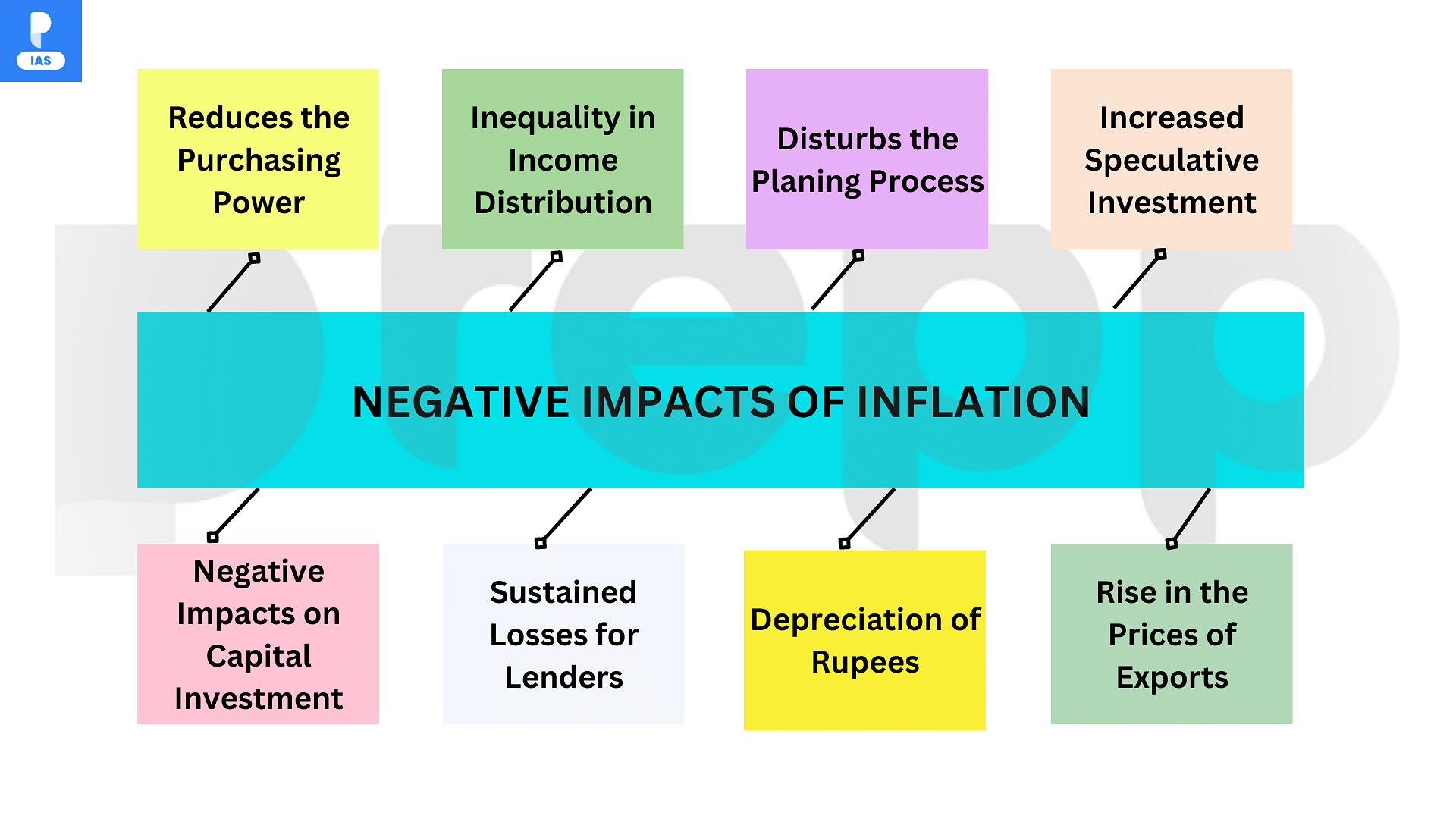
Negative Impacts
Negative Impacts
Real-Income falls for groups with fixed income.
- An individual's true income is the purchasing power of his income money. To put it another way, Real Income=Money Income/Price Level.
- This means that people on fixed incomes, such as salaried workers, pensioners, and the like, will see a drop in real income. To put it another way, their purchasing power will reduce.
Income Distribution Inequality Rises
- Profits for business owners and entrepreneurs rise as a result of inflation.
- People in fixed-income groups, on the other hand, see a decrease in their real income.
- As a result, income inequality becomes more pronounced during this time period.
Disturbs the Planning Process
- Inflation raises the prices of goods, raw materials, and factor services. As a result, the government must spend more money to complete any investment project initiated during the planning period.
- If the government fails to raise more financial resources through savings or taxation, the entire planning process is thrown off.
Increased Speculative Investment
- Assume that prices are increasing at an alarming rate. People are unsure how much prices will rise in the coming weeks or months. Many people begin speculative investments in such cases.
- For example, they may begin purchasing shares, gems, land, and so on solely for speculative purposes.
- This is done with the intention of making quick money. Such investments do not contribute to the creation of productive capital in the economy.
Negative Impacts on Capital Accumulation
- Assume that rising prices become a recurring feature of an economy. People begin to prefer goods over money during such times because the real value of money will fall in the future. In addition, people begin to prefer immediate consumption to future consumption.
- As a result, the general desire to save begins to wane. As people's willingness and ability to save decreases, so does the amount of money available for further investment.
- As a result, the overall impact on the economy's capital accumulation is negative, because capital accumulation in an economy is dependent on investment growth.
Lenders Will Sustain Losses
- As mentioned before, borrowers benefit from inflation when it has a positive impact.
- As a result, lenders risk losing money during such times. This is due to the fact that they receive a sum with less purchasing power than the amount loaned.
Rupee may depreciate
- Due to less purchasing power parity, the demand for the dollar increases, depreciating the Indian rupee.
- This benefits the exporters and will burden the importers.
Export Earnings Suffer as a Result
- Because the prices of raw materials and factors of production rise during inflation, the prices of export items rise as well.
- As a result, their demand in foreign markets may fall, resulting in a decrease in the country's export income.
- Though the rupee depreciates, lack of demand due to high prices nullifies the exchange rate benefit.
Conclusion
Conclusion
Though inflation reduces the purchasing power of the households and creates a demand-supply mismatch it is necessary to the economy. Inflation as a result of an increase in demand for goods and services will help in increased production and contribute to the growth of the economy.
FAQs
Question: What is inflation?
Answer: Inflation refers to the sustained increase in the general price level of goods and services in an economy over a period of time.
Question: What are the primary causes of inflation?
Answer: The primary causes of inflation include demand-pull inflation (excess demand), cost-push inflation (rising production costs), and built-in inflation (wage-price spiral).
Question: How does inflation impact purchasing power?
Answer: Inflation reduces the purchasing power of money, meaning consumers can buy fewer goods and services with the same amount of money.
Question: What is core inflation?
Answer: Core inflation excludes volatile items like food and fuel prices, providing a clearer picture of long-term inflation trends.
Question: How does inflation affect economic growth?
Answer: Moderate inflation can stimulate economic growth, but hyperinflation or deflation can disrupt economic stability by reducing investment and savings.
MCQs
MCQs
- Which of the following is NOT a type of inflation?
a) Demand-pull inflation
b) Cost-push inflation
c) Seasonal inflation
d) Built-in inflation
Answer: (C)See the explanation
Seasonal inflation does not exist as a specific type of inflation. The three main types of inflation are demand-pull, cost-push, and built-in inflation.
- How does cost-push inflation occur?
a) When production costs decrease
b) Due to increased demand for goods
c) When production costs increase
d) Due to increased government spending
Answer: (C) See the explanation
Cost-push inflation occurs when production costs rise, leading to higher prices for consumers. This could be due to increased labor costs or raw material prices.
- Which index is primarily used to measure inflation in India?
a) Wholesale Price Index (WPI)
b) Consumer Price Index (CPI)
c) GDP Deflator
d) Index of Industrial Production (IIP)
Answer: (B) See the explanation
The CPI is widely used in India to measure inflation by tracking the price changes of a basket of goods and services consumed by households.
- What is the impact of high inflation on savings?
a) Increases savings
b) No effect on savings
c) Reduces the real value of savings
d) Leads to negative savings rates
Answer: (C)See the explanation
High inflation erodes the purchasing power of money, thus reducing the real value of savings over time.
- Which type of inflation is caused by an increase in aggregate demand in an economy?
a) Hyperinflation
b) Demand-pull inflation
c) Stagflation
d) Cost-push inflation
Answer: (B) See the explanation
Demand-pull inflation occurs when there is an increase in aggregate demand that outpaces aggregate supply, leading to higher prices.
GS Mains Questions with Model Answers
Q1: Discuss the causes and effects of inflation on the Indian economy.
Answer: Inflation in India can be caused by demand-pull factors (high demand for goods and services), cost-push factors (rising production costs), and structural bottlenecks (poor infrastructure, supply chain issues). The effects include reduced purchasing power, increased cost of living, and potential impact on savings and investment. While moderate inflation can stimulate economic activity, high inflation can erode public confidence and hinder growth.
Q 2: Explain the role of the Reserve Bank of India in controlling inflation through monetary policy.
Answer: The RBI uses monetary policy tools like repo rate adjustments, open market operations, and cash reserve ratios to control inflation. By raising interest rates, the RBI can reduce money supply and curb inflationary pressures. Inflation targeting helps the RBI keep inflation within a specified range, contributing to macroeconomic stability.
Q 3: Evaluate the impact of inflation on different sections of society, particularly low-income households
Answer: Inflation disproportionately affects low-income households, as a larger portion of their income is spent on necessities like food and housing. Rising prices reduce their purchasing power and standard of living. High inflation can also erode the value of fixed incomes, further aggravating inequality in society.
Previous Year Questions on Impact of Inflation - Indian Economy Notes
1. UPSC CSE Prelims 2018:
Question: Which of the following measures is used to calculate inflation in India?
A. CPI
B. WPI
C. Both CPI and WPI
D. Only GDP Deflator
Answer: C
Explanation: In India, both CPI and WPI are used to measure inflation. CPI reflects price changes from a consumer’s perspective, while WPI measures it at the wholesale level.
2. UPSC CSE Mains 2017 (GS Paper 3):
Question: Analyze the impact of inflation on different sections of society in India.
Answer: Inflation affects various sections of society differently. For fixed-income earners and pensioners, inflation erodes purchasing power as their incomes remain stagnant while prices rise. Low-income groups are most affected, as they spend a larger portion of their income on essentials. Business owners may benefit in the short term if they can pass on the cost increases to consumers. However, rising costs can lead to decreased demand. Investors in certain assets, like real estate or stocks, may benefit from inflation, while those holding cash or fixed deposits see the real value of their savings decline.
3. UPSC CSE Prelims 2017:
Question: Cost-push inflation is caused by which of the following factors?
A. Increase in wages
B. Increase in raw material prices
C. Increase in demand
D. Both A and B
Answer: D
Explanation: Cost-push inflation occurs due to rising costs of production, such as wage increases and higher raw material prices, leading to increased prices of goods and services.













Comments